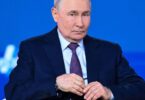
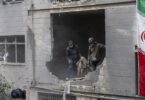
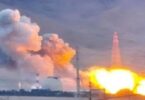
Russia’s recent actions have sparked WW3 fears in Europe (Image: Getty)
Balloons spotted over Lithuanian and Polish airspace have sparked WW3 fears, as experts say Russia has entered « Phase Zero ». The Institute for the Study of War (ISW) assessed that « Russia is intensifying its covert and overt attacks against Europe » after these incidents, which saw balloons enter Lithuanian and Polish airspace from Belarus. This action is being taken by Russia to « prepare for a possible NATO-Russia war in the future, » the institute says.
It says that Russia has « de facto annexed Belarus and that Belarusian incursions into NATO airspace », moves that are « very likely part of Russia’s broader Phase Zero effort ». Balloons from Belarus illegally entered Lithuanian and Polish airspace on the nights of January 27 to 28 and January 28 to 29.
Lithuanian authorities detected 42 balloons entering Lithuanian airspace from Belarus on the night of January 27 to 28, marking the highest number of such balloons in one night since similar incidents were first reported in October 2025. Lithuanian National Crisis Management Centre Head Vilmantas Vitkauskas said that Lithuanian authorities shut down Vilnius International Airport three times on the evening of January 27 as a result.
READ MORE: Trump’s ‘nuke sniffer’ plane arrives in UK as WW3 fears soar
READ MORE: Trump’s 6-word WW3 threat to Iran leaves one city subject to revenge
Authorities recovered eight balloons with smuggled cargo on the morning of January 28. They also found the remains of several other balloons, and four arrests were made.
Meanwhile, the Polish Armed Forces Operational Command reported on January 29 that Polish military radar detected balloon-like objects entering Polish airspace from Belarus late on January 28. This led to airspace over Podlaskie Voivodeship (along Poland’s eastern border with Belarus) being temporarily restricted.
Russia is just one of the countries contributing to WW3 fears as global tensions increase. Recently, Germany began preparing its troops for a possible war between Russia and NATO. Such fears go back to 2022, when Russia first started its war in neighbouring Ukraine.
Trump’s tensions with NATO and conflict in the Middle East have also increased fears of a global outbreak of war. However, Russia’s actions continue to raise concerns across the globe.

Balloons have entered Lithuanian and Polish airspace several times since October (Image: Getty)
A senior Russian politician recently said that Europe is effectively « defenceless » against Moscow’s latest hypersonic weapons. The chilling warning was posted on Telegram by Aleksey Aleksandrovich Zhuravlyov, a hardline nationalist MP and chairman of the Rodina party.
He claimed that Russia, with its recent strikes in Ukraine, had demonstrated its ability to hit targets in « Western capitals » and at NATO military bases.
Meanwhile, Lord Robertson, who was Secretary General of NATO between 1999 and 2003, said the UK is now « more vulnerable » than before. He told The i: « The volatility of events and the velocity of change has made us much more vulnerable than we were before.
« The danger is that the public doesn’t yet know that, and doesn’t appreciate enough about how much of a threat there is to us, or therefore what to do about it. »
« Britain is very vulnerable to an external enemy, because we’re already being attacked, » he added. « We are under attack at the present moment, in the grey zone in terms of cyber attacks, targeted assassinations and sabotage and the rest of it. We now know that the threat could be even greater. »
Citizens in several European countries, such as Sweden and Poland, have been issued information about preparing for a war between nations. Included in the advice is information about emergency kits, which include items like non-perishable foods and batteries.
Professor Anthony Glees, a security and defence expert and lecturer at the University of Buckingham, told The Mirror that the UK should follow suit. The European Commission recently said the EU is facing unprecedented threats, including geopolitical tensions and conflicts.
Source link