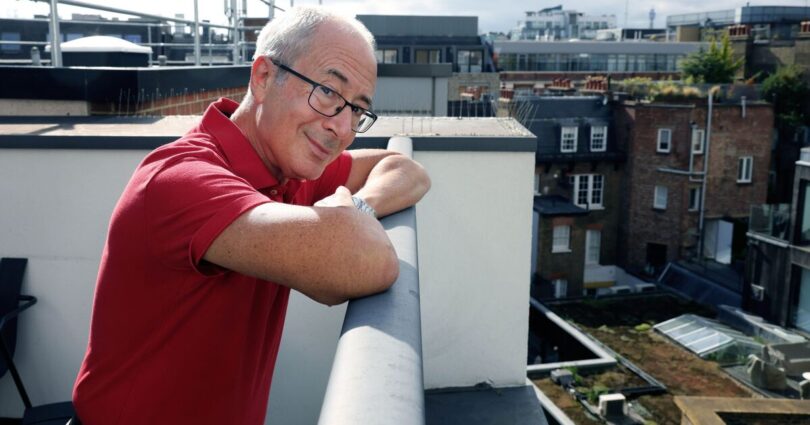
Ben Elton, who published his autobiography What Have I Done? in October, praises Dark Renaissance (Image: Jonathan Buckmaster / Daily Express)
‘Marvellous soap opera and great history’ … ‘A riveting account’
Writer and comic Ben Elton, whose brilliant memoir, What Have I Done? (Macmillan) came out in October, says: “I love history books, particularly when they intersect with popular culture. Two great new books I have on the go are Dark Renaissance (Vintage), Stephen Greenblatt’s riveting and evocative biography of Elizabethan playwright and spy Christopher Marlowe. Also 1929 (Allen Lane), Andrew Sorkin’s account of the Wall Street crash which has many lessons for today. I don’t read a lot of fiction but have just become a late convert to audio books and have started listening to them while on my cross trainer. I am sweating away to John Galsworthy’s The Forsyte Saga (Penguin) and loving it – marvellous soap opera and great history combined!”
Historian Helen Fry, whose latest book, The White Lady (Yale University Press), is a thrilling account of British intelligence networks behind enemy lines in the First and Second World Wars, says: “Dermott Turing’s Misread Signals: How History Overlooked Female Codebreakers (History Press) brings to light the women at Bletchley Park who challenged the assumption that they were low-grade workers and nothing more than secretaries or clerks, who in fact solved sophisticated Enigma problems and conducted crucial code-breaking work. Their contributions have been obscured for decades by official secrecy and the conceptual superencipherment created by our own preconceived notions. As trailblazers they pushed past society’s limits to tackle the toughest coding and tech challenges of their time. While Elyse Graham’s Book and Dagger (Ecco Press) is the intriguing and unknown story of how scholars and librarians, people no one expected to enter the shadows of espionage, became unlikely spies for the Allies. They slipped into libraries and museums across Europe to steal enemy secrets. A riveting account of how these scholarly boffins and their equally daring accomplices turned paper and books into a weapon.”

1929 by Andrew Ross Sorkin has ‘many lessons for today’, writes Ben Elton (Image: Allen Lane)

RAF veteran turned historian John Nichol tips books on remembrance and the end of WWII and (Image: Philip Coburn)
Read more: We’re all bestselling thriller writers – these are the page-turners of 2025
Read more: We’re bestselling crime writers – these books set our pulses pounding in 2025
‘A gripping tale of decidet, cover-ups and that very British habit of punishing the whistleblower’ … ‘meticulous research and concise style’
Broadcaster and historian Phil Craig, whose latest must-read book is 1945: The Reckoning (Hodder), says: « Wallis Simpson: Her Lotus Year, by Paul French (Elliott & Thompson) is a revelatory and largely sympathetic account of Wallis Simpson in China in the 1920s. This original and fascinating book makes you think of one of history’s supposed villains in an entirely new way. Anyone who cares for honest reporting and the health of the BBC should read Dianarama by Andy Webb (Penguin). On one level it’s the definitive account of the BBC’s disastrous Martin Bashir saga and its consequences, by the man who exposed it all. It’s also a gripping tale of deceit, cover ups and that very British habit of punishing the whistleblower while promoting time-serving hacks!”
Rachel Trethewy, whose Muv: The Story of the Mitford Girls’ Mother (The History Press), was published in the autumn to accalim, says: “I thought I had seen and read everything on the Mitford Girls, but Mimi Pond’s graphic biography on the incorrigible family, Do Admit! The Mitford Sisters and Me (Jonathan Cape), really breaks new ground. Whimsical but insightful, telling the six sisters’ stories in cartoons is an inspired idea. It has just the right lightness of touch and sensitive insight required when dealing with a story which combines eccentricity, glamour and tragedy in equal measure. The illustrations are brilliant and it’s just such fun; a great gift for anyone who has a penchant for those outrageous girls. Andrew Lownie’s best-selling biography of Andrew Mountbatten-Windsor and Fergie, Entitled: The Rise and Fall of the House of York (William Collins), has to be top of my books of 2025. As a biographer, I have tremendous admiration for what Andrew Lownie does. His meticulous research and concise style courageously communicates a powerful message. The shocking details about the Yorks’ relationship with Jeffrey Epstein and their lavish lifestyles is nauseatingly unforgettable. Lownie is one of those rare historians who changes history as well as records it.”

Wallis Simpson: Her Lotus Year, by Paul French is ‘revelatory and largely sympathetic’ (Image: Elliott & Thompson)

Entitled by Andrew Lownie ‘courageously communicates a powerful message’ (Image: HarperCollins)
‘Swoops brilliantly from sandy foxholes to the planning tables of the generals’ … ‘One of the best, not just for military geeks like me’
Roger Moorhouse, whose latest book is Wolfpack: Inside Hitler’s U-Boat War (William Collins), says: “The two books that top the pile for me this year are Baltic by Oliver Moody (John Murray) and Tunisgrad by Saul David (HarperCollins). Baltic is a brilliantly-written account of the recent history of the Baltic States – Latvia, Lithuania and Estonia – explaining how their politics and world-view is shaped by their historical experiences, especially the threat posed by their eastern neighbour, Russia. Moody argues that this region, which many in western Europe still view as peripheral, is actually central to current events and, crucially, to the future of the west itself. My second pick is more of a straightforward history book. Saul David is one of the country’s foremost military historians, and Tunisgrad exposes a campaign – the battle for Tunisia in 1943 – that we have long misunderstood. Elegantly written and convincing, the book swoops brilliantly from the sandy foxholes to the planning tables of the generals, and places Tunisia back into the narrative of the wider war, making the case that it was one of the conflict’s major turning points.”
RAF veteran turned author John Nichol, whose moving, majestic examination of Remembrance, The Unknown Warrior: The Extraordinary Story of the Nation’s Hero Buried in Westminster Abbey, (Simon & Schuster), is out now, says: “Amidst a plethora of ‘end of WW2’ books marking the 80th anniversary of VE Day, Victory ’45: The End of the War in Eight Surrenders, by James Holland and Al Murray (Bantam), was one of the best. Not just for military geeks like me, it weaves together the crucial details of the time with the personal stories of those who were witnesses to history. Lest We Forget: War and Peace in 100 British Monuments by Tessa Dunlop (HarperNorth)shines the spotlight on the stories behind some of the nation’s most iconic and recognisable monuments. I enjoyed the combination of wonderful history with the accounts of those who have been touched, affected or involved with the monuments themselves.”

Lest We Forget by Tessa Dunlop ‘shines the spotlight’ on stories behind the nation’s monuments (Image: HarperNorth)

Victory ‘45 by WWII podcast kings James Holland and Al Murray is ‘not just for military geeks’ (Image: Bantam)
‘A superb counterblack against race grifters’ … ‘A fabulous evocation of the brotherhood of elite warriors’
Dr Robert Lyman, whose latest page-turning history, co-written with General Richard Dannatt, is Korea: War Without End (Osprey), signals many of the ways the West has gone wrong since the original Cold War, says: “Ben Barry’s The Rise and Fall of the British Army 1975-2025 (Osprey) is a forensic – and depressing – analysis of how an army designed over decades to counter a first-class opponent has been allowed to be run into the ground by successive governments since 1990. With the collapse of the Berlin Wall the government decided we had reached the broad sunlit uplands of international peace, savagely slashing the defence budget to secure what was euphemistically described as a ‘peace dividend’. We are now, as a result, disarmed. The second most consequential book I’ve read is Nigel Biggar’s superb counterblast against race grifters in his Reparations: Slavery and the Tyranny of Imaginary Guilt (Forum). It’s a carefully argued destruction of the specious arguments manufactured to foster a sense of guilt in the West about the slave trade. Biggar demonstrates that most are built on lies.”
SAS chronicler Damien Lewis, whose latest bestseller is SAS The Great Train Raid (Quercus), says: « All The Light We Cannot See by Anthony Doerr (HarperCollins) is a Second World War novel – adapted as a Netflix series by Steven Knight – and had me bowled over, gripped and dare I say a little obsessed. I read it during a stint in hospital in July, and it got me through some dark and tough days. Author Doerr takes the reader deep into Nazi-occupied France and to the core of the Third Reich, as the two key protagonists, a blind French girl, Marie-Laure, and a German orphan, Werner, endeavour to survive the war. The twin story lines are woven together as the plot progresses, to reach a riveting climax, as the teenage Werner’s gift as a wireless technician is hijacked by dark forces in the Reich, driving him into Marie-Laure’s world of half-shadows. Magical. Born of the Desert: With the SAS in North Africa, by Malcolm James (Pen&Sword), was first published in 1945, but recently re-issued. This is the classic SAS origins story, written by the medic who was attached to David Stirling and Paddy Mayne’s originals in the North African desert. While serving at the heart of SAS raiding operations, Malcolm Pleydell was, of course, strictly speaking a non-combatant, which set him apart from the rank and file. Published under the pen name Malcolm James, the author proved to be a brilliant observer of this unique body of men at war, and an equally gifted writer. A fabulous evocation of the brotherhood of elite warriors, it is a true classic. »

Reparations by Nigel Biggar is a ‘superb counterblast against race grifters’ (Image: Forum)

Ben Barry’s Rise and Fall of the British Army is a ‘forensic analysis’ of how we have been disarmed (Image: Osprey)
‘A gripping and often horrific tale’ … ‘Lennon emerges not as a saint but as a flawed, complex musician’
Historian and podcaster Saul David, whose latest book is Tunisgrad (HarperCollins), says: “Wolfpack: Inside Hitler’s U-Boat War, by Roger Moorhouse (William Collins), is a wonderfully gritty and visceral view of the only campaign that really scared Churchill from the unusual perspective of the German submariners. Hugh Sebag-Montefiore’s Battle of the Arctic (HarperCollins), which relates the gripping and often horrific tale of the northern convoys as they ran a gauntlet of high seas, freezing weather and German attacks in their efforts to deliver vital supplies to the Soviets; and Victory ’45 (Bantam), the first collaboration by historian podcast duo Al Murray and James Holland that brilliantly and originally charts the end of the Second World War through the lens of eight surrenders.”
Cultural critic Alexander Larman, whose next book, Lazarus: The Second Coming of David Bowie (Putman) is published in January, says: “The best book I read this year was Ian Leslie’s sublime John & Paul: A Love Story in Songs (Faber). As a fully paid-up Beatles fan, I never thought I’d need another book about the relationship between Lennon and McCartney, but what Leslie does so brilliantly is to bring the dynamic between the two very different geniuses alive. He gives McCartney his proper due but also allows Lennon to emerge not as a saint but as a flawed, complex musician. And Thomas Permohamed Lambert’s Shibboleth (Europa) is a hilarious satire on Oxford and wokery and the funniest and wisest debut novel I’ve come across in years.”

Wolfpack by Roger Moorhouse: a ‘gritty and visceral view of the only campaign that scared Churchill’ (Image: William Collins)

John & Paul by Ian Leslie explores the ‘the dynamic between the two very different geniuses’ (Image: Faber)

Battle of the Arctic by Hugh Sebag-Montefiore relates a ‘gripping and often horrific tale’ (Image: William Collins)

Peter Caddick-Adams tips Jane Thynne’s Appointment in Paris and Ring of Fire, a new history of WWI (Image: Courtesy Peter Caddick-Adams)
‘A fresh and compelling geopolitical account’ … ‘An intelligence thriller worthy of Len Deighton or John le Carré’
Historian Peter Caddick Adams, whose short but brilliant biography of Winston Churchill is out now via Swift Press, says: “The Great War has been much explored, but mostly through national lenses. In Ring of Fire: A New Global History of the Outbreak of the First World War (Apollo), authors Alexandra Churchill and Nicolai Eberholst give us its first year as a series of regional clashes that eventually merged into worldwide conflagration – a fresh and compelling geopolitical account of the war we thought we knew. When not writing and researching military history, I like to wallow in world war fiction. One of my favourite story-tellers is the prolific Jane Thynne, who has established a reputation for her accurate research, the noir atmosphere of the 1930s and 40s, racy plots and seductive characters. Appointment in Paris (Quercus) follows MI5 operative Harry Fox and his colleague, Stella Fry, and builds on Midnight in Vienna when the duo tackled a sinister conspiracy as Britain slid towards war in 1938. In an intelligence thriller worthy of Len Deighton or John le Carré, she paints a convincing picture of the paranoia of wartime London and Paris, leavened with just the right amount of period detail.”
Source link