
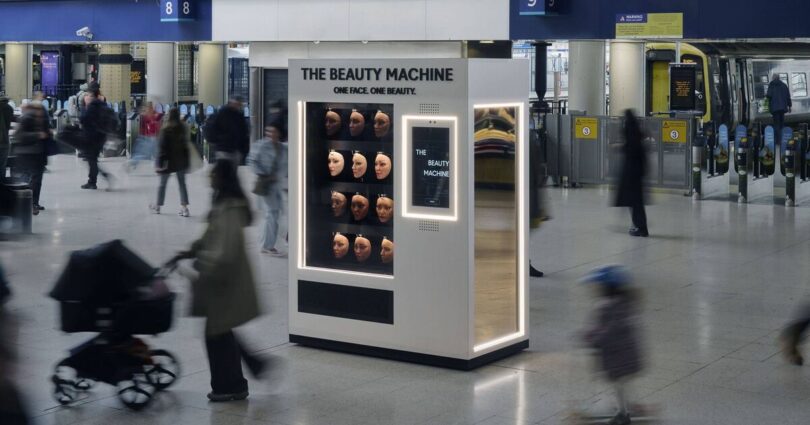
A vending machine filled with identical faces has been installed to illustrate how ‘the algorithm’ reinforces a single ideal of beauty. Dove unveiled The Beauty Machine at Waterloo Station in London this week, with a device that appears to offer variety but delivers the same face again and again.
According to the Dove State of Beauty report, almost half of women and girls in the UK feel pressured to change their appearance even when they know an image is fake. Dove says the stunt is a reminder that our differences are what make us beautifu.
Women are being invited to ‘celebrate their beauty’ by taking a photo of themselves and then either scanning the machine’s code or taking part using #DoveOpenCall. I mages will st art to appear on billboards across Waterloo within 48 hours.
Marcela Melero, Chief Growth Marketing Officer at Dove, said: « In the age of the algorithm, online beauty is starting to look the same. But why are the algorithms getting to decide what is beautiful? Dove wants to remind women that beauty in the real world is far more creative, unique and expressive than what we often see online.
« Our aim here is for beauty to be individual and defined by women themselves and not how algorithms choose to amplify it. »
Dr Aleks Krotoski, international broadcaster, author and lecturer on the impact of technology on our lives, said : « Algorithms influence us far more than most people realise. They reward the aesthetics and images that generate the most engagement, meaning certain faces and beauty ideals are shown endlessly.
« Over time that repetition has narrowed the range of beauty we see online – creating the impression that there is a single ideal, even though real beauty is far more diverse across communities and cultures around the world. »
Dr Nicole Paraskeva, Senior Research Fellow at the Centre for Appearance Research, UWE, Bristol, said: « We know from years of research that seeing idealised and digitally edited images can make people feel worse about their bodies and feel pressured to fit narrow beauty standards.
« As ‘perfected’ faces become increasingly common across platforms, it risks making it even harder for women to recognise and value their own unique beauty.
« These technologies are moving fast, so we must too. »
Source link