
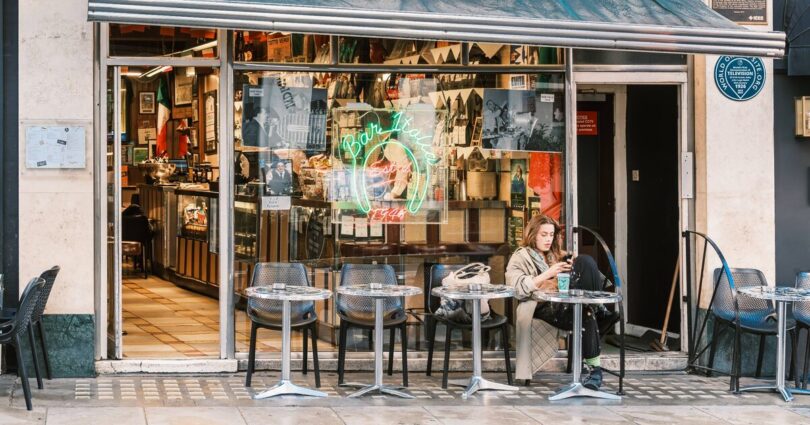
It may appear as a normal bar, but it’s history will shock you (Image: joningall via Getty Images)
As you meander down Frith Street in the vibrant heart of Soho, London, you might overlook the gleaming blue plaque nestled at number 22, commemorating a significant historical event that unfolded on this very street.
Now home to Bar Italia, a bustling hub for nocturnal revellers seeking a late-night tipple, this building was once a sanctuary for some of the most brilliant minds and innovators of their time. It was within the attic of number 22 Frith Street that the concept of television first came to life, thanks to a pioneering engineer who rented the space.
On 2 October 1925, this unassuming building etched its name into history as the site of the world’s first television demonstration, an invention that would forever alter the course of humanity. The man behind this groundbreaking presentation was John Logie Baird, a Scottish engineer who had been relentlessly pursuing his innovative vision.
The loft he leased in Soho served as his laboratory, where he devoted countless hours to experimentation from 1924 onwards. He tirelessly tinkered with his vast and intricate contraption, which was notorious for malfunctioning and scattering its components across his chaotic workspace.
While his apparatus successfully projected images of a ventriloquist’s dummy named Stooky Bill, Baird needed to test whether it could also depict a human subject. Enter William Taynton – a humble office boy employed downstairs, who found himself unexpectedly thrust into the role of experimental subject. The experiment was repeated successfully with a human participant, marking another milestone in Baird’s revolutionary journey.

John Logie Baird, pioneer of the television (Image: Bettmann, Bettmann Archivevia Getty Images)
READ MORE: The gorgeous riverside town that’s a hidden gem and ‘England’s most beautiful’
READ MORE: Londoners are going wild for hidden gem with ‘incredible’ pubs and bakeries
That pivotal moment signalled the birth of television as we know it. Though it wasn’t until January 26 1926, a century ago, that he delivered the inaugural public demonstration of his groundbreaking invention.
The historic event unfolded at his laboratory on Frith Street, where he revealed to onlookers how his system could both transmit and receive moving images. Just 12 months later, the world’s first television sets went on sale at Selfridges in London, before Baird transported his innovation across the Atlantic.
When they eventually became accessible to ordinary households, TV sets were priced at approximately £60, which would equate to roughly £4,000 in today’s money. Now, the premises operates as Bar Italia, which was established in 1949 by the Polledri family, who remain the proprietors to this day.
The venue has since developed its own rich heritage, deeply intertwined with Soho’s artistic community and famously immortalised in a Pulp track. Entitled ‘Bar Italia’, the song pays homage to the café and bar, featuring on their celebrated 1995 record Different Class. The lyrics describe the establishment as a sanctuary where « all the broken people go… round the corner in Soho ».

22 Frith Street now boasts a blue plaque to commemorate the historic moment (Image: chrisdorney via Getty Images)
One recent customer characterised the venue as an « authentic experience » in the capital, writing: « An oasis of calm to escape the madness of the West End.
Bar Italia has been a haven for discerning patrons for seventy years, boasting a rich history and a devoted following that’s second to none.
If you’re ever in doubt, just take a look at the walls adorned with photographs and trophies from both renowned and lesser-known visitors who’ve relished their time here. »
Source link