
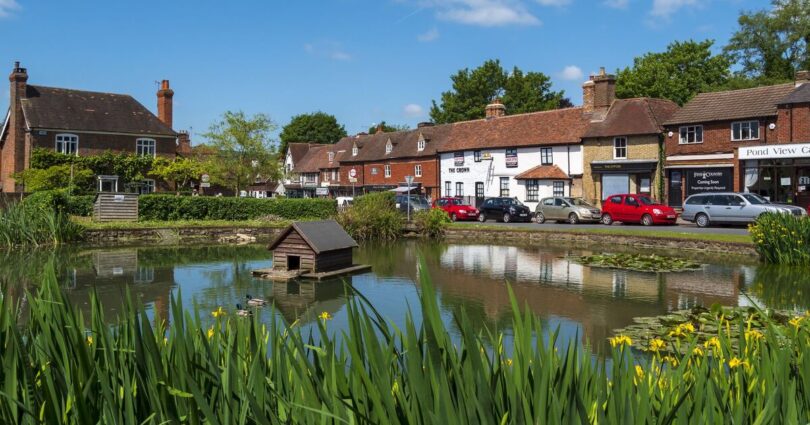
The village doesn’t have street lights (Image: whitemay/Getty)
There are over 400 villages throughout Kent and hundreds of small hamlets. Their histories are influenced by the past, weather, landscape, geological features, wildlife, conflicts, inhabitants, faith, travel, commerce and more.
One unusual village contains England’s smallest listed building, and previously featured a palace grander than Hampton Court. This is the close-knit treasure Otford in the Darent Valley and close to Sevenoaks, a town often on ‘best places to live’ lists. For those who yearn to escape city life and feel surrounded by the natural world, one of Otford’s attractions is that the majority of it lacks street lighting.
Read more: Small UK coastal village named among the best to visit this summer
Read more: Tiny English village is ‘hidden gem’ with the UK’s most beautiful walks
Some residents have said they « like to see the stars » and one recommended to « buy a torch ». One resident wasn’t entirely prepared for the darkness though, remarking: « I remember my shock the first night after we got the keys to our house.
« I’d never been to Otford at night before. But you will get used to it, and grow quite fond of it, very quickly. Just wait for the first full moon with clear skies and suddenly the penny will drop for you. »
One long-term resident added: « Otford doesn’t have street lights as it’s a village not a small suburban town. There are very few people living in Otford who I think want street lights due to light pollution as it’s lovely at night when the skies are clear to see the moon and stars so easily », reports Kent Live.
The village has approximately 3,500 people, with locals described as « really friendly » and « lovely ». Surrounded by countryside, residents appreciate the « fresh air » and abundance of pleasant walking routes.
It also offers convenient access to the M25 and excellent rail connections to London, with journey times at 35 minutes to London Bridge, requiring one change.
Another intriguing feature of this village, perhaps even its claim to fame, is its diminutive Grade II listed structure which holds the title of England’s smallest. Its occupants are of the web-footed variety, as it serves as a duck house situated in the village pond.
Historic England said: « The award for smallest listed structure goes to the Duck House in the middle of Otford Village Pond roundabout in Sevenoaks. This rubble and brick circular house shelters the luckiest ducks in England – they enjoy a food allowance from the Parish Council! »

The duck house is the smallest listed building (Image: Getty)
For those considering relocating to the area, Rightmove states the average sold house price over the past year stood at £810,059. The majority of properties sold were semi-detached, fetching an average of £693,458.
Prices rose by two per cent compared to the previous 12 months. For context, the average sold price across Kent was £421,327.
Well worth a visit is the Otford Solar System, which is a scale representation. Constructed for the Millennium, it guides visitors around the village to each planet in scale.
Take time to explore the village boasting the picturesque River Darent, four churches, a village pond, pubs, cafés and shops. Otford has a rich heritage spanning at least 3,000 years, from Iron Age farmers, Romans and Royalty.
In more recent centuries, the village has been home to a palace, a poor house and a manor court.
The Bull Pub on the High Street is a former coaching inn that dates back to 1512. Owned by WH Pubs, which also operates The Chaser Inn in Shipbourne, The Little Brown Jug in Chiddingstone and two further establishments in Kent, the pub is particularly renowned for its popular Sunday roasts and burgers.
For those wishing to explore more of Otford, a visit to Otford Palace is essential. The site of the Archbishop’s Palace dates back to 821 AD, though it was in 1515 AD that Archbishop Warham constructed one of the largest palaces in England, marginally bigger than Hampton Court.

The village has plenty of history (Image: whitemay/Getty)
The buildings fell into disrepair during the 17th century, leaving only part of the North Range standing. The North West corner tower, a section of the Northern Gatehouse and a connecting wall, which has since been converted into a row of three modest cottages. The site, including the Palace Field, remains open to visitors.
The hunting-obsessed Henry VIII visited Otford Palace in 1519 alongside his companions, pursuing game throughout the vast deer park adjoining the palace grounds. Between 1532 and 1533, Princess Mary, the future Queen of England, sought refuge there from the political and religious upheaval gripping the country following the dissolution of her mother’s marriage to Henry.
Ownership of Otford Palace was transferred to a trust in the early 2020s, rescuing it from being turned into a housing development.
For those keen on a five-mile circular walk, the Otford Walk winds out of the village, along pathways, over stiles, through woodland and up onto the North Downs, rewarding walkers with breathtaking views across the surrounding countryside.
Should you choose to drive, parking for the Otford Walk is available in the High Street, directly opposite the Bull Pub.
Source link