
Dr Helen Sharman shares excitement over Artemis II mission
The Moon is our constant companion. Mankind gazed up at it in wonder for countless millennia as it looked back dispassionately as we squabbled among ourselves. Civilisations rose and fell as it continued to orbit, exerting a powerful gravitational pull on both the planet itself and our collective imagination.
Finally, in 1969, we decided to pay a visit, and Neil Armstrong became the first man to set foot on the lunar surface, in the early hours of July 21, and the first in a very select club of 12. When Commander Gene Cernan brought Apollo 17 home just over three years later, on December 14, 1972, he earned the distinction of being the last man on the Moon.
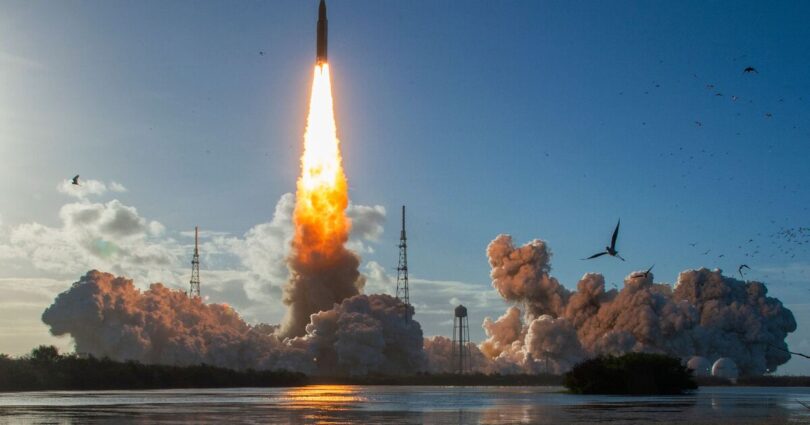
The Artemis II crewed lunar mission lifts off from Pad 39B at Kennedy Space Center (Image: AFP via Getty Images)
Which explains why all eyes were on Kennedy Space Center for Wednesday’s Artemis II launch. Whatever happens, Cernan will retain his title, at least for a few years, because the crew – led by mission commander Reid Wiseman – won’t be touching down on the Moon’s surface, only swinging past it. Nevertheless, the significance of a rocket going back after a 54-year gap cannot be overstated.
Dr Helen Sharman certainly thinks so. In 1991, she became the first British person in space when she flew to the Soviet Mir space station after answering a radio advert and beating 13,000 other applicants. And speaking prior to take-off, she offered a window into the minds of Wiseman, Artemis II pilot Victor Glover, and Mission Specialists Christina Koch and Jeremy Hansen.
She told the Express: « For the astronauts, this isn’t weird; it’s been part of their lives, part of their families’ lives, for a long time. Actually, this is the easiest time in the last few days and hours before the launch, because you’ve done all the training. It feels like you’re on a conveyor belt, really, and you’re just sort of moving along.”
The Artemis II mission is a 10-day loop which serves as the ultimate proof-of-concept for deep-space travel. After the initial « High Earth Orbit » checkout, the crew will perform the Translunar Injection (TLI) burn, a powerful engine firing that will sling them toward the Moon at speeds exceeding 20,000 mph. They will not enter lunar orbit; instead, they will follow a « free-return trajectory, » using the Moon’s gravity as a natural slingshot to whip them around the far side and back toward Earth. If all goes to plan, the mission will conclude with a high-velocity re-entry and a splashdown in the Pacific Ocean.
In the high-stakes minutes following liftoff, the crew endured a barrage of extreme physical forces and critical system checks as the SLS rocket shed its spent boosters and climbed through the thinning atmosphere.
Dr Sharman, 62, who these days is the UK Outreach Ambassador at Imperial College London, explains: « When the rocket launches, you’re pressed down into your seat because you’re launching upwards. Your weight feels heavier and heavier as the acceleration builds up—typically there’s about 4g or so of acceleration during a launch, and so then we feel four times as heavy as we do normally.

Artemis II’s crew – Reid Wiseman, Victor Glover, Christina Koch and Jeremy Hansen (Image: Anadolu via Getty Images)
« These astronauts will go into a high Earth orbit, where they’ll be tens of thousands of kilometres high. Then they’ll be able to see the whole of the Earth in one go. That’s amazing.”
In selecting Koch, the first woman to leave Earth’s orbit, and Glover, the first person of colour to do so, NASA has sought to make the Moon a mirror for all of humanity. Alongside them is Canadian Mission Specialist Hansen, the first non-American to venture into deep space.
For Professor Chris Lintott, the Oxford astrophysicist and Sky at Night presenter, it’s unquestionably a pivotal moment. He says: « We know that China has plans to go back to the Moon. So I think it is about getting a flag there first, just as it was in the ’60s.
« The difference is this is the start of something that might continue for decades. The intent is to keep going so that we might end up with a lunar gateway space station in orbit and a permanent base. »
Prof Lintott adds: « My favourite reason to go back to the Moon is that the oldest piece of Earth that still exists might be on the Moon. So there might have been a rock that was thrown off Earth by an impact that would still exist. But the region that everyone’s interested in is the South Pole of the Moon, and that’s an amazing place. »
Perhaps most crucially, Prof Lintott hopes the mission provides a much-needed chance for humanity to take stock. Recalling how Apollo 8’s iconic 1968 Earthrise photo galvanised the environmental movement, he eagerly anticipates the 21st-century equivalent.
Artemis II blasts off from Florida for first crewed Moon mission
He says: “Maybe it’ll be an astronaut TikTok or something, instead of a colour photo this time. I want to hear somebody standing back safely on Earth telling us what it was like to be there. I think that’s what we’ll get out of this mission.”
Professor Mahesh Anand, Professor of Planetary Science and Exploration at the Open University, believes that the true prize of this new era lies in the « strategic real estate » of the lunar poles.
He explains: « That’s where we think we can get direct access to large quantities of water ice, and it’s much easier to process water ice, to convert it into some form of water that you like to have it, rather than processing tons of dirt. »
Prof Anand also points to a « scientific dividend » that supports a whole generation of engineers and scientists back on Earth – and looking ahead, he sees the Moon as a vital testing ground for even more ambitious journeys.
Describing the Moon as « yet another extreme, inhospitable, challenging environment » that will teach us how to survive further afield, he adds: « Imagine what this could do to a five-year-old who has no idea what this ‘space’ is and what is possible. They could think that in 20 years’ time they could be actually playing a role.”
Dr Megan Argo, reader in astrophysics at the University of Central Lancashire, explains that the near-four-year delay preceding the mission was a vital period of troubleshooting. She points to the uncrewed Artemis I flight in 2022, where the heat shield—designed to ablate and carry heat away during a 3,000°C re-entry—suffered « far more damage than had been anticipated”.
While the investigation eventually cleared the shield for flight, Dr Argo argues that the endeavour remains a staggering test of human endurance. During the « High Earth Orbit » phase, the crew will travel more than 44,000 miles from Earth, leaving the protective embrace of the magnetosphere.
Dr Argo explains: “The astronauts will experience a significantly higher radiation dose as a result. During the mission, the crew will be wearing dosimeters to check their radiation levels. »
Their isolation will also be unprecedented; by swinging approximately 4,700 miles beyond the far side of the Moon, the crew will travel further from Earth than any human in history.
While this flight is a « fly-around, » it is the essential precursor to Artemis III, the mission currently slated to return humans to the lunar surface. Originally targeted for 2025, that landing has moved on the schedule to no earlier than September 2026—and potentially as late as 2027—to allow for the development of the SpaceX Starship HLS (Human Landing System).
At that moment, a new generation will finally step into the lunar dust – another giant leap for mankind.
Source link