
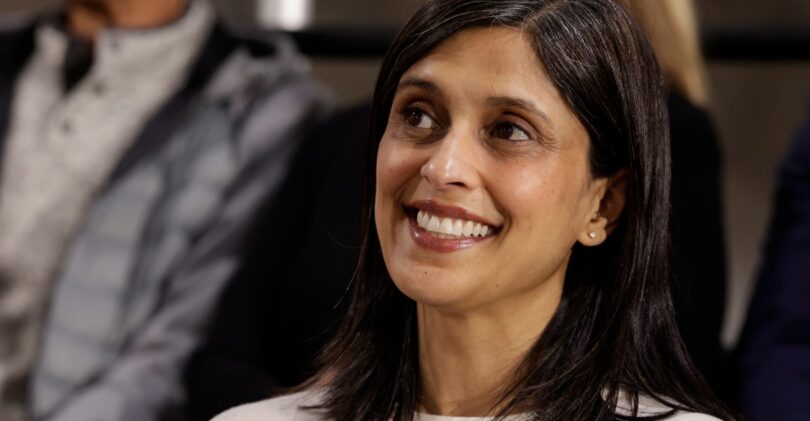
Usha Vance has a new podcast: Storytime with the Second Lady. It’s exactly what it sounds like. Each episode begins with a brief introduction, after which JD Vance’s wife reads a children’s story. The first three episodes were released Monday, and none is longer than 11 minutes — children’s books are, after all, quite short.
It’s an unexpected move for Vance, who gave up a career as a high-powered lawyer to be second lady. But her pivot to podcasting isn’t entirely unprecedented. She’s simply the latest conservative spouse to pivot to content creation. It’s a new front of the ongoing culture wars: Instead of trying to win back supposedly liberal institutions, the right is hell-bent on creating its own. And if these institutions reinforce conservative gender norms, that’s all the better.
“I’ve always loved reading, from when I was a kid until today. And now as a mom, storytime with my kids is the highlight of my day,” Vance says in the inaugural episode, a reading of Beatrix Potter’s The Tale of Peter Rabbit. Lest anyone think she will only be reading classics in keeping with the right wing’s aversion to contemporary children’s literature, the second episode is a reading of Cars — as in, a book based on the Pixar movie — featuring racecar driver Danica Patrick, and the third is Playground Lessons read by author and Paralympian Brent Poppen.
This is completely anodyne, even wholesome content, at least if you ignore the fact that the Trump administration slashed grant funding for libraries. As second lady, Vance has championed literacy: Last year, she announced a summer reading challenge for children. Vance said the challenge was about focusing more deeply, being more present, and spending less time on devices. Her taste skews literary: She has read Hernan Diaz’s Trust and Emily Wilson’s new translation of the Iliad, the latter of which was much denigrated by conservatives. Storytime with the Second Lady seems like the right’s answer to Ms. Rachel, the popular children’s entertainer who, to the chagrin of some conservatives, has been outspoken about the ongoing war on Gaza and the Trump administration’s detention of immigrant children.
Katie Miller, wife of Trump adviser Stephen Miller, launched a podcast last year after leaving the Department of Government Efficiency, where she was a spokesperson. Erika Kirk took over her late husband’s media empire after his assassination. Unlike Kirk, however, both Miller and Vance are creating content that is apolitical on its face. Miller and Vance’s seemingly banal podcasts are indicative of conservatives’ efforts to create a parallel media ecosystem, a project that signals their aspiration for cultural relevance that they feel they’ve been denied by the mainstream.
You’d be forgiven for thinking that some on the right want nothing more than to be liked. They aren’t content with power; they want cultural cachet, and their politics of resentment are often born of an understanding that this desire will always remain out of reach. So much of the MAGA movement revolves around culture wars: They are fixated on the wokeness of children’s cartoons, Hollywood’s liberal slant, and the perpetual boogeyman of drag queen story hour. The Vances were reportedly hurt by the negative reaction to the film adaptation of Hillbilly Elegy. The vice president and second lady are often heckled in public: they were booed at the recent winter Olympics in Milan and jeered at the Kennedy Center. During Trump’s first term, the Millers reportedly avoided going out in public because of how often they got harassed.
Unable to win over the public, these political wives have chosen to carve out spaces for themselves in conservative media. “There isn’t a place for conservative women to gather online,” Miller said when announcing her podcast in 2025. Except, as The New York Times pointed out at the time, there is a thriving right-wing “womanosphere” as embodied by magazines like Evie and The Conservateur and a litany of podcasts including The Brett Cooper Show, Alex Clark’s Culture Apothecary, and Allie Beth Stuckey’s Relatable. But right-wing media relies on the illusion of rejection and transgression — Miller needs to position herself as a conservative lighthouse in a sea of liberal lifestyle content, because she has nothing else to differentiate her from the crowd. Similarly, Vance’s podcast is just the latest among many storytime podcasts, some of which are overtly political.
The most interesting thing about Vance and Miller’s podcasts is that they aren’t interesting at all. Episodes of Storytime with the Second Lady are short: there’s a brief introduction, a reading, and that’s it. Miller does long interviews, but as Tess Owen wrote in Slate, her podcast is “eye-wateringly boring.” Granted access to some of the most powerful people in the country and the world — her former boss Elon Musk, FBI director Kash Patel, attorney general Pam Bondi, and JD Vance himself — Miller asks such hard-hitting questions as: Is a hot dog a sandwich? Her big cultural gets are those few celebrities who have publicly aligned themselves with the right: Dr. Oz; vaccine skeptic Jenny McCarthy; fitness personality Jillian Michaels; Cheryl Hines, the first lady of MAHA; Mike Tyson; and Nicki Minaj, who recently cast her lot with the MAGA crowd. Miller’s latest guest is NBA player Tristan Thompson, who is perhaps most famous for cheating on Khloé Kardashian. (He is, for the record, good friends with Eric Trump and averse to repeating outfits.)
For Vance and Miller, these podcasts also function as a sort of rebrand. Miller has had political ambitions since college. She was involved in student government at the University of Florida, where she had her fair share of scandals. As an assistant press secretary for the Department of Homeland Security during Trump’s first term, Miller was tasked with defending the administration’s family separation policy. She was such a hard-liner that her supervisor once sent her to the border in the hopes that it would make her more compassionate — which, Miller later told journalist Jacob Soboroff, “didn’t work.” Amid this cruelty, she met Stephen Miller; the two nativists found love in a hopeless place. “Where does true love happen?” she said in a recent interview. “Over border security,” naturally. Usha and JD Vance met at Yale Law School, where she was his “spirit guide” through the rarified world of the university. Until her husband received the vice presidential nomination, she worked for the prestigious firm Munger, Tolles & Olson. Vance quit this job to support her husband’s political goals, and aside from a handful of projects, has remained largely out of the spotlight.
These are driven, high-achieving women who have recast themselves as domestics, even as they pursue careers (in Miller’s case) and projects (in Vance’s) outside the home. This is the paradox of the “tradwife” influencer: these are jobs and performances, a canny camouflaging of professional ambition. It’s also worth noting that both Miller and Kirk sought fame and attention for most of their lives. As a teenager, Miller appeared on a reality show about her high school’s student newspaper. Kirk was a contestant on the reality show Summer House and founded a Christian clothing brand called Spiritual Gangster. Vance, by contrast, is a private person — her foray into podcasting is likely an effort to fit into a more traditional second lady role. Vance has said she hopes to practice law again someday. For Miller, the podcast appears to be the apex of her career. She spent all those years shilling for homeland security so that someday, she could interview a lesser Kardashian’s cheating ex.
Source link