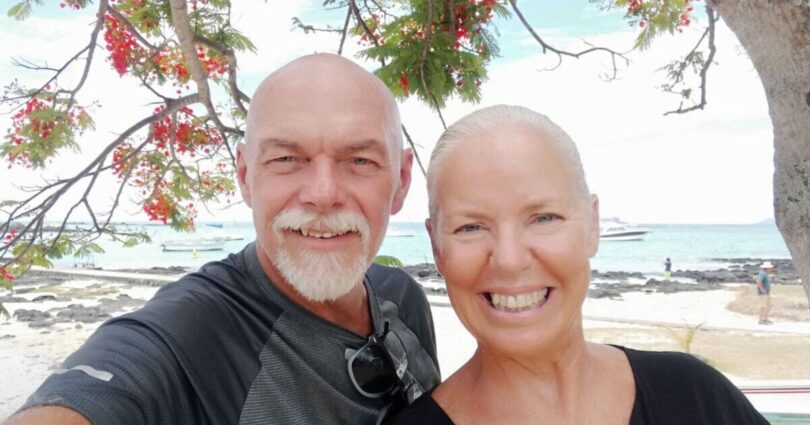
The couple moved to the African island after considering Dubai (Image: Penny Jones)
As Brits fly home from the Middle East, one African island may be on the radar as a business hub, with some serious tax savings and sunshine. With no inheritance, capital gains or property duties, and income tax capped at 20%—compared with the UK’s tiered system of up to 45%—foreign residency numbers have increased in recent years, according to its Economic Development Board.
Its CEO Mahen Kundasamy believes life in Mauritius is far “beyond the sea, sun and sand », despite the Indian-Ocean island rarely dropping below 20C, with world-class golf courses, vibrant coral reefs and white sandy beaches. « Over the past decade, the country has seen a growing number of foreigners who have relocated to Mauritius and are staying permanently, » he says, stating around 30,000 people from Europe, Africa, and Asia have relocated to date.

The couple now works with views over the sea and year-round sunshine (Image: Penny Jones)
Read more: ‘My mum died on holiday island loved by Brits – nobody should go there’
Read more: Foreign Office Spain, Turkey and Portugal advice as Brits warned
“More foreigners are choosing Mauritius due to personal safety, security and low taxes, and expat-friendly policies, » he explains.
This was the case for Penny Jones, 64, who moved with her husband Ken to run their health and safety training company INTRA on a retirement visa. They had originally considered relocating to the Middle East years ago before the latest conflict broke out, but thought twice after comparing lifestyles.
« We did go to Dubai and have a look, but there the heat is unbelievable, » she said. « You’ve really got to live indoors and you go from aircon car to aircon environment and kind of live in those bubbles, and we don’t like that. We really just enjoy opening the door and walking outside. »
The Brit said she feels a sense of safety now, having relocated from Cape Town, where she had moved with her father who was in the Royal Air Force in Lyneham, Wiltshire.
“I think for us the biggest, the number one driver was just the feeling of peace that we always have when we’re here. This is really where we feel the most comfortable, » sharing that her husband’s mobile phone was even returned to him after her lost it.

The couple lives next to the beach now on a retirement visa (Image: Penny Jones)
« It’s not for everybody, island living. If you want big city life and new restaurants every day and the best in opera and ballet, it’s not that. But the peace that we feel here is just tremendous. That’s what we really value the most.”
It is a similar story for Wayne Sheridan, who was born and bred on the border of South Staffordshire and Wolverhampton, but now lives minutes from the beach in Mauritius as CEO of AFG Furniture Group, where he feels safe enough to leave his keys in his car overnight.
“It’s probably like how the UK used to be years ago. When I remember growing up, the front door used to be left open.”
He was invited to move to the volcanic island, which has 1.27million residents, to redevelop a product range in a one-year job. Eight years later he is still there. « Without question » his quality and standard of living has improved since, across his finances, health and lifestyle.
“I love England, I love where I come from, I love what it stands for, but it’s just chalk and cheese. There is that expat lifestyle here, it’s just a much more relaxed life. Being here, it’s just friendlier, more peaceful, more calming, » he explains.
“I wake up to a swimming pool every day that I don’t have to heat. You’ve got a great beach lifestyle, a fantastic reef, » he continues, listing several things that would make anyone enduring the UK winter jealous.

Wayne Sheridan has lived in Mauritius for eight years despite originally moving for a year (Image: Wayne Sheridan)
“Don’t get me wrong, you get challenges everywhere in the world, but where would I sooner be? Definitely here, » jokingly adding: “And I still get a good English breakfast. »
For both Wayne and Penny, the move has paid off professionally. Having started in a 25,000sqft warehouse, AFG expanded to a site four times the size in the first 12 to 18 months, and now they employ more than 120 people.
Penny points out that she and Ken can still run a business on the retirement visa with corporate tax capped at 15%. In the UK, it is higher at 19% for small companies and 25% for companies with profits over £250,000.
“We have our desks in our lounge because we like to look at the sea whenever we can, » Penny says. « The internet is excellent. We’ve got fibre internet. I’m not sure if it’s quite as fast as in the UK, but it’s adequate for our needs. »
However, there are some caveats. Most know about the so-called ‘Golden Visa’, which allows foreign nationals to apply for residency if they invest at least $375,000 (£280,000) into real estate.
But Brits may need cash behind them either way, since most retirement and occupational visas require a guaranteed monthly income, and housing on average can be more expensive.

Penny was born in the UK and moved to South Africa with her RAF father (Image: Penny Jones)
The average listing price is £528,000 in 2024, according to Propertycloud.mu, the country’s leading real estate platform. In the UK in January 2026, the average was £268,421.
Prices are also rising steeply in Mauritius, having nearly tripled in a decade from £184,557 in 2017, according to the platform.
Wayne said you can do “tremendously well”, but you need to have an entrepreneurial mindset, and of course, work in an in-demand sector.
His business now earns him more than the UK, but he believes he gets “a lot” more for his money in Mauritius, combined with the fact you pay lower tax, so you get to keep “a hell of a lot more”.
“Would I ever be able to have a six metre swimming pool in the UK and a four bedroom detached property living in mangroves? It’s just impossible to get that. It’s just given in one hand, taken in the other in the UK.”
Penny explained that some people live lavish lifestyles in the premium real estate. « But it’s up to you and what your budget is and how you choose to live, » she declares, saying you can live « very, very reasonably ».
Prices vary hugely by region, with houses in the centre costing an average of £256,000, and homes on the east of the island reaching £2million. At least when you get there, you can sip a pint of beer for £1.60.
Source link