
Though catching monsters and making them fight have always been core elements of the Pokémon brand, spinoffs like the Pokémon Snap and Detective Pikachu series have stood out by approaching the franchise from different angles. In different (and often small) ways, recent mainline Pokémon titles like Sword / Shield, Scarlet / Violet, and Legends: Z-A have acknowledged that there are some players who would much rather spend their time hanging out and taking pictures with their monster friends.
That leisurely approach to enjoying the Pokémon world doesn’t exactly gel with the main games’ focus on becoming a competitive champion, but it is exactly the sort of mindset you should have when you start playing Pokémon Pokopia for the Nintendo Switch 2. Co-developed by The Pokémon Company, Game Freak, and Koei Tecmo’s Omega Force division, Pokopia feels like Nintendo taking another stab at everything that makes Animal Crossing so enjoyable while experimenting with features from other crafting-forward games, like Minecraft.
Pokopia uses conventions from the core Pokémon series to make its spin on classic life simulation game mechanics like building and nurturing relationships feel distinct. It’s a fun, cute game that plays just differently enough from Animal Crossing to say that Pokopia isn’t simply a Pokémon-themed New Horizons. But what delighted me most when I recently spent some hands-on time with the game was how — when you look past its bright, island-y vibes — Pokopia’s story seems to be teasing something dark and ominous about the Pokémon world.
In Pokopia, you play as an unusual Ditto that has somehow ended up on an island after getting separated from its trainer. This Ditto isn’t great at transforming into other pokémon, and it doesn’t remember what happened to its partner. But after finding its lost trainer’s pokédex, the Ditto uses its powers to assume their form (the game’s character customization options are surprisingly robust), and it starts to explore the land around it.
When I first started playing, I knew that Pokopia was focused on a Ditto in human drag making friends with other pokémon, like Professor Tangrowth, and creating unique habitats to attract more monsters. But I was surprised and intrigued when the grass-type professor explained that it hadn’t seen another living human or pokémon out in “the desolate world” for a very long time.
After teasing me with the mystery of what happened to everyone, Pokopia dropped me right into a simple bit of gameplay involving a dehydrated Squirtle that covered the basics of how things work on the island. By meeting certain pokémon with special moves like Water Gun, Ditto can copy them and use their powers to affect terrain in the game. When selected, each move — which can only be used a certain number of times before you have to eat to recharge your Power Points — displays a grid of squares letting you know the areas it will affect when used.
1/3Image: The Pokémon Company, Game Freak, Koei Tecmo Games
Hitting patches of dried-up grass with Water Gun turned them vibrant green, and when I’d created enough connected grass squares, they sparkled to let me know that I had created a patch of Tall Grass. In Pokopia, your Pokédex registers pokémon and areas like Tall Grass as different kinds of habitats where specific monsters might show up. A timid but friendly Charmander popped out of my first patch of Tall Grass, and its powers were exactly what I needed to start a campfire. The deeper you get into Pokopia, the more complex creating new habitats becomes.
Some pokémon would only spawn if I created patches of grass shaded by large boulders, while others required me to cultivate fertile ground with wheelbarrows nearby. I had to have already met certain pokémon in order to use the moves necessary to create the conditions that would attract new monsters. And it wasn’t always guaranteed that the exact pokémon I wanted would spawn when their habitat requirements were met.
The more pokémon you befriend on the island, the more Pokopia begins to open up in terms of space that you can explore and things you can build using Animal Crossing-style recipes and workbenches. I could easily imagine myself spending hours just making places for wild pokémon to relax, but Pokopia is also clearly a game that’s aimed at builders. With the right moves and transformations, you can start doing heavy construction to reshape your island’s geography or travel to other nearby landmasses. Full-on island overhauls might take a while to complete if you’re working by yourself, but the work can go much faster when you’re using Pokopia’s multiplayer mode.
1/3Image: The Pokémon Company, Game Freak, Koei Tecmo Games
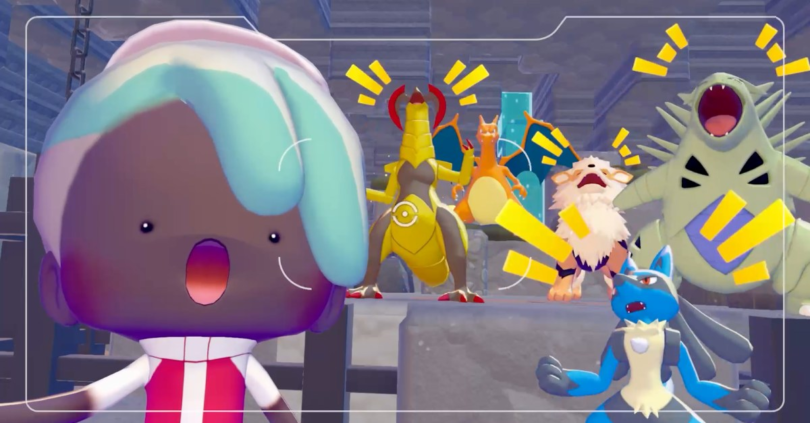
During my demo run, my groupmates and I didn’t spend much time trying to complete the objective we were encouraged to focus on as a team because it was much more fun to run around transforming into Dragonites and flying through the air. But if we had been a little more goal-oriented, we could have built some buildings or snapped a few group photos with our conspicuously retro Pokédexes.
Aside from the foreshadowed desolation, what struck me most about Pokopia was how relaxing its interpolations of classic Pokémon songs were and how expressive the game’s monster animations are. Though the game isn’t voice acted, pokémon’s faces charmingly convey the emotions they’re feeling — sometimes they’re excited to talk to you, sometimes they’re in a bad mood and need cheering up — as you visit them in their new homes. And while I wasn’t able to get a look at just how many pokémon can be befriended in the game, it was clear that a sizable number of them can make appearances on the island.
Even though it’s clearly aimed at kids, Pokopia feels like the kind of game that’s going to be just as enjoyable for adult Pokémon fans when it hits the Nintendo Switch 2 on March 5th. And if the game’s deeper story is anywhere nearly as dark as it seems, it might be one of the franchise’s most fascinating side stories yet.
Source link