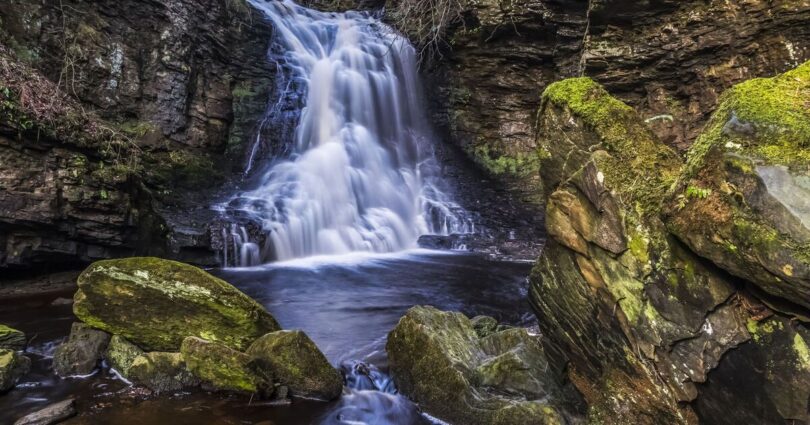
Even whilst nearing the waterfall, you’ll start to detect the surge of water before the trees open up to unveil the shimmering cascade of white. This moderate route can prove demanding in places featuring brief ascents, steps and certain uneven stretches. Walkers suggest wearing robust boots, particularly during wet conditions when this trail can turn slippery, according to Northumberland National Park.
The Waterfall
Adrian wrote on TripAdvisor: « Wow! Amazing place – much better than I imagined. Lovely views of the woodland and river, then you’re met by a lovely waterfall. Well worth a visit.
« The stone pool beneath the waterfall provides an excellent wild bathing location on warm summer afternoons before heading back, or at any time of year for the more adventurous amongst us. »
Marta J said: « Loved the place. Nice walk, great reward at the end. Not too strenuous. We also did wild swimming at the bottom of the waterfall. »
As a protected Site of Special Scientific Interest (SSSI), there’s an abundance of wildlife to observe along your route. Within this compact location there are an impressive 300 species of mosses, liverworts and lichens. You can also spot squirrels and even bats at the appropriate time of day.
The Route’s History
The precise route begins at Northumberland National Park car park at Hareshaw Linn, in Bellingham. This is a region steeped in ironwork heritage.
Hareshaw Ironworks opened in 1939 and was utilised to manufacture coal-sourced pig iron, iron ore, and limestone. If visiting, you will also see the charming stone terrace of Foundry Farm – this would have been used to accommodate the foundry managers responsible for supervising production in the metal casting facility.
Ascending the footpath you will reach mounds created from the remnants of the 70 ironworks ovens that supplied raw material to the furnaces. Proceeding through the gate you will see a dam on your left just before you reach a picturesque stretch which you can picnic on.
Then you will find more spoil mounds from furnaces – with this lot used to produce stone for the local miner’s houses. Here you can also see blocked mining entrances. Then you will reach the ancient woodland leading up to the Linn, featuring oak, hazel, elm and ash trees. At the summit of the waterfall is the bridge to Cupid’s Bower seat overlooking the stream.
On the second bridge there are two old mine shafts to your left and, on the third and fourth bridges, tall Douglas firs planted by the Victorians tower over the path. The Victorians additionally made their presence felt on the fifth bridge, constructing a bandstand for picnics, musical performances and storytelling.
Ensure our latest headlines always appear at the top of your Google Search by making us a Preferred Source. Click here to activate or add us as your Preferred Source in your Google search settings.
Source link