
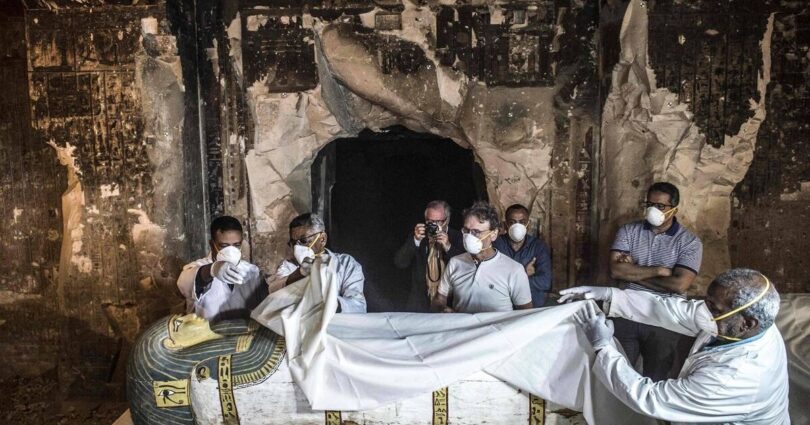
A mummy of a woman, remarkably well-preserved within a coffin in Egypt and dating back over 3,000 years, has been discovered.
The ancient casket, known as a sarcophagus, was one of two unearthed in El-Asasef, Luxor, on the bank of the River Nile.
Authorities opened a previously unopened sarcophagus in front of international media in 2018.
« One sarcophagus was rishi-style, which dates back to the 17th dynasty, whilst the other sarcophagus was from the 18th dynasty.
« The two tombs were present with their mummies inside, » stated Egypt’s Minister of Antiquities Khaled Al Anani.
The Eighteenth Dynasty harks back to the 13th century BC, a period renowned for some of the most famous Pharaohs, including Tutankhamen.
The team of French researchers commenced the excavation in March, paused in May but resumed work in August.
They also discovered five coloured masks and over 1,000 Ushabti statues in another nearby tomb.
Ushabti statues are miniature figurines of servants intended to serve the deceased in the afterlife.
More than 300 metres of debris were cleared over five months to reveal the tomb, which contained coloured ceiling paintings depicting the owner and his family.
The tomb, which also houses mummies, skeletons and skulls, dates back to the middle-kingdom almost 4,000 years ago, but was reused during the late period.
Ancient Egyptians mummified humans to preserve their bodies for the afterlife, whilst animal mummies were used as religious offerings.
The nation hopes these findings will enhance its image internationally and rekindle interest amongst travellers who previously flocked to its iconic pharaonic temples and pyramids but who have avoided the country since its 2011 political uprising.
Source link