
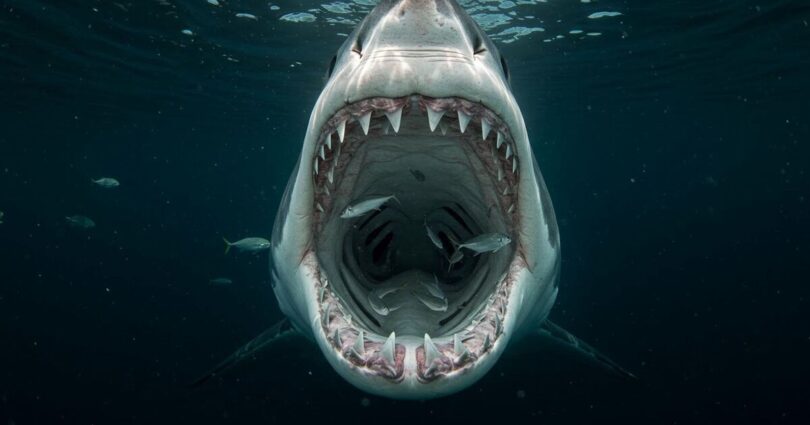
Great white sharks may be breeding again in the Mediterranean, scientists believe, in an announcement likely to spook British tourists who flock there every summer. The revelation comes after a juvenile shark, measuring around 210cm and weighing 80–90kg, was accidentally caught off Spain’s eastern coast on April 20, 2023.
The rare find prompted researchers to examine historical records from 1862 to 2023, with their results recently published in the open-access journal Acta Ichthyologica et Piscatoria. Once made infamous by Steven Spielberg’s Jaws, the species was thought to have vanished from the Mediterranean, apart from occasional visitors from other seas.
Despite their fearsome reputation, Great Whites are often unfairly maligned, suffering from a « villain » narrative that does not match reality. While headlines often lean into sensationalism, the statistical likelihood of a shark encounter is extraordinarily low.
In fact, you are significantly more likely to be struck by lightning or injured by a household appliance than to be bitten by a shark. Worldwide, unprovoked attacks have hit historic lows—with only 47 recorded globally in 2024—and in the Mediterranean specifically, there have been fewer than 40 recorded attacks in the last 150 years.
These apex predators do not hunt humans; rather, most incidents are cases of mistaken identity in murky waters. Far from being monsters, they are shy, elusive, and increasingly threatened residents of our oceans.
Dr Jose Carlos Báez, study lead, said: “Detecting juvenile sharks is particularly important. The presence of young individuals raises the question of whether active breeding may be occurring here.”
The review suggests that while the Mediterranean great white remains a « ghost » population, it has not entirely disappeared. The species is listed as Vulnerable on the IUCN Red List, with numbers continuing to decline.
Researchers caution, however, that sightings remain extremely rare, underscoring the shark’s scarcity in the region.
Scientists stress that long-term monitoring is vital to understanding Mediterranean great whites. They say combining occasional sightings with modern tracking could support effective conservation strategies.
Dr Báez concludes: “These large predators play a crucial role in marine ecosystems. Highly migratory, they redistribute energy and nutrients, scavenge carrion to keep seas clean, and even in death provide nourishment for deep-sea communities.”
Source link