There are always a few reasons people give for not buying a foldable phone. Some — price, battery life, camera quality — are mostly a matter of manufacturers balancing spec sheets to offset the added cost of the folding hardware. Others — durability, size — were practical design problems that have mostly been solved. But the crease always felt different, fundamental: something that foldables would be stuck with no matter what.
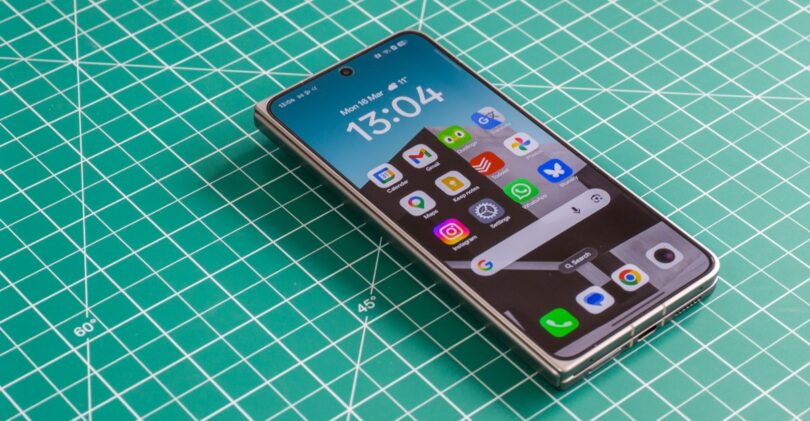
It claims that the Find N6 is the first foldable with a “zero-feel” crease, one so subtle that you can hardly tell it’s there. And while there’s just a hint of marketing exaggeration there, Oppo isn’t too far off. The crease may not be gone entirely, but it’s hard to imagine this version of it putting anyone off buying the Find N6.
That wouldn’t be enough on its own, but the Find N6 also offers clever multitasking software, a slim design, stylus support, and impressive battery life. The cameras still feel like the main compromise you make buying this over one of Oppo’s traditional Find X9 flagships, but they’re up there with the best in other foldables. Taken as a whole, that makes this the best foldable phone on the market right now — but only if you’re in one of the handful of countries where it’s sold, since the Find N6 is only available in China and a few other Asian countries, plus Australia and New Zealand, with no US or European launch at all. In Australia, it’ll set you back $3,299 AUD — around $2,300 USD.

I’ve got to start with the crease. I wrote a couple of weeks ago about how Oppo achieved its nearly creaseless display, but in short, it uses 3D liquid printing to fill the gaps in the hinge itself, creating a more even surface for the foldable screen to sit on top of.


The result is pretty astonishing. You can see the crease, but only when you tilt the phone in just the right way so that it catches the light just right; you can feel it, but only when you try to, passing your finger back and forth across the central column and concentrating on the sensation. The rest of the time, it might as well not be there. Holding the Find N6 next to Honor’s recently announced Magic V6, the crease is obviously shallower and subtler; next to Google’s six-month-old Pixel 10 Pro Fold the difference is night and day.
The question is how much this really matters. The crease clearly bothers plenty of prospective foldable buyers, at least in theory. It’s always one of the first things people mention when considering a foldable, or that friends look for when trying out one I’m reviewing. The flip side is that creases basically got good enough several years ago — it’s been a long time since a crease really bothered me during a phone review, and I normally forget it’s there within an hour or two of using a phone. In practice, Oppo has simply shaved that adjustment period down to near-zero, but it’s the kind of change that has the potential to really get more people buying foldables. I mean, not as much as Apple launching a foldable would, but still, the Android companies are out here trying their best.

And in fairness to Oppo, it’s had foldable software figured out for a while, and it’s only getting better. The company rightly received credit for the best multitasking on any foldable phones for the split-screen options it implemented in previous Find N phones, alongside the OnePlus Open. The Find N6 builds on this with a new option to open up to four floating windows, which can be resized freely and dragged all around the screen, and each stays active while open. With a couple taps, you can convert these to the more rigid split-screen view, allowing the apps to share screen space equally, and then tap back to the floating mode — with the phone remembering where you left every window each time. It’s an extra level of flexibility no other foldable phone offers.
A new stylus called the AI Pen has been designed specifically for the Find N6, and it works on both inner and outer screens. Alongside the usual note-taking and doodling options, it has a clever laser pointer-esque mode that lets you draw bright red doodles that disappear a few seconds later. It’s sold together with a case for the N6 that includes a charging slot for the stylus; the bundle costs $199 AUD (about $140).


Elsewhere, the Find N6 takes after the Find N5, my favorite foldable of last year. It’s about the same size — 8.93mm thick and 225g — making it a hair thicker than the Honor Magic V6, the thinnest foldable around, but about the same size as Samsung’s Galaxy Z Fold 7, and as thin as many slab flagships. This is as thin as these phones are getting until we ditch the USB-C port.
A seven-core version of the Qualcomm Snapdragon 8 Elite Gen 5 powers the phone, and the loss of one core hasn’t compromised performance in any meaningful way — it breezed through a 60fps Diablo Immortal session without even warming up, though I’m sure more demanding games would be able to find its limits. It ships with 16GB of RAM and 512GB storage, which is plenty of both.
The 6,000mAh silicon-carbon battery is one of the other meaningful upgrades from last year’s phone. It’s enough that I’ve frequently gone to bed with about 50 percent of the charge remaining, even on days with heavier use of the 8.12-inch internal screen, but I wouldn’t trust this to take me through two full days without a power bank on hand. Charging is fast, up to 80W using Oppo’s own SuperVooc charger, though limited to 55W on universal PPS chargers. 50W wireless charging also assumes you’re using an Oppo charging pad, otherwise the Qi speeds will be much slower — and there’s no Qi2 magnetic support, sadly.


Another slight downside is the durability: IP56, 58, and 59, which indicates great water-resistance but less protection from dust than Google and Honor’s latest foldables, though an upgrade from the Find N5, which had no rated dust protection at all. The triple rear camera, with a 200-megapixel main lens and 50-megapixel ultrawide and 3x telephoto lenses, is great compared to other foldable phones, but still not a patch on what Oppo delivers in its slab flagships like the Find X9 series. That difference is mostly noticeable at night, where it struggles a little with correctly exposing bright light sources. I don’t want to overegg the point — for a foldable phone this camera system is excellent — but if you spent half as much on a regular phone, it would be better at photography than this.
1/14
Of course, that phone wouldn’t fold. If you’re committed to getting a foldable phone, and are able to get ahold of the Find N6, it would be my choice right now. The screen looks fantastic, the battery life is impressive, and the multitasking software is unmatched. If Apple’s rumored iPhone Fold does arrive this September as expected, it’ll be hard-pressed to improve on this.
Photography by Dominic Preston / The Verge
Agree to Continue: Oppo Find N6
Every smart device now requires you to agree to a series of terms and conditions before you can use it — contracts that no one actually reads. It’s impossible for us to read and analyze every single one of these agreements. But we started counting exactly how many times you have to hit “agree” to use devices when we review them since these are agreements most people don’t read and definitely can’t negotiate.
To use the Phone 4A Pro, you must agree to:
- Google Terms of Service
- Google Play Terms of Service
- Google Privacy Policy (included in ToS)
- Install apps and updates: “You agree this device may also automatically download and install updates and apps from Google, your operator, and your device’s manufacturer, possibly using cellular data.”
- Oppo User Agreement
- Oppo User Privacy Protection
There’s also a variety of optional agreements, including:
- Provide anonymous location data for Google’s services
- “Allow apps and services to scan for Wi-Fi networks and nearby devices at any time, even when Wi-Fi or Bluetooth is off.”
- Send usage and diagnostic data to Google
- Let contacts nearby find and share with you
- Google Gemini Apps Privacy Notice if you opt in to using Gemini Assistant
- Oppo Global Search services
- Oppo Smart Decision-Making Service
- Oppo Enhanced Intelligent Services
Other features, like Google Wallet, may require additional agreements.
Final tally: six mandatory agreements and more than eight optional agreements.
Source link