
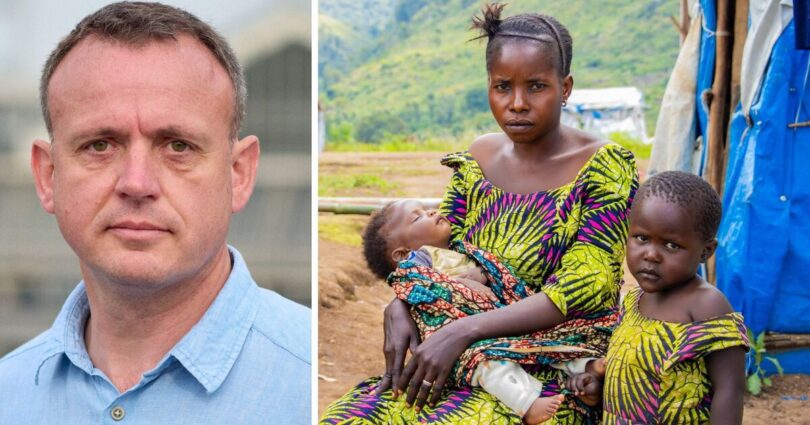
As festive lights flicker across our country and families get ready for Christmas, millions of people in the Democratic Republic of Congo (DRC) are living through a nightmare that barely registers here. Earlier this year, M23 forces – backed by neighbouring Rwanda – seized control of the Congolese provinces of North and South Kivu, forcing more than five million people to flee their homes.
Thousands were killed. It’s the latest chapter in a conflict that has claimed around six million lives since the Rwandan genocide in the mid-1990s. Yet in the UK, the crisis barely made an appearance in the media – this is the biggest humanitarian emergency people in Britain haven’t heard of. In October, I spent several days in eastern DRC meeting Christian Aid’s partners. Their work is both humbling and inspiring. Day to day, they deal with the basics: food, shelter, and clean water.
On a deeper level, their work strives for something far more challenging, but important – bringing people together across divides that have been forged in violent conflict over decades.
I can share first-hand that the reality on the ground in eastern DRC is grim. I met Chance, a former shopkeeper and mother-of-eight living under a UN-branded tarpaulin in an unofficial displacement camp.
Her life collapsed in February when fighting reached her community, and soldiers looted her shop. Chance fled with her eight children – her baby wearing only a nappy – and walked for 50 miles, hungry and exhausted, to reach safety.
Her husband stayed behind, and she hasn’t seen him since, fearing he was killed in the fighting. The journey cost Chance more than her home and livelihood. In the camp, her seven-year-old son died, most likely from a diarrhoeal disease as a result of unsafe water.
Chance’s tragic and dire story is just one piece of the larger crisis that has unfolded. The main airport in Goma has been bombed, banks and businesses are shut as a result of a blockade by the government in Kinshasa and, most urgently, hunger is everywhere.
Congo’s deep tragedy is being made worse by the collapse of international aid. The closure of the US aid programme and cuts by the UK Government have left a huge gap in the UN’s humanitarian response, and in global health funding.
In a one-room health clinic I visited in the hills of South Kivu, serving 8,000 people, the staff told us that basic drugs and equipment for common diseases like malaria were increasingly scarce, putting lives at risk in a country where 10% of children die before their fifth birthday.
Donald Trump’s agreement, signed last week in the White House with the Rwandan and Congolese presidents, looks more like a business deal than a peace deal. It may open up mining opportunities for US companies, but there is no ceasefire between the warring parties
Despite how difficult it is to grasp and convey the severity of the situation, it’s vital for me to report on it because we’ve seen a deficit in media attention around the DRC. Why does this matter now?
Because media coverage shapes public awareness, it creates pressure for governments and international bodies to respond. Christian Aid’s new campaign, Not Another Silent Night, is a call to end the silence surrounding the suffering of Congo’s people. Our message is simple: the world needs to pay attention and play its part in ending the crisis in eastern DRC. Silence isn’t neutral.
When crises are ignored, aid is cut, political will evaporates, and suffering increases. Journalism such as the stories that have been told by the Daily Express has a critical role, and Chance herself understands this.
She told me that her son wants to become a journalist because “when information spreads, we are informed”. Telling these stories is not just a privilege; it is a responsibility.
So, what needs to happen? First, editors and reporters must give the DRC the urgent coverage it deserves. Stories like Chance’s should not languish in obscurity. Second, readers – all of us – need to share these stories, amplify these voices, and refuse to let this crisis remain invisible.
And third, policymakers must step up: restoring humanitarian aid and investing in the diplomatic efforts needed to address the root causes of violence. This isn’t about charity; it’s about justice. Every statistic masks a human life – a mother like Chance, a child lost to preventable disease, a family torn apart by conflict. Our indifference should not compound their suffering.
As we celebrate this season of peace, let’s remember those for whom peace is still a distant dream. Let’s make sure this Christmas is not another silent night for the people of the DRC.
Source link