
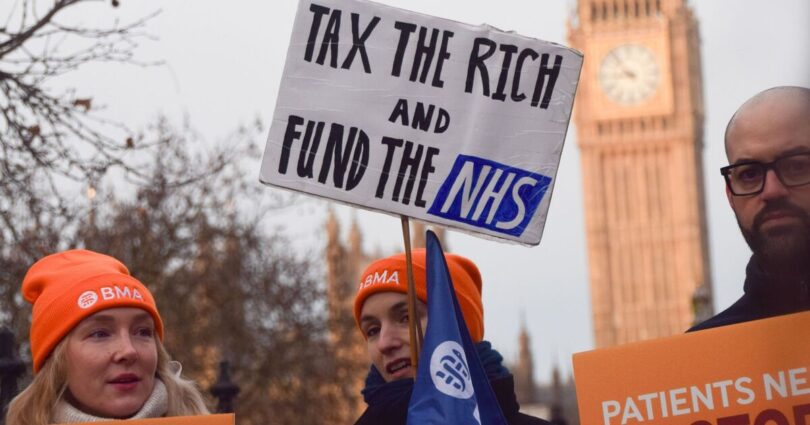
« Strike action over Easter risks a perfect storm » (Image: Getty)
NHS chiefs are preparing to rely less on resident doctors after a wave of crippling strikes – sparking a fierce backlash ahead of a six-day Easter walkout set to hit patients hard.
A source close to Sir Jim Mackey, Chief Executive of NHS England, said the current model – heavily dependent on doctors in training – is no longer sustainable during repeated industrial action.
“You cannot run a health service based on an unreliable source of young doctors,” the source said.
The explosive intervention follows remarks by Sir Jim last week signalling a potential long-term overhaul of how the NHS is staffed, raising fears that striking doctors could be sidelined altogether.
But critics have hit back furiously. Professor Carl Heneghan, Director of Oxford University’s Centre for Evidence Based Medicine and an urgent care GP, pointed to official data showing the UK already has below the average number of doctors compared to other developed countries.
And he warned: “It is wholly unacceptable for ministers and appointed health chiefs to play politics with people’s lives.”
The dispute comes to a head next week, when resident doctors – previously known as junior doctors – are set to walk out for six days from Tuesday.
It will be the 15th round of strikes since 2023, underlining the scale of a dispute that has dragged on for more than two years with no clear resolution.
Health leaders warn the timing – over Easter – risks a perfect storm, with reduced staffing, holiday pressures and rising patient demand colliding at once.
The action is expected to cost the NHS more than £250million in lost activity and emergency cover – piling further strain on a system already struggling with waiting lists and staff shortages.

NHS patients facing record (Image: Getty)
The comments come after Sir Jim, who leads NHS England, said last week the service must explore ways of becoming less dependent on what he described as a “transient training workforce” – referring to resident doctors.
Speaking to the Health Service Journal, he said NHS leaders are looking at how to make services less reliant on rotating junior doctors and instead build a more stable workforce of permanent staff.
He suggested the NHS may need to go further in that direction if strikes continue, amid growing concerns about reliability.
A source close to him said this could mean greater reliance on doctors recruited from overseas, as well as expanding less qualified roles such as physician associates and advanced clinical practitioners.
These roles typically require less training than fully qualified doctors and are increasingly used to carry out routine clinical work such as taking blood, ordering tests and supporting patient care.
Critics, however, warn such a shift risks papering over deeper staffing shortages rather than fixing them.
The strike was called after the British Medical Association (BMA) rejected a government pay offer worth up to 7.1 per cent for this year.

Wes Streeting: « strikes unecessary and damaging » (Image: Getty)
Health Secretary Wes Streeting blasted the planned action as: “Unnecessary and damaging.”
Prime Minister Keir Starmer said doctors had “recklessly” walked away from a deal after months of negotiations.
The Government says the offer would have taken total pay rises for resident doctors to around 35 per cent over three years, with some earning more than £100,000.
Ministers argue this would place doctors among the better-paid public sector workers – a claim hotly disputed by unions.
The BMA insists the offer is not what it appears. Dr Jack Fletcher, chair of its resident doctors committee, said: “Ministers effectively moved the goalposts on the deal at the last minute.”
He warned that spreading pay increases over a longer period meant: “At best, [pay] barely treads water.”
He also accused the Government of using workforce pressures as a bargaining tool, saying:
“Removing potential doctors’ posts at a time when corridor care and GP queues are already putting the NHS under pressure is clearly bad for patients.”
Union leaders say they remain open to talks – but only if a “credible” offer is put forward.
Experts say the row has exposed long-standing weaknesses in the NHS workforce.
Professor Heneghan pointed to official data showing the UK has around three doctors per 1,000 people, below the average for many comparable countries.
He said the NHS faces a significant shortfall, with tens of thousands more doctors needed to reach European levels.
Oxford University public health expert Dr Tom Jefferson said: “Tell me how you are going to run a service without juniors?”
He added: “This is what you get when you put accountants and bureaucrats in charge of a health service. No coal-face time – no understanding.”
Sir Jim’s remarks point to a potentially significant shift in how the NHS is run if the dispute drags on.
Some hospital leaders have told NHS England that services have operated differently during strike periods, with consultants and senior clinicians stepping in to maintain core care.
However, Sir Jim has also acknowledged that a “pipeline” of future consultants is essential, highlighting the risk of undermining long-term staffing.
Any move towards a more “blended” workforce is expected to involve greater use of nurses, paramedics, pharmacists and other clinical staff alongside doctors – a change that could reshape the frontline of the NHS.
Despite the escalating rhetoric, negotiations are continuing behind the scenes in a bid to avert further disruption.
BMA’s Dr Fletcher said: “We believe there is a deal there to be done… and we are seeking to talk once again with the Government with every intention of achieving a meaningful outcome.”

Sir Keir Starmer says 15th walkout « reckless » (Image: Getty)
In a letter to the BMA last week Wes Streeting wrote: « Having rejected the deal we had agreed with you and your officers, I had expeced the BMA Resident Doctors Committee to at least ocme back with a counterproposal to end these strikes…the Government’s offer is on the table. The BMA has chosen to reject it and ut the NHS through another round of damaging and uncessary strike action. »
Source link