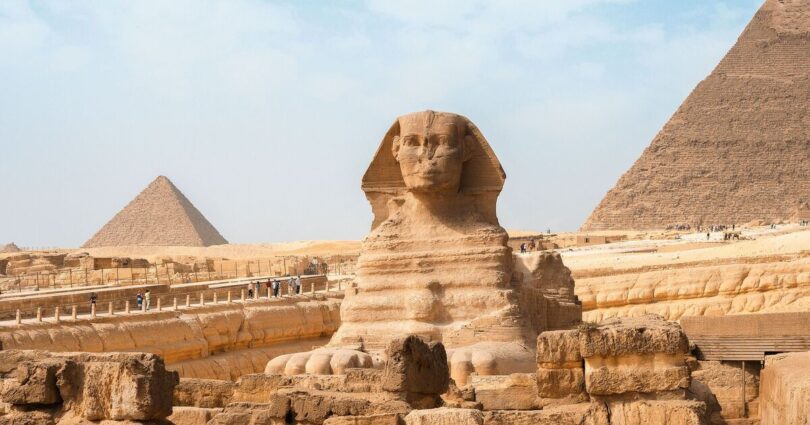
LaCroix said a photograph of the Sphinx Temple revealed an inverted step pyramid carved into it (Image: Getty)
For years, most experts have rejected the idea that highly advanced civilisations before the last Ice Age, largely due to the absence of supporting archaeological, geological, or paleo-environmental evidence. There’s one independent researcher, author, and media creator, however, who believes he has found evidence of a lost civilisation due to newly identified patterns carved into ancient stone in different parts of the world.
Matthew LaCroix said his research reveals what he describes as « paradigm-shifting evidence of a lost civilisation » that encoded its knowledge into geometry, symbolism and monumental design to preserve it through catastrophic events. Sparked by a recent find in Egypt, LaCroix told the Daily Mail that these symbols appear across multiple continents and date back as far as 38,000 to 40,000 years
READ MORE: Ancient seafarers mastered the ocean 760K years before Europeans
READ MORE: The incredible 3,500-year-old lost city with abandoned homes and temples

The researcher then analysed the entire Giza Plateau (Image: Getty)
The investigation was prompted after LaCroix noticed recurring features carved into ancient stone across the globe, including giant T-shapes, three-level indents, and step pyramids.
The researcher believes the civilisation tracked cosmic cycles, predicted global catastrophies, and embedded teachings about human origins, the structure of the universe, and divine existence into monuments and sacred sites.
LaCroix has outlined his findings in a new book, The Missing Key, which documents the decade of research into what he believes was a lost pre–Ice Age civilisation. The book traces the discoveries from eastern Turkey to South America and culminates in the recent finding at Egypt’s Giza Plateau, which LaCroix said helped unify the symbolic and architectural system shared across ancient sites worldwide.
LaCroix told the Daily Mail: « These specific symbols that are built in different size proportions, and the symbols are found in ancient stones around the world, are not supposed to exist; no cultures are supposed to have any cross-platform. »
The researcher believes the earliest source of this symbolic system is located in Ionis, near Lake Van in eastern Turkey, which he dates to around 40,000 years ago. He argued the site preserves the original blueprint for monuments that later appeared in places such as Giza and Tiwanaku where he found the same designs.
One nearby artifact, known as the Kef Kalesi relief, has become central to his research. The four-foot basalt carving contains what LaCroix describes as repeating T-shapes, step pyramids with three entrances, inverted pyramid forms and a lion figure. He said the same combination of symbols appears in Egypt and South America, linking the sites into a single global pattern.

LaCroix linked Tiwanaku in Bolivia to his global theory of an ancient civilisation (Image: Getty)
LaCroix believes the relief clarified the symbolic system and accelerated his study of similar features at Egypt’s Sphinx Temple. However, mainstream archaeologists disagree, dating the Lake Van sites to the Urartian period and thereby rejecting the idea of a pre–Ice Age global civilisation. No peer-reviewed research currently supports LaCroix’s dating.
LaCroix said his interpretation gained momentum in November 2025 after re-examining a photograph of Egypt’s Sphinx Temple that he had owned for several years. In the image, he believes he identified an inverted step pyramid embedded in the temple’s layout.
He claimed the same architectural language can be found throughout the Giza Plateau, including the Sphinx Temple, the Valley Temple and the mortuary temples of Khafre and Menkaure. Some researchers have previously suggested the Sphinx may have originally been carved as a lion before being reshaped with a human face, though this is not accepted by mainstream archaeologists.
Using astronomical precession and the Sphinx’s proposed alignment with the constellation Leo, LaCroix narrowed the construction date to either around 12,000 years ago or approximately 38,000 years ago. He rejected the later Ice Age date, arguing that widespread flooding would have destroyed surface structures, and instead placed the pyramids and Sphinx at roughly 38,000 years old.
According to LaCroix, these symbols form what he calls a cosmogram, a geometric model representing the structure of the universe.
In his interpretation, three-tiered pyramids, inverted pyramids and T-shaped forms encode different realms of existence: a non-physical underworld, the physical human world and higher celestial realms.
The vertical axis of the T symbol, he said, represents a central balancing point known in ancient cosmology as the axis mundi, connecting all layers of reality. He links this framework to later Egyptian spiritual traditions such as Hermeticism, which emphasise humanity’s divine nature and its connection to the cosmos.
LaCroix added: « We have ancient proof that shows that we’re a divine being that’s connected to the all, and a part of everything… we’re supposed to be living in harmony with the Earth and the universe. »
Source link