
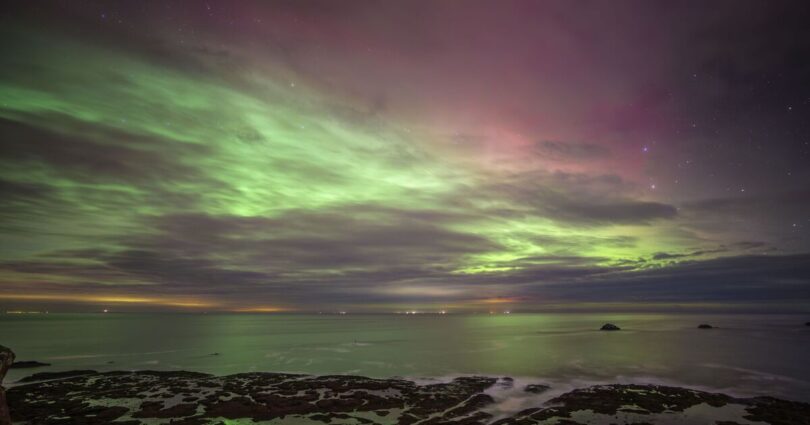
Brits will get the chance to see the Northern Lights in a rare occurrence this week. It comes as the Met Office forecasts a coronal mass ejection (CME) that left the sun on January 18, arriving on Monday night (January 19) or Tuesday morning (January 20).
As a result, the aurora belt, which typically occurs in Norway, Iceland, and Greenland, could be moved directly over the UK, allowing Brits to experience the spectacular light display.
According to the weather agency, those in Scotland, Northern Ireland and northern England are in with the best chance to see it. Those further south could also experience a sighting; however, the visibility will depend on the timing of the arrival and cloud cover.
Krista Hammond, Met Office Space Weather Manager, explains: « There is still some uncertainty around the exact timing of the CME’s arrival, but it is expected overnight tonight or tomorrow morning. The CME is likely to result in geomagnetic storming, giving the potential to view the aurora. However, sightings are dependent on the CME arriving during hours of darkness and clear skies.
« The effects of the CME may linger into Tuesday night, with aurora sightings possible across Scotland, perhaps also Northern Ireland and northern England, where skies are clear. This is likely to wane further by Wednesday night, perhaps with some glimpses possible from the far north of Scotland. »
In order to get the best chance of viewing the display, tips provided by the agency include finding dark, clear skies, as light pollution and cloud cover can obscure the view, noting that north-facing coasts and rural spots make the best locations to view them, and that the lights are most active around the Equinoxes, though strong solar activity can bring surprises at other times of the year.
The Northern Lights are caused by solar activity. The Sun emits charged particles known as solar wind, which travel at around 1 million miles per hour. As these particles interact with Earth’s magnetic field, they are funnelled toward the magnetic poles.
Energetic particles then collide with gases in the upper atmosphere and release energy in the form of light. Oxygen produces green and, at higher altitudes, rare red auroras, while nitrogen creates blue and purple hues, resulting in the beautiful phenomenon that we get today.
Source link