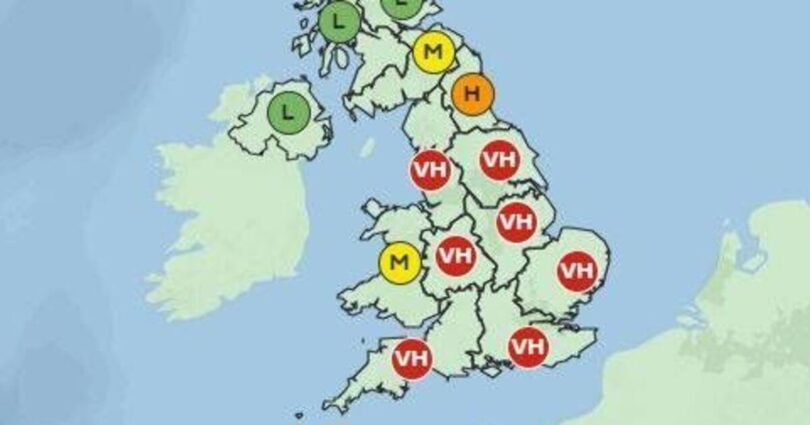
Seven areas across the UK have been struck by a Met Office red ‘very high’ pollen alert this week as hay fever season gets firmly into its stride.
This follows a spell of record-breaking temperatures for the time of year, with highs of 26.5C recorded in the south of England on Wednesday, April 8, with sunshine and temperatures in the 20s enjoyed across large swathes of the country.
The unseasonably warm weather has now come to an end, with temperatures dropping back to their seasonal average across most parts of the UK.
However, despite the mercury returning to more typical levels, pollen counts remain extremely high across the country, triggering severe hay fever symptoms for countless Britons.
Throughout the spring and summer months, the Met Office issues a pollen forecast to alert hay fever sufferers as to when they can expect their symptoms to peak. Alerts are issued across varying levels of severity, ranging from low (green), medium (yellow), high (amber), and very high (red).
Hay fever affects more than 10 million people in the UK and is triggered by an allergic reaction to pollen, which can bring on congestion, sneezing, itchy eyes and, in some cases, even headaches and hives. Pollen varieties are typically classified into three principal categories – tree, grass, weed – which provoke allergies at varying periods throughout the year. Tree pollen is the most probable offender at present, as it generally reaches its height in early spring – between March and May. This week, the Met Office has cautioned that hay fever sufferers with allergies to birch, ash, or plane pollen will experience the greatest impact.
The alerts are issued by the Met Office in different levels of severity – from yellow (medium), orange (high), or red (very high). Next week, nine UK regions have been placed under a very high warning.
On Thursday, 9 April, six UK regions have been given a red alert for pollen – ash and birch pollen – including Yorkshire and Humber, West Midlands, East Midlands, south west England, east of England and London and south west England.
The same regions face very high pollen on Friday, 10 April, alongside north west England which encompasses Greater Manchester.
Source link