President Donald Trump is used to bending financial markets to his will.
But with the war in Iran, he may have reached the limit of his ability to do so.
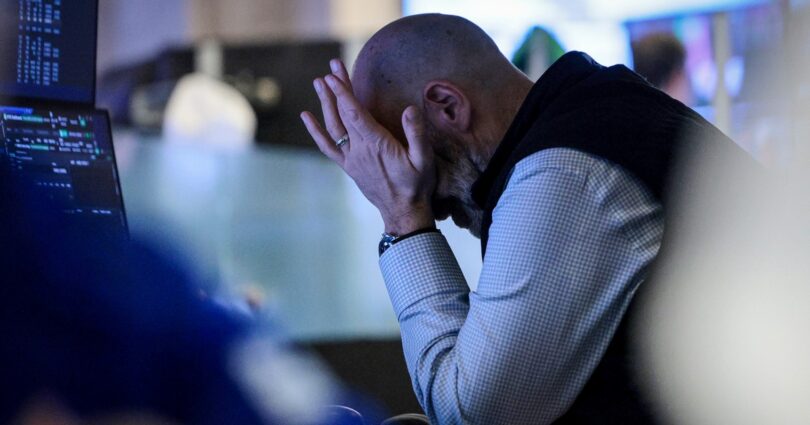
On Friday, the S&P 500 closed down 1.7% and notched its fifth-straight weekly decline, its worst stretch since 2022 and a sign of rapidly faltering confidence in a swift resolution to the Iran war.
Since the U.S. attacked Iran on Feb. 28, the S&P 500 has declined about 7%, while the Dow Jones Industrial Average fell 1.7% and has lost nearly 4,000 points. It is now down more than 10% from its most recent high, a correction in technical terms.
The tech-heavy Nasdaq fell further into correction territory Friday, closing down 2% and off 13% since a record close in October.
Oil prices also rose sharply, with U.S. crude topping $100 a barrel and global Brent crude at approximately $114 at around 4 p.m. ET. The yield on the 10-year Treasury note surged to 4.4%, the highest since last summer. Some energy stocks, like Exxon, traded near all-time highs.
Shortly after stock markets had closed Thursday, Trump announced he was pausing attacks on Iranian energy sites for 10 days. But stocks barely budged.
Just days earlier, they had rocketed higher Monday when the president announced there had been “productive” talks with Iranian representatives, so he would pause strikes on Iranian power facilities for five days.
“The market is looking beyond commentary from the administration,” said Adam Turnquist, chief strategist at LPL Financial investment group, which manages nearly $2 trillion in assets. “They actually want concrete details and a resolution. And actions speak louder than words, that’s really present in [current] price action.”
This new reality stands in contrast to Trump’s ability to move markets throughout his first term and into the outset of his second.
Trump spent the better part of 2025 whipsawing traders via frequent changes regarding tariff levels. Eventually, a pattern emerged: The president would announce a new import duty, markets would fall, and Trump would usually end up reversing himself in some way.
The trend even got a nickname, coined by a columnist for the Financial Times: “TACO” — for “Trump Always Chickens Out”. (Last month, the Supreme Court struck down many of the tariffs.)
This time, the chain of events unleashed by Trump’s decision to attack Iran are such that a return to pre-war conditions — and market levels — is virtually impossible in the short or even medium term, experts say.
The disruption to flows of oil and gas has been so substantial that transport costs, and ultimately the price paid per barrel, are likely to stay elevated indefinitely. Even when the Strait of Hormuz, which Iran has used as a chokepoint to drive concessions from the West, eventually reopens, the cost of transiting through it has likely gone up for the foreseeable future.
And the broader fallout on the economy and consumer purchases is already being felt.
That, in turn, has made interest rate cuts by the Federal Reserve less likely, because the higher oil costs are set to contribute to already-sticky inflation. The odds of a rate hike before the end of the year have now outpaced the odds of a cut.
“Let’s say hostilities end tomorrow — the market will rally, but it’s not necessarily ripping back to where it was before because of the disruptions that have occurred,” said Steve Sosnick, chief strategist at Interactive Brokers financial group. “You’re not going to see oil go back to where it was immediately. You’re not going to see markets price in rate cuts the way they were before.”
A White House representative did not respond to a request for comment Friday.
A day earlier, the president said that he was not concerned about the market’s recent performance.
Oil prices, he said during a Cabinet meeting, “have not gone up as much as I thought, Scott, to be honest with you. It’s all going to come back down to where it was and probably lower,” addressing Treasury Secretary Scott Bessent.
Markets have not fallen further because the outlook for earnings growth remains bullish, Turnquist said — though that could change the longer the conflict drags on and further impinges consumer spending and business investment.
And compared to prior oil shocks, the U.S. economy is less oil-intensive, as it has transitioned to one that is largely service-oriented. Global oil markets have also been supported by America’s oil production boom over the past decade — with more supplies online, overall prices are less likely to rise as much.
Yet by some metrics, stocks were already considered expensive prior to the hostilities. Having already contended with stretched valuations, traders may find it much harder to power stock prices back to the record levels seen just prior to the start of the latest conflict.
“The risk-reward is still very heavily weighted toward (the) risk” of further stock-price declines, said Matt Maley, chief market strategist at Miller Tabak financial group.
Should hostilities persist, Trump’s ability to influence markets will only further erode, Sosnick predicted.
“He now realizes he’d like to jawbone his way out of it, but it’s not that easy at this point because the situation encompasses so many moving parts and difficult variables,” Sosnick said. “it doesn’t lend itself to a quick set of comments mollifying investors.”
Source link