Rameses and the Pharaohs’ Gold: The Exhibition (Image: Tim Merry)
There is something about Ancient Egypt that refuses to let go, and millennia after the fall of that civilisation the stories they leave behind endure. When a touring exhibition of King Tutankhamun’s treasures travelled to 22 cities around the world it attracted 20 million visitors. Recently in Tokyo some half a million people came to see the artefacts of Ramses II.
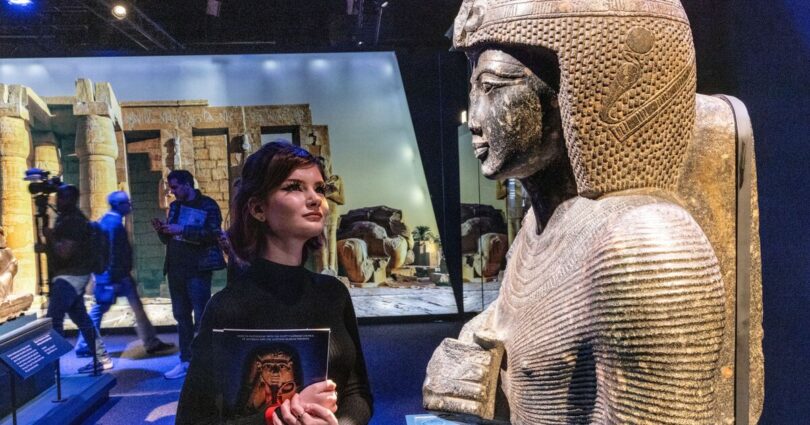
Now I’m joining the excitement as I visit the Ramses and the Pharaohs Gold: the Exhibition at London’s Battersea Power Station. Ahead of today’s (Saturday’s) opening, I’ve been given a sneak preview of the 180 priceless treasures on show by historian Dan Snow, the narrator of the exhibition’s official audio guide.
« There is something magical about that original civilisation on the Nile surrounded by desert and sea, protected, they believed, by the Gods, » marvels Snow, as we admire the ornately carved sarcophagi, dazzling jewellery, stone heads, sacred amulets and animal mummies.
« It is just this cradle of innovation and civilisation. Their inventions, their writing, their artistry. Look at these statues and you think you can actually see a personality. »
Snow believes Ramses II endures like almost no other ancient figure. « Few people in the history of the world have outlasted time, » he observes. “But Ramses II surely has. » The exhibition features many artefacts never before seen in the UK, having been loaned from Egypt’s Supreme Council of Antiquities. I’ve been obsessed with Ancient Egypt since I was a boy and enjoyed a visit to the country myself.
From the Pyramids to Thebes to Abu Simbel, little Aaron pretended to be an explorer each and every step of the way, armed with nothing but an overactive imagination and a sun hat several sizes too large. Nearly two decades later, the magic hasn’t faded, it’s simply evolved. The pull is different depending on which pharaoh draws you in.
Traditionally, Tutankhamun has enthralled Ancient Egypt lovers as the boy king of great wealth because his tomb is a time capsule of unimaginable riches. “Nothing on Earth compares to the goods you find in Tutankhamun’s tombs,” agrees Snow. “Over 3,000 years old.” Yet the historian also raves about the objects in the new exhibition.
“They are gold, they are silver, they are beautifully made, and the craftsmanship is extraordinary,” he says. Ramses II ruled for a record-breaking 67 years, eclipsing those who came after him in antiquity and even the Middle Ages. His own heir was 50 when he took the throne. That longevity gave him something most pharaohs could only dream of: time to build his legend. And build it he did.
Snow describes him as a « master of creating his own image ». Inside the exhibition we see the head of Ramses II. We see his cartouche, an Egyptian form of signature, inscribed on everything – even Egypt itself, for Ramses was a great glory hound, even going so far as to slap his mark on objects fashioned long before his time.
He styled himself as a mighty warrior, claiming to have led 100,000 men early in his reign to defend Egypt from enemies which besieged it from all sides.
« Ramses is called the great because he wanted to be remembered as the great, » Snow explains. « He got lucky – if you want to be great you need to rule for a long time. Also, he built a lot of buildings in that time and he made sure he carved his name onto all the other buildings in Egypt, so people thought he must have been great. He is a winner who wrote the history books. »
1 of 4
-

Picture Reach PLC – Express – Rameses and the Pharaohs’ Gold the Exhibition at Neon, Battersea Powe (Image: Tim Merry)
-

Picture Reach PLC – Express – Rameses and the Pharaohs’ Gold the Exhibition at Neon, Battersea Powe (Image: Tim Merry)
-

Picture Reach PLC – Express – Rameses and the Pharaohs’ Gold the Exhibition at Neon, Battersea Powe (Image: Tim Merry)
-

Picture Reach PLC – Express – Rameses and the Pharaohs’ Gold the Exhibition at Neon, Battersea Powe (Image: Tim Merry)
Such is his influence that his collapsed statue at his Thebes Temple inspired Shelley’s Ozymandias. One of his most famous temples, Abu Simbel, is seen as a monument to the love he held for his wife, Nefertari, who bore him seven sons, all of whom died before him.
A whole section of this exhibition is taken up by the Battle of Kadesh, today seen as one of the most monumental battles of ancient times. Ramses, declaring himself victorious, is recorded to have said: « Behold! I am victorious, me alone. »
The records taken by his Hittite opponents, however, beg to differ. They suggest the bloodshed ended in a draw. Ramses, it seems, was not overly concerned with such minor details as the other side’s version of events. But to the victor, the spoils, and apparently the history books. Over time Ramses erected countless monuments to his victory, claiming the Hittites swarmed the hills like locusts, there’s even a suggestion he fought lions. He commissioned festivals to his own glory, and even when he died, ascended into legend further.
Dr Mohamed Ismail Khaled, Secretary-General of the Supreme Council of Antiquities, describes Ramses’s simple coffin as « a masterpiece ». « When you look at it you cannot look away, » he adds.
It is carved from cedarwood, and the craftsmanship is simply exquisite. Depicted is the funeral mask of the pharaoh alongside hieroglyphs telling his story of the journey from tomb to this cask. It is almost impossible to comprehend that this object is thousands of years old. It looks like it was made yesterday.
Sherif Fathy, the Egyptian Minister of Tourism and Antiquities, who attended the opening, urges us to « try and imagine you are sitting next to the creator of one of these artefacts. Imagine what they think, what they dream about, to create this innovation ».
It is not difficult. When you stand before these objects, you cannot help but feel the pull of that imagination. These were not anonymous craftsmen working on forgettable trinkets, they were artists creating for eternity – and they succeeded. « As someone who makes TV shows about history I find it very easy working in Egypt, » Snow tells me. « You can go into royal tombs like Seti’s, Tutankhamun’s, or Ramses. You do not have to ask the audience to imagine it because it’s right there. »
The revenues generated from the exhibition as it tours the world will go to maintaining relics back in Egypt, ensuring future generations can experience the magic. From Seti I, through to the boy king Tutankhamun, and the self-promoter, warrior and builder Ramses II, Egypt pulls us in. The reasons vary. For some it is the wealth, for others the mystery. For me, standing before the colossus of Ramses at the end of this exhibition, it is the stories.
-
Ramses and the Pharaohs’ Gold opens today and runs until May. Tickets start at £24.90 for adults, with discounts for children and seniors. For more information, visit ramsestheexhibition.co.uk
The greatest phraoah of them all, by Dan Snow

Ramses was a ‘pioneer’ (Image: Tim Merry)
The “Great Ancestor”, “Ozymandias”, “Keeper of Harmony”, and “Balance, Strong in Right, Elect of Ra” – Ramses II was undoubtedly Egypt’s greatest pharaoh.
He ruled for nearly 70 years and fought over a dozen military campaigns from what is now Sudan to Syria. He presided over some of the most ambitious building projects in ancient Egyptian history.
Just his name, Ramses II, or ‘Ramses the Great’ has come to embody the sheer force of a life lived to its absolute zenith.
Ramses II was a pioneer of his own branding.
Long before spin doctors he was a master of PR. Though almost certainly a formidable warrior, he was an even better myth maker. He never let an inconclusive battle get in the way of proclaiming a crushing victory. He projected an image of the all-powerful warrior king, and for centuries people were happy to go along with his hype. He seems to have been wise enough to declare victories while pivoting to cooperation.
During his extraordinary 66-year reign, he brokered the world’s first recorded peace treaty, understanding that the best outcomes spring from deal making rather than just conquest.
The opulent jewellery and royal masks in this collection are his blueprints of leadership – a king who used art, architecture, and diplomacy to achieve a secular immortality.
Ramses and the Pharaohs’ Gold is more than a display of objects; it is a monumental encounter with a titan of history. This exhibition is a must-see for 2026.
Source link