
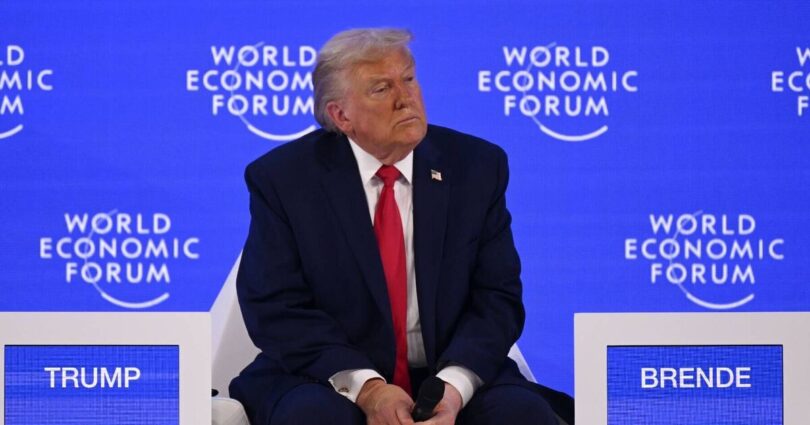
A psychotherapist and behavioural expert has offered her analysis of President Donald Trump‘s recent address at the World Economic Forum, spotting his contrasting show of authority on what should have been a cooperative international platform.
The Commander-in-Chief spoke to global leaders and financial heavyweights in Davos, Switzerland, yesterday, covering everything from his ambitions to acquire Greenland for the United States to his views on America’s ties with China and NATO.
However, according to Shelly Dar, a qualified mental health therapist boasting over 15 years’ expertise, it was Trump’s body language and delivery method that proved most revealing.
« What stands out from Trump is how rigidly controlled his presentation is, » Dar observed. « For the first 95 minutes we only see him from the elbows up. Both hands are anchored to the podium, his posture is rigid, and when you can’t see two-thirds of the body that limits our information, » she elaborated.
« A lot of behavioural information is removed because lower body movement often signals anxiety, agitation, tapping, foot movement or self-regulation », reports the Mirror US.
According to Dar, this concealment is entirely deliberate. « By staying behind the podium, those signals are all effectively concealed, » she noted.
« Psychologically this creates containment, it limits emotional leakage and it reinforces authority. What the audience is seeing is someone who looks immovable rather than someone who is expressive. »
Yet the most illuminating observations emerged considerably later, when Trump eventually moved away from the lectern and his entire physique became apparent.
« Only then do we see his whole body and the dynamic changes, » Dar said.
« He visibly exhales, his pace loosens and his pitch varies. He defaults to his usual behaviours – boastfulness, anecdotes, scaling things up. That tells us something important. His confidence isn’t dependent on structure.
« He appears more confident when improvising than when delivering prepared remarks, » she said. « I think it’s well known that he doesn’t like reading off an autocue. »
From a psychological perspective, this indicates a profoundly ingrained sense of authority: « Overall his communication strategy prioritises dominance over dialogue. He provides certainty over nuance, and his narrative control is built on assertion rather than persuasion. »
Such a method, Dar contends, presents a stark contrast to the setting in which it unfolded. She said: « Davos is built on multilateralism, shared norms and collaborative language. So this contrast is deliberate.
« What stands out about Trump is the type of confidence that he shows. Behaviourally, he assumes authority that is already his. He doesn’t adapt to the room, but he expects the room to adapt to him. »
Dar explained this assumption of authority is central to Trump’s psychological profile and is visible throughout his appearance. « This is a dominant personality style, » she said.
« It’s not a collaborative one.
« For some people, this can be a strength. It reads as certainty, stability, decisiveness. For other people, it feels rigid. It can come across as inflexible or unyielding.
« He isn’t shifting himself to match the energy of the room. He’s not there to belong in the room, » Dar said. « He’s there to set the tone of the room. »
Source link