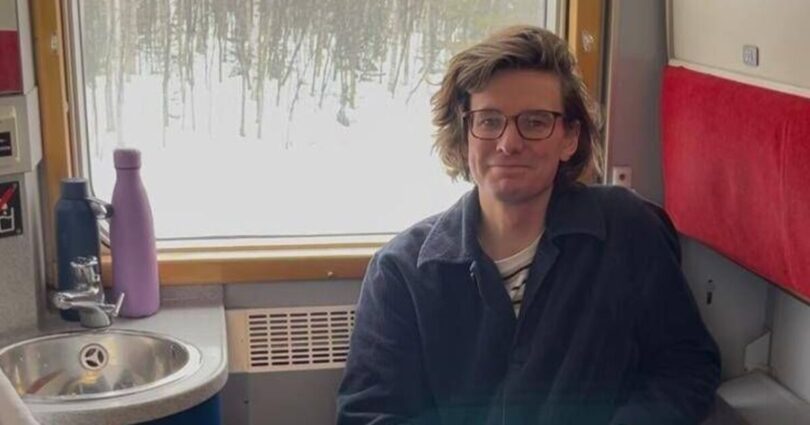
The train trundles all the way up into the Arctic circle (Image: Milo Boyd)
From my bunk, I observed my wife manoeuvre herself from her bed onto the cabin floor before turning on the spot to face the toilet door. The track lights of somewhere in the Midlands filtered and crept around the edge of the blind, providing sufficient illumination for her to locate the handle and enter.
Unknown to either of us, in stacking our bags inside the cubicle, we’d primed the above-toilet shower to drench my wife and our possessions with an unwanted blast of water the moment she squeezed in. My half-waking dreams were interrupted by her waterlogged wails as the reality of the Caledonian Sleeper quickly shattered my night train illusions. I recall this experience not to suggest the Sleeper, which links London with the great cities and Highlands of Scotland, is a poor service.
Read more: Abandoned theme park to open again after £86million project
Read more: UK travellers warned ‘unspecified’ items could be banned from hand luggage

Milo boarded the SJ night train at Stockholm Central Station (Image: Milo Boyd)
In fact, you’d be hard pressed to find a greater pleasure than gazing out the window after a night’s sleep on the northbound route to see snowcapped mountains and glistening lochs. Not just that, but it compares very favourably cost-wise to a flight and hotel, whilst being much less environmentally harmful.
But it is to say that returning to my pillow damp, in a bed far too close to a standard issue National Rail toilet (which the private cabins really don’t require) isn’t the sophisticated, James Bond adjacent experience I’d been anticipating. Nor was raising the blind to a crowd of commuters on a Euston platform at 6am, staring back at my pyjamaed self. So, two years later, it was with a comparable sense of apprehension that my wife and I boarded the SJ night train at Stockholm Central Station to embark on one of Europe’s longest railway journeys.
The Narvik Stockholm night train, officially designated as Nattåg 94, links the Swedish capital with Narvik in Norway, spanning more than 1,500 kilometres each way. Leaving from Stockholm Central Station in the evening, it takes approximately 18 hours to complete the journey.
Rather than heading up the west along the coast of the Gulf of Bothnia, the train travels straight up from Stockholm, rolling through some of Sweden’s 28 million hectares of forests, as well as flatlands and marshes.

An iron mine in Sweden owned by company LKAB (Image: AFP via Getty Images)
The final destination on the line may be recognisable to war history enthusiasts. During WW2, the British Navy entered the Norwegian fjords through the ice-free, Gulf Stream-warmed port of Narvik in pursuit of Nazi vessels. They launched a dramatic and comprehensive assault that would be Hitler’s first major strategic defeat of the war.
The reason the Allied and Axis powers committed resources to this remote patch of Lapland is iron ore. The northernmost Swedish city of Kiruna is home to the world’s largest underground iron ore mine, which now delivers 90% of all of Europe’s supply. Securing the ore and the railway line that has been transporting it to Narvik since 1902 was vital for powering both sides’ war machines. In March, 124 years after the route first launched, I boarded the sleeper train to Kiruna — two hours short of the final destination, yet firmly within the Arctic Circle.
It was, in a word, magnificent.
Upon stepping into my second-class private cabin, I feared it might prove somewhat tight for my wife and me. Yet, unlike the Caledonian Sleeper, which features two fixed beds, the SJ’s three bunks can be folded back against the wall. When you’re not sleeping, the middle bunk folds away entirely, revealing a concealed backrest beneath and transforming the bottom bunk into a comfortable sofa.
My wife and I settled into this arrangement for much of the journey, buried in our books whilst watching the Swedish countryside drift past, including the amusingly named town of Bastuträsk (sauna swamp).
I would not be so bold as to claim that the Swedish landscape rivals the Highlands. Its lakes may be broader and its mountains considerably taller, yet few places stir the soul quite like Rannoch Moor or dazzle quite as brilliantly as the summit of Mam Ratagan Pass.

Milo’s journey eneded in Kiruna (Image: Milo Boyd)
That said, Sweden is no disappointment in the scenic department, and it is surprisingly diverse. Travelling through two-thirds of the country, you’ll witness shimmering blue lakes give way to vast frozen plains; the four mighty, free-flowing national rivers Torne, Kalix, Pite, and Vindel; more ancient woodland than almost anywhere else in Europe; and ultimately the magnificent Kölen mountain range.
The train is certainly not new, but it possesses a sturdy, retro character that stands in stark contrast to some of the rather flimsy contemporary trains I’ve travelled on. There was something unusually calming about the reassuring thud of the door and the Scandinavian-design approved coat hooks. The inclusion of a Bakelite radio alarm clock positioned above each bed was the icing on the 70s-themed experience.
Unlike on the Sleeper, where we’d piled our luggage in the bathroom owing to limited cabin space, two storage compartments positioned just beneath the ceiling maintained the corridor clear and the room feeling notably spacious.
A comparable design distinction emerged with the lavatory. The Caledonian Sleeper’s en-suite facility sounds indulgent, but in practice, it’s an unwelcome, even disagreeable feature. The shower compartment functions as a toilet, with a substantial, industrial lid concealing the loo and acting as a seat beneath the flow. There was something rather disconcerting about sleeping in such proximity to a mechanical, apparently suction-operated WC, and unpleasant about moisture and shower spray drifting into the sleeping quarters.
On the SJ, the notion of an ensuite is discarded. Instead, the compartments feature a mechanical shower keycard, which grants access to the shower facility at the end carriage. They boast a changing space, a pile of thick, fresh towels, excellent water pressure, and even a hairdryer.
Following a remarkably sound night’s rest and a freshen up in the finest on-the-move bathroom I’ve ever encountered, I was feeling revitalised and prepared to visit the buffet carriage. The carriage is split into four seating sections surrounding solid tables, with windows running along the length of the carriage. This, combined with the ‘påtår’ unlimited tea or coffee arrangement in operation, meant there was little else to do but settle back, unwind and observe the Arctic pass by.
Book it
The starting price of the SJ night train from Stockholm to Kiruna is 1,125 SEK (£90) for a couchette and 1,695 SEK (£136) for a 2nd class sleep carriage.
Source link