
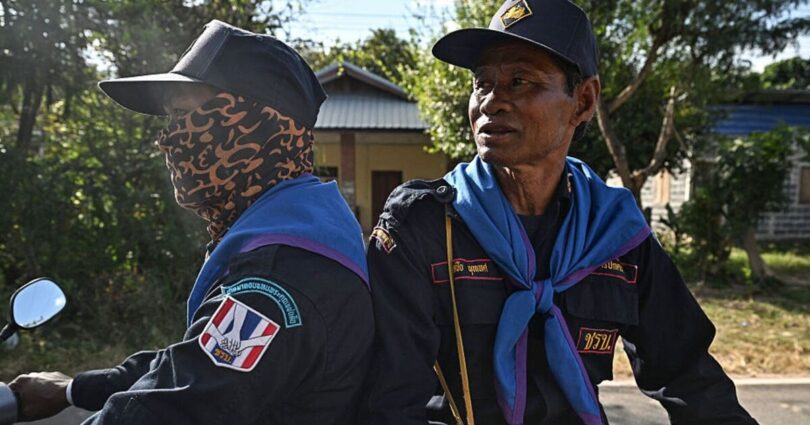
The border dispute between Thailand and Cambodia has once again reignited hostilities. Tensions are sadly rising which manifests itself in great swathes of humanity displaced, only interested in escape and survival. With the engagement of reputable and knowledgeable sources, I hope to shed some light on this unique issue. The sound of incoming artillery and mortar fire is a terrifying experience as those who have endured it will very quickly tell you.
But what has provoked this exchange of lethal ordinance between Thailand and Cambodia? Unfortunately, there is no simple answer to this question. In fact, it is impossible to comprehend the current hostilities unless the basic historical background is understood. The relationship between Thailand and Cambodia has often been confrontational.
The friction is highly emotional and partly driven by an acute sense of nationalist-inspired patriotism, but also largely by cultural issues dating back several centuries.
For reference purposes it should be noted that Siam and Khmer refer to Thailand and Cambodia respectively as they were historically known at one time.
The catalyst, however, is to be found in more recent events that took place in the early twentieth century. As a result of the colonial-era spat between France and Siam in 1893, Siam was forced to cede extensive previously conquered territory to French Indochina.
Further cessions of territory culminated in the Franco-Siamese treaty of 1904, and the treaty of 1907. Which included the ancient Khmer capital of Angkor.
These treaties established the boundary between Siam and French Indochina, the latter of whose borders with Thailand were inherited by Cambodia and Laos when they gained independence in 1954.
The maps used in formal proceedings that ultimately recognised the demarcated border were never challenged by Thailand. Nonetheless, the simmering border dispute really ignited at the time Cambodia decided to register the Preah Vihear temple complex as a UNESCO world heritage site.
The Franco-Siamese treaties of 1903 and 1907 defined the relevant segment of the boundary should be defined by the natural watershed line of the Dangrek Mountains.
The logic in this approach is clear and would have placed the temple and most of the temple complex clearly within Thai territory. French surveyors subsequently produced maps that deviated from this line in the now-disputed areas, including around the Preah Vihear temple, which contradict the original demarcation.
Thailand argued at the ICJ that it never approved the maps, reasonably assuming that the basis of demarcation as stated in the treaties finally settled the issue of sovereignty.
Besides, the temple’s location on a cliff, more accessible from the Thai side would, in the absence of anything else indicate that it was on Thai territory.
The ICJ opted to accept a legal technicality and decided in favour of Cambodia, largely based on the fact that Siam never officially protested the map or claimed ownership of the temple on the basis of the legal principle « Qui tacet consentire videtur si loqui debuisset ac potuisset » , which translated means “He who is silent seems to consent if he ought and could have spoken”.
In other words it was deemed by the court that Thai silence on the adoption of the surveyors maps was tacit acceptance of their accuracy.
My sources concur in the assessment that this all would seem to boil down to a mish-mash of colonial era gunboat diplomacy by the French in pursuit of their colonial ambitions juxtaposed with the realities of regional conquests as one empire falls and another rises. History is littered with numerous examples of this phenomenon.
The Imperial legacies of both Thailand and Cambodia, or Siam and Khmer, along with the unique cultural heritage that both have should have determined the matter.
Colonial power bullies driven by self-interest ride roughshod over civilizations that in some cases existed long before those colonials emerged from the dark ages of medieval existence.
The current reality is that Cambodia has been caught red-handed laying land mines in Thai territory resulting in death and serious injury to numerous Thai people, civilian and military alike.
Despite the intervention of both President Donald Trump and Malaysian Prime Minister Anwar Ibrahim, Cambodian provocation remains a serious stumbling block to lasting peace.
Cambodia of course hotly disputes these facts and instead portrays itself as the victim when in reality nothing could be further from the truth.
With an evil autocratic dictator still calling the shots in Cambodia, a remnant of the appalling Khmer Rouge, it is unlikely that this conflict will be settled anytime soon.
The strongman in Phnom Penh is playing the victim when in fact he is the aggressor, who seems to cravenly enrich himself at will at the expense of his people.
Regardless of what the facts are, or the endless yoke of repression in Cambodia the problem must be resolved within a context that those who live in the region understand.
Visiting this part of the world is a truly wonderful, often magical experience, but the good people who live here and whose ancestry is rooted here see the world very differently from the way we do.
Let us rather understand them first before we try and meddle in something about which we are glaringly ignorant. My information is that Thailand seeks peaceful solutions.
History has perhaps been unkind to Thailand insofar as the bombastic opportunistic strong arm tactics employed by the French over their Indo China ambitions at the end of the nineteenth and the beginning of the twentieth centuries.
Thailand has always sought pragmatism in their international relations which is very well demonstrated by their willingness to cede vast swathes of territory in the past.
But for a simple failure to recognize a natural border coupled with faulty maps and the interpretation thereof there might have been a far more peaceful co-existence.
My sources also tell me the stakes become elevated on a geopolitical level manifested on maritime sovereignty issues which also directly relates to this issue too.
Access to and benefit from natural resources can be a powerful motivating factor too, hence the interest of the big global powers in this seemingly petty spat. As with many things in this world it isn’t perhaps quite that simple.
Source link