
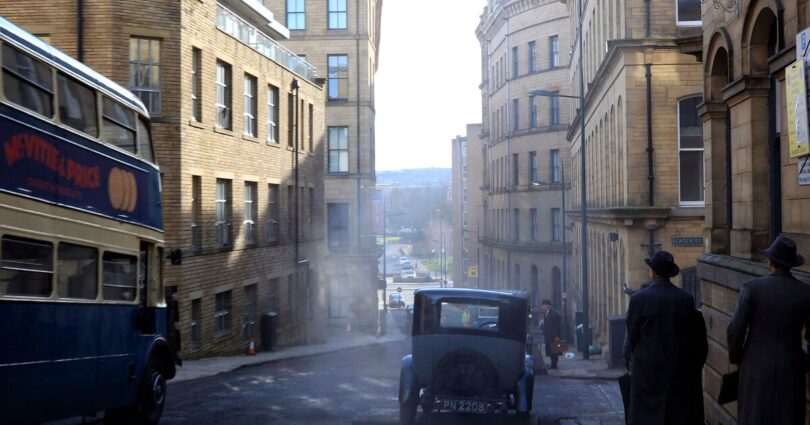
Nestled just off Bradford’s main shopping areas in the heart of the city centre lies a remarkable quarter that transports visitors to a bygone era.
Affectionately dubbed ‘Little Germany’ by locals, this captivating destination boasts 55 listed buildings, all crammed into a compact corner of the bustling Yorkshire city centre.
It stands as one of Britain’s most spectacular heritage destinations, packing an extraordinary wealth of history into a remarkably modest space.
Boasting one of the highest concentrations of listed buildings anywhere in the UK, every street offers a visual feast, with ornate designs and stunning architecture at every turn.
No specialist architectural knowledge is required to appreciate these magnificent stone structures; their artistry is clear to all, and can be further explored via the Little Germany heritage trail, which highlights notable treasures along the route.
READ MORE: Beautiful village used to film hit BAFTA TV series is an ‘unspoilt hidden gem’
READ MORE: Village with cosy pubs overlooked by mountain with ‘best views ever’
History
What began as a modest market town rapidly flourished into a thriving hub for the wool trade – and Germany deserves much of the credit.
With their homeland’s yarn market already prospering, several German entrepreneurs identified Bradford’s untapped potential and opted to relocate, expanding their commercial operations.
In doing so, they established an entire district between the city’s retail centres, constructing what are now regarded as some of Britain’s finest textile warehouses.
Built between 1855 and 1890, these imposing structures rose amongst narrow streets, and today are cherished as historically significant listed buildings. Thanks to their prosperous origins, these entrepreneurs didn’t rest on their laurels; they recognised opportunities throughout Bradford and channelled their capital into the city’s development.
Little Germany in Bradford, Yorkshire (Image: Huddersfield Examiner)
They became tremendously powerful figures, bankrolling initiatives including the building of St George’s Hall, Bradford’s Eye and Ear Hospital and even the Bradford Chamber of Commerce.
These strategic choices truly established Bradford’s prominence and enabled it to gain recognition as a vital component of the wool industry. Indeed, by the mid-19th century, the city of Bradford had produced approximately two-thirds of Britain’s entire wool output.
A recent visitor described the district as « unusual », writing on TripAdvisor: « Quite unexpected – a large block of mock gothic stone warehouses, perched on a steep slope above the town.
« Highly interesting architecture, from a day when trade and money meant investing in buildings. Look for stone chair, Delius plaque, and the Munchen house café. »

There are 55 listed buildings all in one concentrated area of Little Germany (Image: Huddersfield Examiner)
TV and Film
Wandering through Little Germany genuinely feels like travelling back to the 18th and 19th centuries; which explains why the district has featured in numerous television and cinema productions set during that period.
Most famously, the warehouse on Cater Street actually serves as the location for Tommy Shelby’s headquarters in BBC’s Peaky Blinders.
More recently the area’s immaculately preserved Victorian architecture has attracted a film crew for Greta Gerwig’s The Chronicles of Narnia, scheduled for release this year.
While the production crew has maintained strict secrecy surrounding the project, observers have spotted period vehicles and horses stationed in the vicinity, alongside various other filming equipment.
Source link