
In August 2020, a 13-year-old girl failed to return from a toilet break in the sugarcane fields. Her family went searching for her, only to find her body mutilated.
Her dad said they found her with her eyes gouged out and her tongue cut off – something the police denied. « There were scratches near the eyes, likely due to the sharp sugarcane leaves where the body was found, » a spokesman said. That is one of the tens of thousands of annual rape cases in India. Despite reforms to the criminal justice system after the abhorrent gang rape and murder of a 23-year-old physiotherapy student in 2012, campaigners say things have not changed.
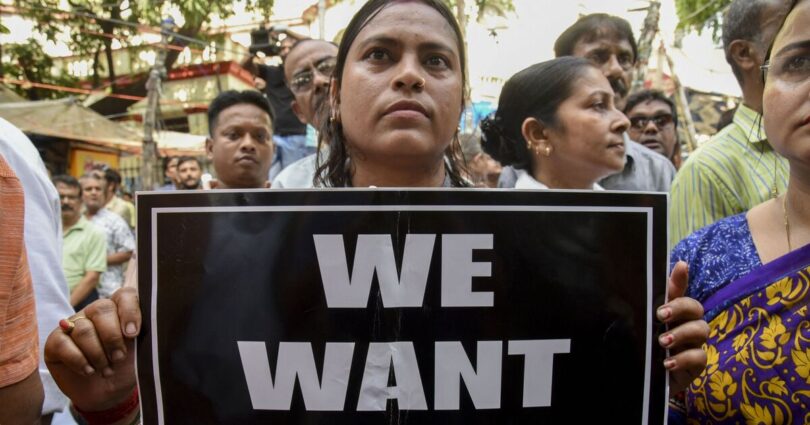
A protester told Indian newspaper The Telegraph that « the atrocities against women do not stop », despite high-profile rape cases spurring demonstrations.
India announced new laws in March 2013 following the horrific gang rape of the student who was dubbed Nirbhaya – the fearless one.
She died from her injuries days after being raped by six men on a bus. She was brutally assaulted with an iron rod. Her friend was beaten. They were thrown off the bus naked and covered in blood, left to die. Four men were hanged for the attack.
Government prescribed harsher punishments for rapists, including a minimum sentence of 10 years with a possible extension to life, and the death penalty if the victim is younger than 12. They expanded the definition of rape to state that the absence of physical struggle didn’t equal consent.
But under the new laws, statistics have remained high. Around the time of the 2012 attack, police were recording up to 25,000 rape cases a year across India, according to data from the National Crime Records Bureau (NCRB).
Attacks peaked at nearly 39,000 in 2016. In 2021, there were 31,677 reported cases of rape. That is 86 rapes every day. It is important to take into account that many rapes go unreported.
But statistics are only part of the story – campaigners say thousands of rapes and cases of sexual assault are not reported to the police.
There is no discrimination for age. Recently, a five-year-old was gang-raped in Meerut. A 26-year-old was gang-raped in Faridabad. A 42-year-old was gang-raped in Delhi’s suburbs. A 12-year-old girl was kidnapped and gang-raped in Bikaner.
« The cases are gruesome — intestines pulled out, rods inserted, tongues cut out, acid thrown, decapitation, strangulation, and burning, » writes Al Jazeera. It claimed that India had become the « gang rape capital of the world ».
In May last year, a 45-year-old woman who had attended a wedding died after she was allegedly brutally gang raped by two neighbours in the Madhya Pradesh province.
Police said that the accused were so brutal that parts of the woman’s small intestine had come out of her body, and she was bleeding excessively.
Campaigners say that low conviction rates contributed to the violence. Senior criminal lawyer Rebecca M John, who has represented many rape victims, said some rapists still believe they can get away with their crime.
« One of the factors would be the absence of fear of the law, » she told Reuters. Between 2018-2022, just 27%-28% of cases were convicted, according to NCRB data.
Police have invested heavily into new laws to clamp down on violence against women. In Mumbai, the Nirbhaya Squad conducts daily patrolling across the city, dispatched from police stations. They are assigned to patrol sensitive areas three times a day.
It is important to note that in the UK, statistics of reported rape were far higher than in India, despite having a tiny population in comparison. In 2024 in the UK, 71,227 rapes were recorded by police.
The conviction rate was higher, with 60.2% of cases linked to rape convicted in 2023-24 and 63.5% the year before, according to Crown Prosecution Service data.
The United Nations Office on Drugs and Crime said it does not recommend comparing countries on rape statistics for several reasons, including differing legal definitions of rape and cultural factors influencing whether people report an offence.
Source link