Australia and the world is still reeling from a terror attack at Bondi beach at the weekend, which left 15 people dead, including a 10-year-old girl. Sajid Akram, 50, and Naveed, 24, allegedly targeted Jews celebrating Hanukkah in an act believed to be motivated by an allegiance to Islamic State (IS). Akram was shot by police and died, and Naveed was hospitalised. Two IS flags, thought to have been homemade, were found in a car that belonged to the pair.
A video showed Ahmed al Ahmed, a fruit shop owner and father-of-two disarming one of the gunmen, sneaking up on him and taking his firearm before turning it on him. Two rabbis and a Holocaust survivor were also killed during the attack. A further 42 people were taken to hospital. Police say two officers were shot and injured. One of them, Constable Scott Dyson, is believed to have been attached to Eastern Suburbs Police Area Command for 18 months.
Reports have suggested that the two alleged gunmen travelled to the Phillipines for militant training.
Here is what we know about IS in the country.
Muslim insurgents have attempted to found independent state
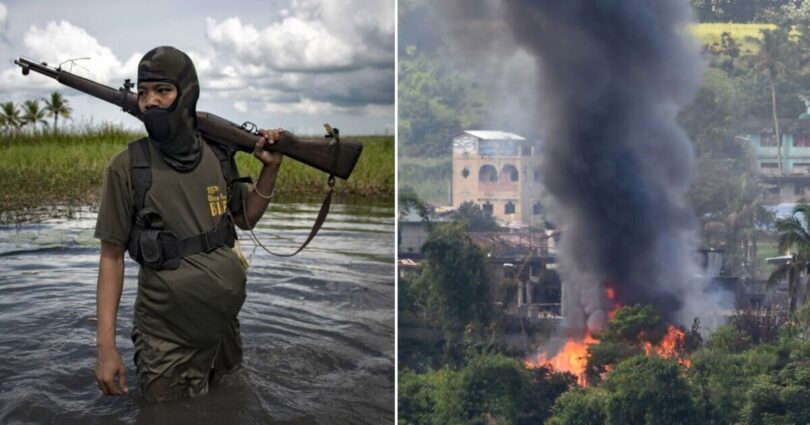
Insurgents in the Phillipines attempted to found an independent state in 2017.
Militants tried to occupy Davao – the largest city on the southern island of Mindanao, The New York Times reports.
They held siege for five months, before the Filipino government killed the group’s key leaders and forced it to surrender.
There have been multiple insurgent groups
There have been multiple militant groups in the Phillipines.
These include:
- Abu Sayyaf Group (ASG) – a violent group that has explicitly stated its goal of establishing an independent Islamic state in the southern Philippines
- Moro Islamic Liberation Front (MILF) – was the largest Muslim separatist group and initially sought an independent state, although not in the name of IS, but later engaged in peace talks with the Filipino government and fought against IS loyalists
- Bangsamoro Islamic Freedom Fighters (BIFF) – a splinter group of the MILF that opposed the peace process and fights for an independent Islamic state
- Maute Group – along with the ASG faction, the Maute Group was responsible for the five-month-long Siege of Marawi City in 2017
Threat still present after victory declared
The Filipino government declared victory over IS eight years ago, but fatal attacks are still being carried out.
The Foreign Office says terrorists are « very likely to try to carry out attacks in the Philippines ».
Officials add: « Terrorist attacks occur frequently in Mindanao and the Sulu Archipelago.
« While attacks primarily target Filipino security forces, certain groups operating in these regions have pledged allegiance to Daesh and have targeted religious groups.
« Terrorist groups may also consider westerners as legitimate targets for an attack. »
Hundreds of IS fighters remain in Phillipines
There are believed to be hundreds of IS fighters in the Phillipines.
Even though groups have splintered, they are still undertood to have an overarching allegience to IS.
They continue to recruit, utilising local poverty and historical political grievances.
Peaceful reintegration offered
The Filipino government has in recent years attempted to offer some IS fighters opportunities to be reintegrated into society peacefully.
Many individuals have surrendered because of the so far failed attempt to establish an Islamic state.
Officials established that Bangsamoro Autonomous Region in Mindanao to give residents a sense of a stake in the country’s political affairs and combat IS groups’ recruitment.
Source link