
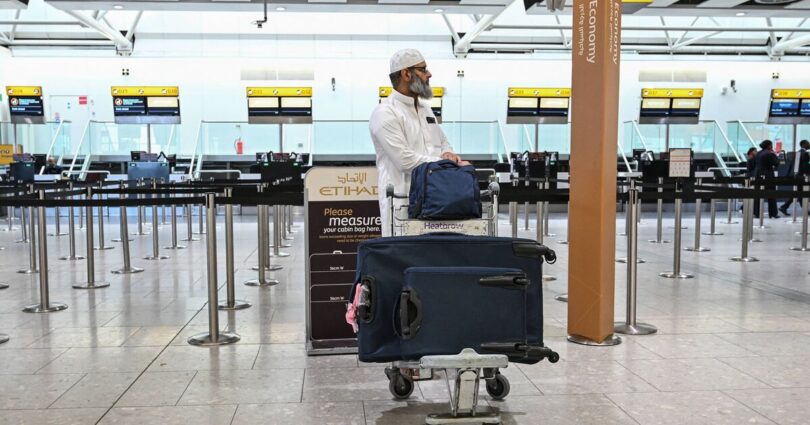
A handful of flights are headed from Dubai to the UK (Image: JUSTIN TALLIS, AFP via Getty Images)
A handful of flights from the Middle East to the UK are set to depart today as the scramble to leave the war-torn region continues.
The small number of flights will transport British nationals stranded in the Middle East back to the UK on Tuesday, although most departures from the region continue to be cancelled.
The fallout from US and Israeli strikes on Iran over the weekend, followed by retaliation from the Middle Eastern nation, has resulted in large swathes of airspace across the region being closed. According to aviation analytics firm Cirium, out of 5,340 flights scheduled to land in the Middle East yesterday, 1,775 were cancelled; however, a large number of those operating were to Turkey.
Oman appears to be a preferred choice for those seeking to leave the country, with 76% of scheduled services operating yesterday. Private jet company EnterJet reported a 40% surge in bookings since Saturday, citing Muscat in Oman as « the only really viable option ». One private jet company charged £20,000 per seat for a service departing Oman for Milan on Monday, according to the FT.
Today, Emirates intends to run two flights from Dubai International Airport to Heathrow, and one each to Gatwick and Manchester. Some of these flights will be serviced by the airline’s A380 jets, which can accommodate up to 615 passengers depending on their configuration. FlightRadar shows that the Gatwick flight departed shortly before 8am GMT.

Most flights to and from the Middle East remain cancelled today (Image: JUSTIN TALLIS, AFP via Getty Images)
Emirates typically operates 146 weekly flights to the UK, equating to roughly 21 per day. Emirates had temporarily suspended all operations to and from Dubai, up until 3pm UAE time on Tuesday, 3 March. However, at 2pm GMT on Monday, it announced that it would « begin operating a limited number of flights commencing on the evening of 2 March. »
Etihad Airways has scheduled one UK flight on Tuesday, from Abu Dhabi to Heathrow. This will be operated by a Boeing 787-10 Dreamliner, which has a capacity of 336 passenger seats. The airline said that while « all Etihad Airways’ scheduled commercial flights to and from Abu Dhabi remain suspended until 2pm UAE time on Thursday 5 March », « some repositioning, cargo and repatriation flights may operate in coordination with UAE authorities and subject to strict operational and safety approvals. »
The to airline has urged passengers not travel to the airport unless they have been contacted directly by Etihad and advised to do so. Access to the airport will be restricted for those without confirmed travel documentation.
Qatar Airways – typically operating flights to Heathrow and Gatwick from Qatar – announced on Tuesday morning that its services remain halted due to the closure of Qatari airspace. FlightRadar reveals that the vast majority of flights scheduled to arrive in and depart from Dubai have been cancelled today.
British Airways has scrapped its planned flights to Heathrow from Abu Dhabi, Amman, Bahrain, Doha and Dubai on Tuesday. The airline informed passengers: « We are closely monitoring the situation and have cancelled a number of our flights to the Middle East. Safety is always our top priority and we would never operate a flight unless it was safe to do so. »
Wizz Air has taken steps to boost capacity from key European bases to Sharm El Sheikh from 6 March. Flights to and from Israel, Dubai, Abu Dhabi, Amman and Saudi Arabia remain suspended up to and including 7 March.
As a result, the airline is increasing frequencies from London Luton, Rome Fiumicino, Budapest, Milan Malpensa and Sofia, offering additional travel options for passengers affected by the suspension of direct services.
Passengers with bookings on certain routes up to March 15 are permitted to change their flights to depart on or before March 29.
Virgin Atlantic has cancelled a flight from Dubai to Heathrow.
The conflict between Iran and the US and its allies has led to extensive airspace closures in the Middle East, triggering significant disruption to flights. Approximately half a million passengers per day utilise airports in Dubai, Doha or Abu Dhabi, which serve as crucial hubs for travel.
Officials are reportedly devising strategies for the potential evacuation of over 100,000 Britons from the Middle East. On Monday, Foreign Secretary Yvette Cooper announced that 102,000 British nationals have registered their presence in the region.
She revealed that around 300,000 British citizens are living in Gulf countries that Iran has targeted. Brits are being urged to follow the guidance of local authorities and stay abreast of the Foreign Office’s travel advice, which officials expect will change rapidly.
Those residing in Bahrain, Israel, Kuwait, Palestine, Qatar and the United Arab Emirates (UAE) are being encouraged to register their presence with the Foreign Office online.
The Government has previously used the registration scheme to deliver urgent updates to individuals affected by international crises, but it hasn’t had to handle such a large number of people across so many different countries before.
Source link