
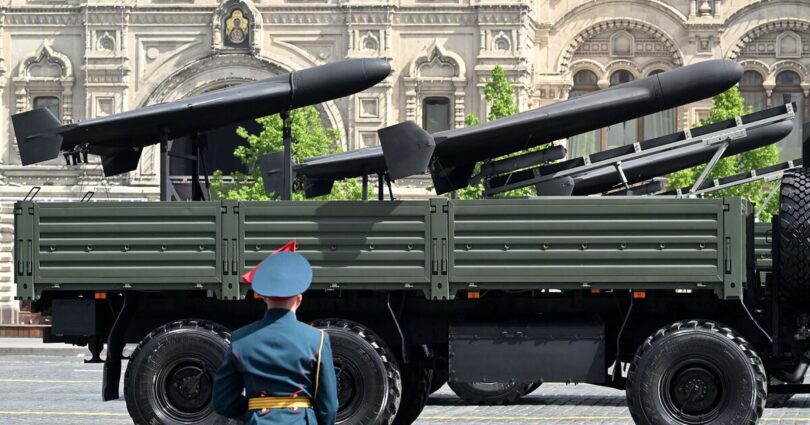
A Russian or Iranian strike on one target could cause a tsunami military experts have warned (Image: Getty)
A retired paratrooper has warned that one of the UK’s most famous, and dangerous shipwrecks, could be vulnerable to a Russian or Iranian drone attack.
The SS Richard Montgomery sits at the bottom of the River Thames just off the coast of Kent’s Sheerness.
The ill-fated vessel set sale for France in 1944 just after the Normandy landings, but was caught in a storm and sunk. On board were, and still are, 1,400 tonnes of explosives, making it one of the most treacherous places in British waters. The wreck also contains 1,000lb (453.59kg) bombs and 500lb (226.79kg) bomb clusters as well as some incendiary munitions.
Furthermore, because of its cargo, it has long been seen as one of Britain’s greatest defensive vulnerabilities with the potential to trigger a five-metre high tsunami in the direction of Essex, Kent, and the liquefied natural gas terminal on the Isle of Grain. Such a tsunami could cause flooding by overwhelming local flood defences.
READ MORE: Russia sends horror WW3 threat to strike 2 countries – ‘Destroy them’
READ MORE: Nuclear expert on two things to do quickly at home if there’s a nuclear strike

The wreck of the SS Richard Montgomery (stock) (Image: Getty)
Speaking to the Telegraph, retired paratrooper Major Andrew Fox, a veteran of three tours in Afghanistan, warned that technology had reached a point whereby drone attacks were now a concern. He said: “The wreck is at risk of drone sabotage because it is a fixed, conspicuous target.”
Meanwhile, professor of international history and security at Lancaster University Marco Wyss said that if Iran and Russia were to launch attack on the wreck, they would probably do so via proxies.
Professor Wyss said this was something that could be “equivalent to an act of war, depending on how it’s interpreted”. Government sources also told the Telegraph that a no-fly zone was put in place over the wreck itself over fears of hostile nations attacking it.
Whilst there are concerns about Britain’s defensive issues off-shore, one security expert has warned that Iran could theoretically hit the UK.

There is currently a no fly zone over the wreck (stock) (Image: Getty)
Speaking to the Express after Iran launched two intercontinental ballistic missiles (ICBMs) at the joint US-UK base Diego Garcia in the Indian Ocean, Emeritus Professor at the University of Buckinghamshire Anthony Glees issued a key warning.
Analysing the incident he said: “We’re told the US Navy intercepted one and the other fell into the sea. No great shakes, perhaps.”
“However, we believed that the maximum range of Iranian missiles was at most 2,000kms so, if Diego Garcia could be targeted, so in theory could the UK and many other European capitals.”
Professor Glees’ warning comes after Israel’s IDF claimed Iran had missiles that could threaten British cities like London. He added: “In effect, the UK right now is an open goal to any adversary. It is the fault of successive UK governments over the past ten years, it’s not Starmer’s fault.”

There are concerns over Britain’s vulnerability to Iranian missiles (Image: Getty)
Despite the fears about threats from Iran, the MOD (Ministry of Defence) and other politicians have said the UK is capable of defending itself. In a statement an MOD spokesperson said: “We have the resources we need to keep the United Kingdom safe from any kind of attacks, whether it’s on our soil or from abroad. The UK stands ready 24/7 to defend itself.
“The UK operates a layered approach to air and missile defence, provided by Royal Navy, British Army and Royal Air Force assets equipped with a range of advanced capabilities, working in tandem with our NATO allies.”
On the threat of Iran itself, last week Housing Secretary Steve Reed said: “We are perfectly capable of protecting this country and keeping this country safe, whether it’s here at home, or whether it’s our assets and nationals across the region.”
Responding to the IDF’s claims directly, he concluded: “There is no assessment to substantiate what’s being said.”
Source link