
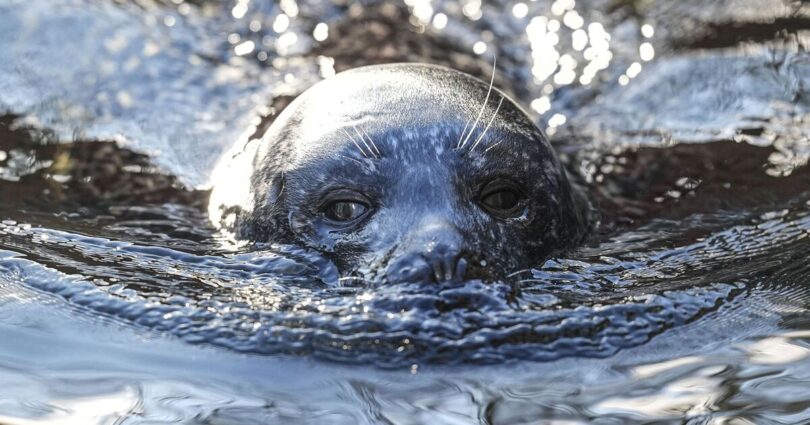
Marine investigators have concluded that a grey seal fatally attacked a common dolphin off the Pembrokeshire coast — the first time such a killing has been confirmed in Welsh waters.
The carcass reportedly came ashore at Newgale beach in late February. Forensic examination revealed a pattern of spiral lacerations around the dolphin’s middle, consistent with a seal biting through to the underlying fat layer and exposing the organs beneath.
Seals ranging across the stretch of sea between south Wales and the Devon and Cornwall coasts are the prime suspects.
The case fits a pattern that has been building along British coastlines. Earlier in January, witnesses observed a grey seal holding a common dolphin in its jaws in the Irish Sea off Dublin. The exprerss understands Devon waters also saw two comparable incidents before the year was out. Across the British Isles, researchers have now reportedly linked 20 named individuals to this type of attack — each identified through the unique scarring on their faces.
Behaviour spreading
Wolfhound Adventure Tours and the Irish and Whale Dolphin Group’s Dave O’Connor said he was dolphin-watching when he witnessed « vigorous splashing » in the water, reports the Daily Mail.
« I noticed then that something darker had grabbed onto it and realised then it was probably a grey seal attack, » he said.
The concern among scientists is that this hunting technique is not staying within those individuals, but spreading, reports GB News.
« I suspect it will be taught, » said Mat Westfield, co-ordinator at Marine Environmental Monitoring. « I think it will be a slow process, but we will see more and more of it. »
Those 20 animals almost certainly represent a fraction of the total. According to the report, Dr Izzy Langley of the University of St Andrews described the documented figure as a « major underestimate » — seals displaying the same behaviour have turned up across the North Sea as far as the German coastline.
Population boom
Britain’s grey seal population tells its own story. A century of hunting had pushed numbers down to roughly 500 by the early twentieth century. The population has since recovered to around 120,000.
Scientists trace the roots of dolphin predation to something closer to home: cannibalism.
Male seals compete fiercely for mates between September and January, going without food throughout. Studies suggest some began targeting pups as a source of sustenance — tearing into the fat beneath the skin and moving on without consuming the rest. Scottish researchers monitoring the behaviour over ten years are said to have recorded the rate of grey seal cannibalism doubling and then some between 2015 and 2016. The behaviour was first observed in Canadian waters in 1992, off the coast of Nova Scotia.
Coastal trap
Seals are no match for dolphins in open water — dolphins are significantly quicker. Yet dolphins show little sign of treating seals as a threat, leaving them poorly placed to react when an attack comes. That vulnerability has been amplified by a fundamental shift in where dolphins are found.
Sea Trust Wales records reported on by GB News show common dolphin sightings along the Welsh coast have multiplied eight times over in the past eight years. Overfishing has hollowed out stocks in deeper water, drawing the animals inshore. Once in close to the coast, with cliffs on one side and beaches on the other, they have little room to manoeuvre.
« It’s like entering a fast food restaurant » for the seals, said Dr Sophie Brasseur, a marine mammal expert at Wageningen University in the Netherlands told reporters.
The animals are not without danger to humans either. « Half the people I know who work with seals have got bits of fingers missing, » Cliff Benson, founder of Sea Trust Wales told The Telegraph. « If you do get bitten the bacteria on their teeth are so bad it usually means amputation rather than just sticking a bandage on. »
Dr Lonneke L IJsseldijk, a marine mammal researcher at Utrecht University, said the move from targeting smaller porpoises to larger dolphins demonstrated « the adaptive and explorative behaviour of grey seals. »
Source link