
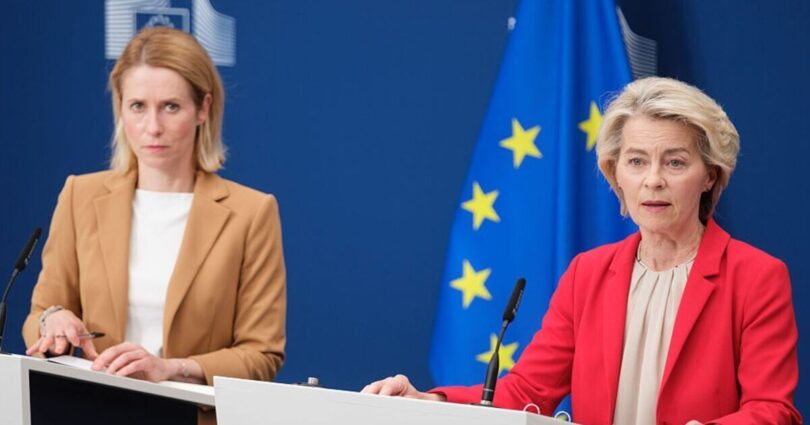
The EU’s top diplomat has warned it looks « increasingly difficult » to secure agreement among European leaders over a vital loan for Ukraine. Kyiv is fast running out of money and is desperately in need of an injection of cash to keep the country afloat and its army equipped with weapons.
Leaders from European states have been discussing a plan to give Kyiv a reparations loan financed by frozen Russian assets totalling €210billion. Most of that money (€185bn) is held in Belgium at Euroclear – a central securities depository in Brussels. The plan has met fierce resistance from Belgium’s prime minister Bart De Wever, who is demanding cast-iron guarantees of protection from Brussels from any Russian retaliation.
EU leaders will attend a crunch European Council summit on Thursday to discuss the reparations loan.
However, it looks increasingly unlikely that an agreement will be reached, potentially leaving Ukraine‘s fate hanging in the balance.
“This [reparations loan] is what we’re working on, » the EU’s Foreign Affairs Chief , Kaja Kallas said. « We are not there yet and it is increasingly difficult, but we’re doing the work and we still have some days. »
She added that the reparation loan was « the most credible option » for financing Ukraine through the next year.
However, in recent days Italy, Bulgaria and Malta have spoken out against the scheme, and join Hungary in opposing it.
And over the weekend, the Czech Republic’s newly-installed prime minister Andrej Babiš, also voiced opposition to the loan.
The EU is also facing a concerted US effort to torpedo the bail out using the Russian assets.
The Trump administration is actively pressuring several European countries to pull their support for the loan, senior EU sources told POLITICO.
Washington is reportedly keen to get its hands on the Russian money to use in US-led reconstruction projects in Ukraine.
Russia has also launched a court case against Euroclear, in which it is seeking damages of up to €196billion.
German Chancellor Friedrich Merz underscored the significance of the upcoming meeting in Brussels this week. He told reporters that the European Union would be “severely damaged for years” if it failed to agree on the loan.
Source link