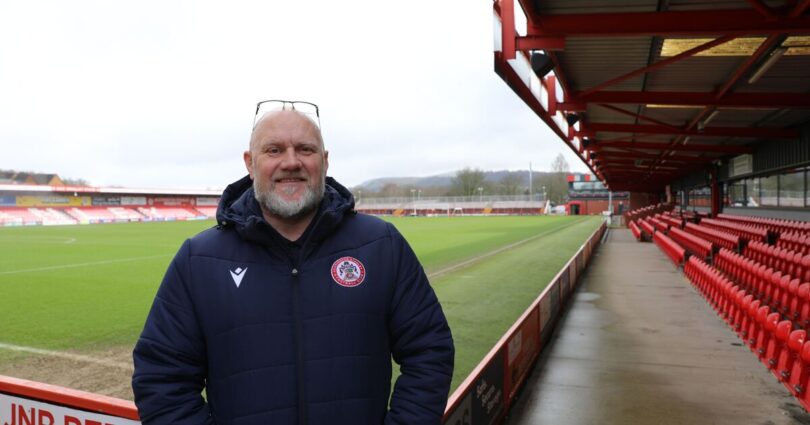
Wayne Eastham dropped what he was doing to show me around (Image: Milo Boyd)
There’s a market town in England, filled with terraced houses that frequently sell for £100,000, and often even as low as £50,000.
Venture onto Rightmove or visit a local estate agent, and you’ll discover two and three-bedroom homes selling for half, sometimes even a third, of the national average. But this place offers more than just affordable housing.
It’s home to one of the UK’s most recognisably-named football clubs, one of the nation’s most esteemed living authors, and one of the world’s finest collections of Tiffany glass.
The stunning glassware, valued in the tens of millions, was shipped from the US in 1933 by local success story Joseph Briggs. The collection then lay in a cupboard, gathering dust for four decades before its brilliance was finally acknowledged.
Accrington – where the collection now gleams in the Haworth Art Gallery atop the town’s hill – is much the same: a hidden gem, long overlooked beyond Lancashire, but, I’d argue, ready to shine.

I received a warm welcome and an Accrington Stanley shirt at the football club (Image: Milo Boyd)
It’s high time, given Accrington has weathered its fair share of tough breaks.
The town is perhaps best known (particularly among FIFA fans seeking an easy team to thrash) for its amusingly named football club, Accrington Stanley. In 1888, the club was among an elite group of 12 that established the Football League, only to plummet out mid-season 88 years later, bankrupt and in disarray. As disheartened fans migrated to Blackburn and Burnley, the 15,000-seat stadium was discarded and replaced with one a third of the size.
The tale of the Accrington Pals is far more serious. In 1914, amidst a significant industry downturn, 5,000 striking mill workers were locked out by machinists Howard and Bullough.
Driven by the need for income, many joined the army, making Accrington the smallest town in England to raise a battalion. On the first day of the Somme, 580 of the 720 Accrington Pals were cut down within half an hour.

Murray Dawson, with an Accrington brick (Image: Milo Boyd)
There’s a bitter irony in the town’s history as a brickmaking titan – its ultra-durable ‘Noris’ bricks forming the foundation of the Empire State Building and Blackpool Tower – contrasted with the relative affordability of its housing. With an average house price of £148,714, and terraces at £110,381, Accrington holds the title of the cheapest place in England or Wales to purchase property.
However, as advertising guru and Amazing Accrington chair Murray Dawson informs me during a tour of the town: « Accrington needs to focus on the future, not the past. »
Indeed, the locals I encountered are resolute in doing just that. Fortunately, there’s plenty to concentrate on.

Steve Hatt’s family have been selling fish in the town for 150 years (Image: Milo Boyd)
Consider Accrington Stanley. A decade ago, the Owd Reds were £1.2 million in debt, playing in a dilapidated stadium with a pitch so waterlogged that six consecutive matches were postponed.
Then entered Jack Holt, a Burnley native who was raised on « the Shameless estate ». Since assuming control in 2015, he has poured approximately £9 million of his plastics wealth into the club.
Upon my arrival, chief executive Warren Eastham took a break from his work on the club’s merchandise website to show me the sparkling corporate lounge adjacent to the new artificial, puddle-free pitch – a facility worthy of a mid-table League Two side now exceeding expectations, following years languishing in football’s seventh tier.
After admiring the nearly finished Stanley mural crafted by the paint-splattered Paul Curtis, Murray and I made our way to the Haworth Art Gallery to meet curator Gillian Berry, custodian of the town’s Tiffany treasures.

Zara Saghir, a local artist teaching at the Accrington Dome (Image: Milo Boyd)
The bustling gallery overlooks the valley towards Pendle Hill, recently scaled by a group of wig-clad Jeanette Winterson enthusiasts retracing the steps of the Oranges Are Not the Only Fruit author.
In 1960, Winterson was brought to the town by her adoptive, evangelical Christian parents, who permitted her to read only six books and incinerated her clandestine literature collection upon its discovery. The town’s cathedral-like public library, funded by Andrew Carnegie and bathed in sunlight filtered through grand stained-glass windows, offered a sanctuary and a source of forbidden literature for Winterson.
The Whitbread Prize winner isn’t the only distinguished daughter of the town. Lydia Becker, a trailblazing suffragist who spearheaded the movement in the North West, also hails from here.
Long overshadowed by her protégé Emmeline Pankhurst, Becker is now being honoured at the newly opened Accrington Dome, part of an ambitious town-centre regeneration spanning several floors and shopfronts.

Manzoor Hussain offered us a tour of the vast mosque (Image: Milo Boyd)
Before long, vendors like Steve Hatt will relocate his 150-year-old family fishmongers into the refurbished Victorian Market Hall. Temporary market stalls currently obstructing the grand town centre will be removed as part of a £20m town centre makeover.
In a world dominated by Amazon, this seems as viable a strategy as any to revitalise a flagging high street, hollowed out by online shopping and two large supermarkets on the town’s outskirts.
Another initiative that has successfully achieved this is Oswaldtwistle Mills. Operating as a working mill until the early 1990s, the two-century-old weaving hub was subsequently transformed into a vast and highly successful shopping complex, brimming with everything from plants and dresses to children’s toys and butter pies.
It’s independently owned by Peter Hargreaves, whose relative, James (somewhat ironically) invented the Spinning Jenny, a machine that automated milling and became a symbol of industrialisation for the homespinners it made redundant.

Paul Curtis was mid-mural when we met (Image: Milo Boyd)
Rivalling Ozzie Mills in scale and contemporary grandeur stands the Raza Jamia Masjid Mosque. This imposing structure regularly welcomes 4,500 worshippers from throughout Lancashire.
The £9.5million project represents the vision of Jawid Hussain, another hometown success story, who amassed his £110million wealth as founder of toilet paper giant Accrol Papers. He now resides opposite the mosque in an expansive property featuring a Lamborghini-filled driveway.
By that stage of my visit, I’d learnt that the genuine hospitality I encountered there, along with the passion of the mosque’s caretaker-turned-spontaneous-guide Manzoor Hussain, epitomises Accrington’s character. It’s the sort of town where chip shop proprietor Dianne roams the square post-lunchtime rush, condiments in hand, ensuring her regular customers receive that extra seasoning if needed.
The sort of town where countless strangers engaged Murray and myself in conversation, extending our planned half-day visit by several hours. It’s equally the sort of town that captured national attention in 2024 when anti-racism demonstrators marched through the town centre following the Southport Riots.
According to Hannah Saxton, who manages the Heritage Dome: « People were coming out of the pubs to shake their hands and hug them. »
Accrington’s difficulties are undeniably genuine. It’s a town where its principal industry has been decimated and has endured years of inadequate investment.
However, what is equally genuine is its determination. In its brickwork, its glasswork, its football club and its faith, the town appears less like a remnant of industrial Britain and more like a place silently reshaping its future.
You can find out more through amazingaccrington.co.uk
Source link