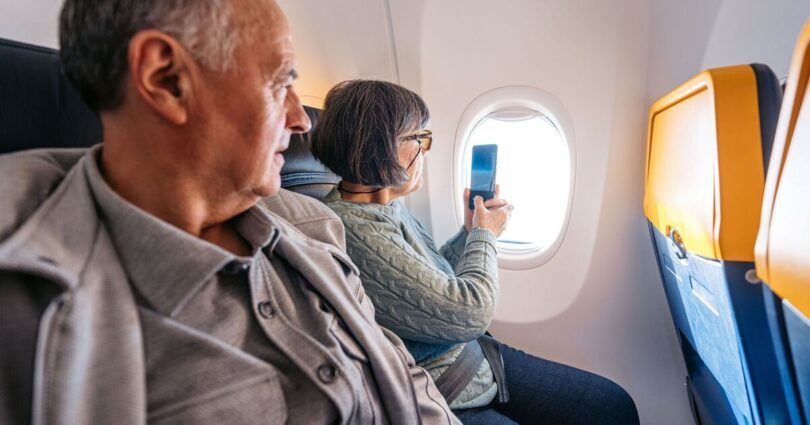
A new study has found that separating elderly passengers on flights could improve passenger safety in an emergency. Researchers found that the placement and number of elderly passengers could significantly affect the time required to evacuate those onboard.
Aircraft are designed to allow complete passenger evacuation within 90 seconds; however, using computer simulations, experts found that elderly passengers can delay how quickly everyone else can exit.
The research team explained in journal AIP Advances that « high elderly ratios and poor seating arrangements led to longer evacuation times and uneven exit usage ».
It added: « These findings emphasise the need for age-sensitive modelling and seating strategies to improve evacuation safety. »
To determine how much of an impact it can have, academics from the University of Sydney and Calgary carried out 27 evacuation simulations based on a dual-fire engine evacuation on an Airbus A320, one of the world’s most widely used aircraft.
The experts tested different cabin configurations, each accommodating different numbers and seating arrangements of passengers aged over 60.
Dr Chenyang Zhang explained that despite a dual-engine fire incident being « statistically rare », the scenario still comes under the broader category of dual-engine failures and aviation critical emergencies.
Software was then used to model how passengers would behave during an emergency, and the results indicated that both the number and the positioning of elderly passengers had a major influence on evacuation time.
The quickest configuration featured had 152 passengers in total with 30 elderly individuals spread uniformly throughout the cabin, yet still took 141 seconds to complete.
The slowest, with a higher number of randomly placed elderly passengers, had an evacuation time of 218.5 seconds.
The scientists behind the research propose distributing older travellers with mobility limitations across different sections of the cabin, meaning family members or couples travelling together would have to sit apart from elderly relatives.
They also believe that targeted safety briefings for older passengers could further reduce evacuation times.
Dr Zhang said: « We hope these findings help airlines proactively mitigate risks.
« By understanding how passenger distribution affects evacuation, airlines could potentially implement more strategic seating arrangements to optimise safety without compromising operational efficiency. »
Source link