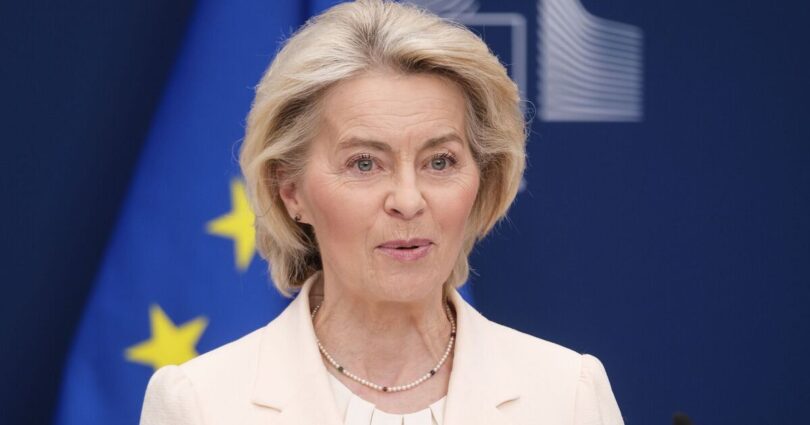
European Commission President Ursula von der Leyen (Image: Getty)
Brussels is ramping up pressure on Britain to « supercharge » its post-Brexit reset, timing demands to coincide with the 10th anniversary of the UK’s vote to leave the European Union. Senior EU figures and reports accuse London of dragging its feet, warning that without bolder action, both sides risk squandering opportunities in a volatile world.
As the landmark date approaches, MEPs and think tanks are pushing for accelerated ties in trade, security, and mobility, framing the call as an ultimatum to overcome lingering Brexit mistrust. French MEP Sandro Gozi, co-chair of the EU-UK Parliamentary Partnership Assembly, urged the UK Government to recognise the EU as Britain’s « closest ally » amid a transformed geopolitical landscape, according to EU Reporter.
Read more: Starmer putting ‘sovereignty on a silver platter’ in Brexit reset
Read more: Spain sends troops to Gibraltar in major threat as EU tries to reverse Brexit

Ursula von der Leyen and Prime Minister Sir Keir Starmer (Image: Getty)
Mr Gozi said: « Progress has been too slow. The EU-UK reset must now be supercharged. Engagement, based on respect of the Union’s principles, should be broadened and accelerated ahead of this summer’s EU-UK Summit. »
Irish MEP Barry Cowen echoed the sentiment, calling for a reset « commensurate with the scale of the challenges we face as Europeans. » He highlighted public sentiment in Britain, noting: « Ten years after the Brexit decision, British people now want a closer relationship, so it is time to supercharge the reset. »
The demands come against a backdrop of patchy progress since Labour’s 2024 election victory, which promised to mend fences without rejoining the single market or customs union. Recent wins include Britain’s return to the Erasmus student exchange and Horizon research programmes, but key areas like veterinary agreements and youth mobility remain stalled.
A joint policy brief from the Centre for European Reform and Konrad-Adenauer-Stiftung questions whether 2026 will be the year to « reset the reset. » Author Ian Bond argued for a « fundamental rethink » to boost security and prosperity, criticising mutual distrust. Mr Bond said: « In turbulent times, the EU and the UK would both benefit from overcoming the lack of trust that the Brexit process engendered. »

Foreign Affairs Committee chairwoman Dame Emily Thornberry (Image: Getty)
Former British MEPs have piled on, with ex-vice president Edward McMillan-Scott citing YouGov polls showing 54% of Britons favour closer EU ties, against 34% opposed. He added: « Remember, 58% say Britain was wrong to leave the EU. »
Pat Cox, a former European Parliament president, invoked economist John Maynard Keynes: « When the facts change, I change my mind. » He stressed dramatic shifts since 2016, including Russia‘s war in Ukraine and US trade aggression under Donald Trump.
Lord Richard Balfe, a House of Lords member and former Tory MEP, went further, suggesting a political party could win big by promising another referendum to reverse Brexit.
He said: « They could once again make the Lib Dems the party of aspirant Middle England. »
Denis MacShane, a former UK Europe minister under Tony Blair, lambasted the slow pace, pointing to Britain’s high youth unemployment and sluggish growth compared to Spain or Poland.
Mr MacShane said: « Right now London and Brussels look like two elephants side by side in the same bed but with no idea how to have sex. » He called on Prime Minister Sir Keir Starmer to ditch « lawyerly caution » for bolder leadership.
Meanwhile, a scathing report from the UK Parliament’s foreign affairs committee highlighted in The Guardian has exposed flaws in Sir Keir’s approach, labelling it lacking in « direction, definition and drive. »
Sir Keir and European Union President Ursula von der Leyen has made little secret of their keeness for closer ties – but committee chairman Emily Thornberry MP warned: « It feels as though we are on a journey with no clear destination. »
The May 2025 EU-UK summit at Lancaster House yielded agreements on youth mobility and agriculture, but only Erasmus has materialised. The report slammed the EU for « changing the goalposts » with demands for financial contributions to poorer member states and an « exorbitant » €2bn fee for joining the Security Action for Europe defence initiative.
Despite setbacks, the committee urged both sides to « go further and faster » on security, including potential UK contributions to a €90bn fund for Ukraine. It criticised secrecy in talks and called for a white paper outlining plans.
The chorus of criticism underscores Brussels’ frustration, with some EU officials even insisting Britain must « pay a price » for Brexit.
Source link