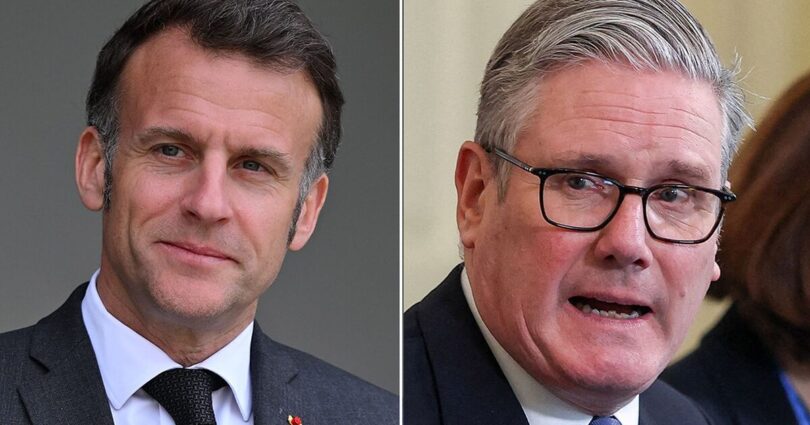
Sir Keir Starmer faced demands to tear up a 60-year-old defence treaty on Saturday after Iranian drones pierced the perimeter of Britain’s most strategically vital overseas military installation — and it shamefully fell to France, not Britain, to scramble warships to the island’s aid.
Cypriot president Nikos Christodoulides spent a lengthy phone call pressing the Prime Minister for a fundamental overhaul of the security arrangements underpinning RAF Akrotiri and Dhekelia, the two Crown-territory bases that together cover 99 square miles of the eastern Mediterranean island.
« We need to have an open and frank discussion with the British government with regard to the status of the British bases… the status and the future of the British bases in Cyprus, » said Mr Christodoulides.
What Nicosia wants
The renegotiation push centres on the 1960 independence treaty — a Cold War-era document that Nicosia regards as wholly inadequate for the security environment now facing the island, The Express understands.
Surrendering the bases entirely is not on the table according to reports. What Cyprus is understood to be seeking instead is a more transparent relationship — advance warning of planned operations, clearer lines of communication over deployments, and a greater say over the security risks the bases may generate for the surrounding population.
The government in Nicosia confirmed on Tuesday that it had « received legal advice on the issue of the 1960 agreements », adding: « The issue of security is complex and will be the subject of discussion with the British side. »
London holds firm
The Ministry of Defence rejected any suggestion the bases’ fundamental status could be revisited, according to a report by the Telegraph.
« The SBAs [sovereign base areas] have never been part of the republic of Cyprus as UK sovereignty was retained over these areas when Cyprus became independent in 1960. We have no plans to change this, » a spokesman is reported to have said.
« The long-standing friendship between the UK and the republic of Cyprus is strong in the face of Iranian threats. »
Starmer is understood to have told Christodoulides that neither base would be used to launch offensive strikes against Tehran, and gave a personal commitment that Cypriot security ranked among Britain’s highest priorities.
The attack that changed everything
The crisis was triggered by a pair of low-altitude drone incursions on March 1 and March 4 that overwhelmed base defences and destroyed a hangar sheltering two American U-2 reconnaissance aircraft at Akrotiri — a significant intelligence blow for both London and Washington.
No British naval vessels were anywhere near the eastern Mediterranean when the strikes came. With Cyprus suddenly vulnerable, Nicosia put out an urgent call to its European Union partners, and it was French warships — not Royal Navy ones — that answered first.
HMS Dragon finally entered the Mediterranean only on Tuesday, arriving roughly three weeks after the attack.
An embarrassment for Britain’s military
The sequence of events has exposed uncomfortable questions about the reach and readiness of Britain’s armed forces.
A French deployment beating the Royal Navy to the defence of a British sovereign territory will intensify long-running concerns about whether stretched defence budgets have left the UK unable to protect its own assets abroad.
The 1960 treaty bound the UK, Cyprus, Greece and Turkey to a framework of mutual consultation on the island’s defence.
Source link