
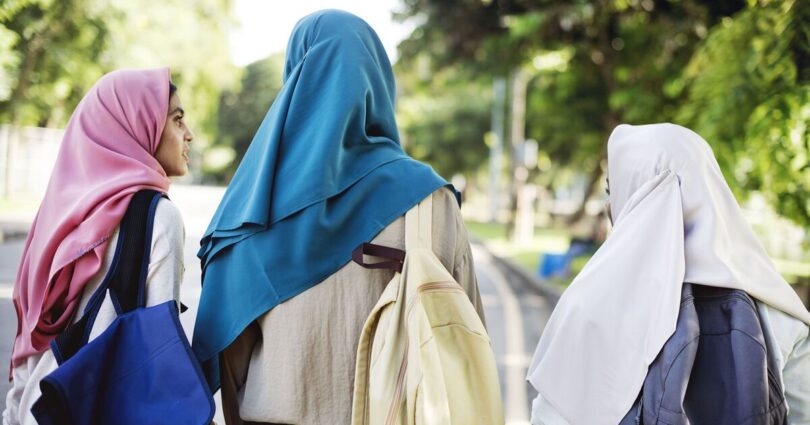
An EU country has banned burqas and niqabs in schools as ministers seek to protect girls from « oppression ». Austrian schoolgirls are now forbidden to wear headscarves while under the age of 14, with the state’s three-party governing coalition claiming it helps establish « gender equality ». Students who do not conform to the new restriction will be told to meet with school leaders and their parents or guardians.
Any further breach of the rule would be referred to Austria’s child and youth welfare officials, and fines of up to €800 (£700) could be imposed. NEOS member of the National Council of Austria, Yannick Shetty, insisted that the policy was “not against religion ». He added that it is « a measure to protect the freedom of girls in this country”. Around 12,000 children are set to be affected. The Freedom Party of Austria (FPO), which is in opposition, stated that the law did not go far enough.
The group described it instead as a “a first step », and suggested that it should include pupils of all ages, as well as members of school staff.
« There needs to be a general ban on headscarves in schools -political Islam has no place here, » FPO’s families spokeswoman Ricarda Berger said.
It comes as Portugal’s parliament approved a bill in October proposed by the far-right Chega party, which would bar people from wearing face coverings – such as a niqab and burqa – for “gender or religious motives”.
Individuals risk a €4,000 (£3,496) fine if they don the item of clothing in a prohibited public place.
A burqa covers a person’s entire body and face, including a mesh screen over the eyes.
A niqab covers the face but leaves the eyes visible, and is typically worn in conjunction with a headscarf.
Those in favour of a ban on headscarves argue that people should not appear in public without being identifiable.
Critics of the garments also argue that they do not promote social and religious cohesion, and represent a view of women that does not align with their own.
Whereas those against a ban suggest that it would impede an individual’s freedom to observe their faith in a way of their choosing.
Source link