
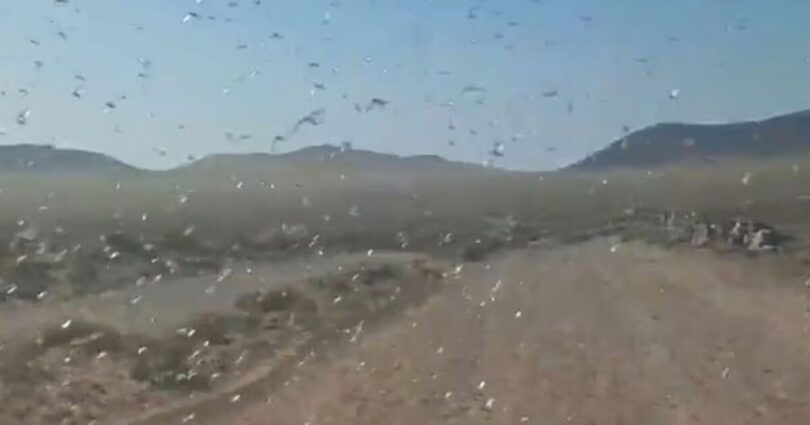
Four Spanish holiday islands have been hit by swarms of locusts, with locals and tourists urged to « stay calm ». Clips circulating online capture vast swarms of locusts sweeping across the countryside, with hundreds of insects spiralling through the air in dense, shifting clouds.
Officials across Lanzarote, Tenerife, Gran Canaria and Fuerteventura maintain that the oversized insects do not pose any risk to people, but they caution that the situation could escalate if their numbers continue to rise. While the current swarms are manageable, authorities warn that a significant increase could endanger local agriculture, potentially developing into a full-scale infestation similar to the one the islands experienced two decades ago.
Francisco Fabelo, Head of Environment for the island’s government, said: “The next two days are going to be key. If they are adult specimens that have arrived exhausted, they will die and nothing will happen. If we see copulations, that would mean that they are reproducing.
« We would have to see it between this afternoon and tomorrow. We already experienced this in 2004 and at the end of the eighties there was another similar episode. »
Theo Hernando, Secretary General of the Association of Farmers and Ranchers of the Canary Islands, sought to reassure famers. He said: « It is common for episodes of winds from Africa, such as those brought by the haze, to have locust specimens. They are blown by the wind and as long as they are isolated cases there is not problem. They arrive very weakened, they are not in a position to settle or reproduce. Nature itself takes its course and many times they end up being preyed upon by birds. »
The insects are thought to have been carried over from Western Sahara after a spell of warm, humid weather created ideal conditions for their movement.
Known locally as the Barbary cigarrón (Schistocerca gregaria), the locusts have been sighted across much of Lanzarote, including well‑known tourist spots such as Arrecife, Costa Teguise, Famara, Uga and Tahíche.
Their arrival has revived memories of the major infestation two decades ago, when swarms devastated crops and disrupted daily routines, prompting firefighters to intervene in some areas to help contain the outbreak.
Historically, these locusts have reached the Canary Islands when easterly or south‑easterly winds sweep Saharan dust across from the African mainland, carrying the insects with them.
Source link