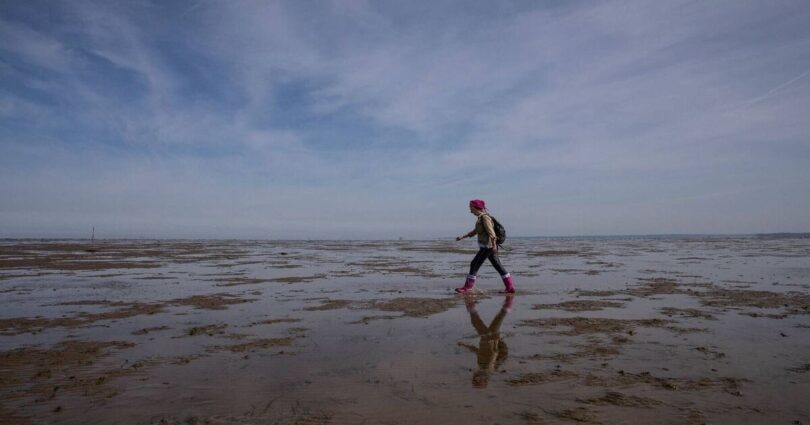
A member of the public crosses The Broomway during a guided walk (Image: Getty Images)
An Amazon delivery van was discovered abandoned on the nation’s « deadliest path » last weekend — sparking a flurry of jokes across social media.
‘Amazon has completed your delivery’ was among the most popular quips after images of the vehicle stranded on mudflats along the Essex coastline went viral. Another joked that « Kevin the seal » must have placed an order.
The unfortunate driver was forced to abandon the van on The Broomway, at Great Wakering, after becoming stuck on mudflats along the tidal causeway.
They had been following their GPS while attempting to reach Foulness Island on the evening of February 14. Following the incident, a spokesperson for HM Coastguard Southend confirmed: « The delivery driver had removed themselves from the van and reported the incident to Amazon.
« HM Coastguard’s primary concern was for the safety of the occupants and any possible pollution. »

HM Coastguard Southend were called out to reports that an Amazon delivery van had driven via Wakering Stairs onto The Broomway (Image: Neal Threadgold/HM Southend Coastguard)
Yet despite the mockery across social media, the 600-year-old path, which extends six miles into the Thames Estuary, is regarded as the most treacherous in Britain, and with good cause.
It is advised that people only traverse it (driving is not advisable) accompanied by a guide.
Unpredictable tides render it perilous and more than 100 people are believed to have perished on it.
Writer Robert Macfarlane referenced it in his book The Old Ways where he described it as the « unearthliest path I have ever walked ».

A walker leaves the mainland across The Broomway (Image: Getty Images)
Referencing The Broomway’s death toll exceeding 100 victims, he continued: « It seems likely that there were other victims whose fates went unrecorded. Sixty-six of its dead are buried in the little Foulness churchyard; the other bodies were not recovered. »
He noted that Edwardian publications eventually dubbed it The Doomway rather than The Broomway.
Describing its contrasting nature, he wrote: « The Broomway traverses vast sand flats and mud flats that stretch almost unsloped for miles. When the tide goes out at Foulness, it goes out a great distance, revealing shires of sand packed hard enough to support the weight of a walker.
« When the tide comes back in, though, it comes fast – galloping over the sands quicker than a human can run.

The remains of an old Oil Tank stand at the end of The Broomway walk (Image: Getty Images)
« Disorientation is a danger as well as inundation: in mist, rain or fog, it is easy to lose direction in such self-similar terrain, with shining sand extending in all directions. »
He also warned that certain surfaces prove unreliable for walkers, describing how mud can « trap you » whilst quicksand can « swallow you ».
Nevertheless, he acknowledged: « But in good weather, following the right route, it can feel nothing more than a walk on a very large beach. »
The perilous tidal route, extending into a military firing range, remains a public right of way maintained by Essex Highways, whilst the Ministry of Defence has owned the land since 1915. It has served as a munitions testing ground for decades.
Misjudging the tide or becoming disorientated in poor weather has claimed lives over the years — but according to 19th century writer Philip Benton, some islanders actually found excitement in using the treacherous route.
He wrote in History of the Rochford Hundred: « It is extremely perilous for any stranger to attempt the passage to or from this island without a guide, but the dangers attending it have been a pleasurable excitement to many.
« Some farmers would stay to the last, and then race the tide, and swim the creeks. »
The final person to perish on The Broomway — so named from hundreds of brooms once positioned at intervals either side of the path — was reportedly a man who was making his way back from the market in Rochford before tragedy struck in 1919.
Source link