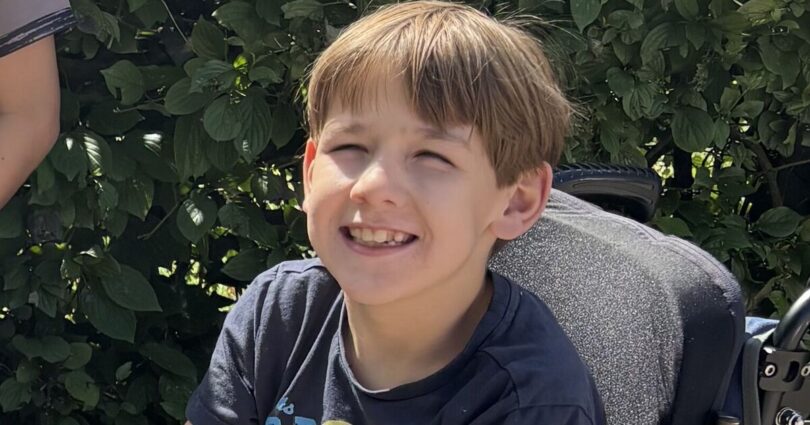
Amy said Frankie is a ‘very happy child’ (Image: PA Real Life)
The mother of a boy with an exceptionally rare genetic condition, believed to affect just 200 people globally, has revealed doctors informed her « nothing can be done » and he is « unlikely to survive past his teens ». Amy Sheridan-Hill, 46, said she was « shocked » when her son Frankie received an H-ABC diagnosis, a rare genetic disorder which impacts specific regions of the brain, in 2021, aged five.
Frankie, now 10, was born in 2015 following what Amy described as an uneventful pregnancy and scheduled caesarean section, with « no issues from birth ». As Frankie was her firstborn, Amy, a former teacher from Ware, Hertfordshire, said she was « quite unaware of the proper development stages », so when her son couldn’t sit upright like other youngsters she observed, she initially dismissed it as « nothing to worry about ».
However, by age two, Amy said Frankie wasn’t walking unaided, which most toddlers master by 18 months, prompting her to consult a doctor who arranged a physiotherapy referral. At this point Amy said she was informed her son might have hypermobility, a condition characterised by exceptionally flexible joints, but when Frankie remained unable to walk by four, a physiotherapist spotted « a certain way his foot went that made her think of cerebral palsy », leading to a neurologist referral.
Amy said Frankie underwent an MRI followed by genetic testing to receive his diagnosis of H-ABC – an extremely rare form of leukodystrophy, a group of genetic conditions affecting the brain’s white matter – at five years old, which arrived as a « massive shock » and turned their world « upside down completely ». According to H-ABC Foundation UK, as of 2019, fewer than 200 documented cases of H-ABC have been identified, the majority of which are children, though that figure is rising as patients gain access to improved clinical diagnoses.
« When you go to a doctor, you expect to be told what can be done, » Amy said. « So I think to be told ‘nothing can be done’ is quite a shock.

Frankie ‘loves’ being in a mainstream school (Image: PA Real Life)
Read more: GP ‘does this every day’ at home to reduce cancer risk
Read more: Pharmacist says ‘normal’ feeling could be ‘red flag’ of thyroid imbalance
« You’re told they’re going to die essentially. I think there’s still some PTSD from the diagnosis and I think a lot of parents say that it’s quite big to be given this information and sent on your way.
« When you Google leukodystrophy, it just gives you the worst-case scenario. With some types of leukodystrophy, kids die within two years, so it is not a word you want to Google if you’ve just been given that diagnosis. »
By this point, Amy said he was lagging behind his peers developmentally, particularly with his walking ability, but also his speech and reading level. Following Frankie’s diagnosis, Amy said she was « Googling everything » and discovered a Facebook group for H-ABC that had « less than 100 worldwide members », so she joined it.
Shortly after, Michelle Teng, another mum from the Oxford-based group, reached out and introduced Amy to Ali Candy-Waters, a fellow Cotswolds mum. After a Zoom call, they decided to establish a charity named H-ABC Foundation UK to raise awareness of the condition.

Frankie is ‘unlikely to survive past his teens’ (Image: PA Real Life)
« I think having mums who are going through what you’re going through is just really helpful, » said Amy. « We don’t see each other that often, but we text constantly.
« I was talking to Ali this morning about the mum guilt of when you don’t put your child in his stander every day – because he should and it’s good for him – but actually getting him in the stander is really difficult. We’ve all got brilliant friends and families, but people that are going through it, they know (what it’s like) when you’re having a meltdown, so you can phone one of them. »
Through fundraising efforts such as marathons and school bake sales, Amy revealed that the charity has contributed to research into the disease and assisted other families affected by the condition in purchasing wheelchairs or iPads, which can aid non-verbal children in communicating.
In addition, Michelle is the co-founder of an Oxford-based firm named SynaptixBio, which has recently selected its candidate drug to progress into clinical trials for treating H-ABC. Amy indicated that these trials could commence within the next year or two and whilst it wouldn’t entirely cure Frankie, it could potentially « hold the disease to stop children losing any more skills ».
At present, there is no known cure for the condition, but treatments such as physiotherapy and certain medication may ease symptoms and enhance quality of life. In the interim, Amy stated her family’s aim is to keep Frankie « as strong as possible » so that he has a « better starting point » if he is chosen for the trial.
To achieve this, Amy revealed Frankie regularly undergoes physio and occupational therapy and receives Botox to relax his leg muscles. He utilises leg splints, Spandex shorts, a stander and a walker, and will require future X-rays and surgeries as his spine will begin to curve.
If Frankie is not eligible for the trial, Amy suggested it might be several more years before he can access what could be a life-altering drug. For now, Amy shared that Frankie enjoys playing with his « protective » and « kind » younger brother Rory, eight, and he « loves » attending mainstream school, where she praised his « amazing teachers » and the entire class who « just really look after him ».

Amy, her husband Greg, and her sons Frankie and Rory (Image: Rachael Griffin-Kett Photography/PA Real Life)
« It’s really sweet to see, » Amy said. « When they do assemblies, they make Frankie the centre of things and they always make sure he’s really involved in everything. They specialise the curriculum for him because he is delayed, so he’ll do his own work, but he just loves being part of the class. »
She continued: « Frankie is a very happy child. He can read, he loves to play PlayStation and he can use his iPad. If we could keep the disease static and he doesn’t decline, he’d have a great life.
« If we could get some form of treatment in the next two or three years, I think Frankie’s path would be quite different. We hope that other families don’t go through what we’ve been through. »

Frankie was diagnosed with H-ABC at five years old (Image: PA Real Life)
Ultimately, Amy explained she wants to raise awareness of the condition because « there’s probably more cases out there ». She stressed people need to understand that organisations like H-ABC Foundation UK « that have been set up to support families and there are doctors and scientists working on treatments » exist.
Amy added: « Now we can tell them where we are and that gives them hope, whereas when Frankie was diagnosed, there wasn’t that hope. So we’ve had to create that hope and now we can share it with other families. »
To find out more about H-ABC Foundation UK, visit its website.
Ensure our latest headlines always appear at the top of your Google Search by making us a Preferred Source. Click here to activate or add us as your Preferred Source in your Google search settings.
Source link