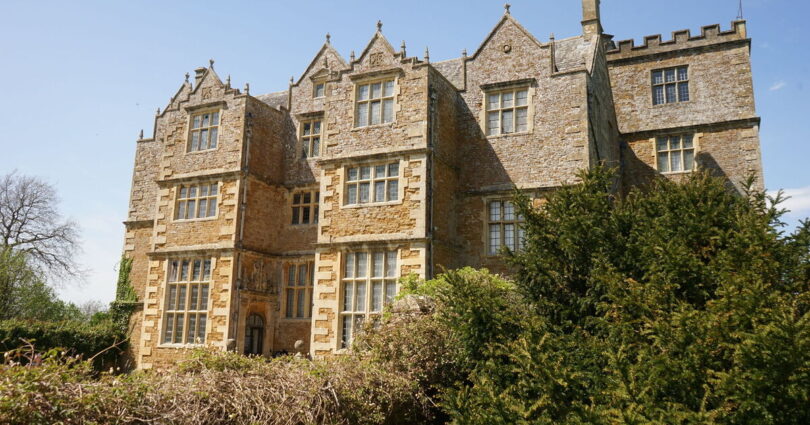
The home was built as a statement of wealth and power (Image: Getty)
Near Moreton-in-Marsh in Oxfordshire lies a stunning estate, once home to the very same family for centuries.
It was initially built as a huge statement of wealth and power in the early 17th century but has since become a space for the public to wander and learn and engage in British history.
Chastleton House became a steady place within the same family for hundreds upon hundreds of years, as the estate continued to remain in their care, passed down through generations.
Now, the property lies in Oxfordshire as a real-life time capsule, hardly touched, with an epic great hall, gallery room and an array of collections that belonged to the renowned family.
Visitors can explore the grounds and take a tour of the rooms that hold so many memories for the Jones family.
A visitor shared on TripAdvisor: « Beautiful house and gardens with discrete but attentive guides. From the entrance to the exit, a fantastic visit. A huge family home with a fascinating past. »

It lived within the same family for over 400 years (Image: Getty)
Early history
It’s believed that some form of settlement has existed in Chastleton for over 1,000 year but by the 16th century, the site of the house as we know it today was owned by the Catesby family. That was until Walter Jones bought the land and previous house from Robert Catesby, and it stayed within his family for 400 years.
He demolished what was there of the old house and rebuilt a beautiful building in its place, finalised in 1612. His purchase was sought to reflect his distinguished career in law, and he aimed to establish himself as a country gentleman, now being a landowner.
Over the course of 100 years, the Jones family continued to marry into some well-established gentry families, helping to solidify this status. The last direct descendant of Walter Jones, however, was Arthur Jones, who inherited the property in 1813 and made some structural improvements to the home.
After his death, the home remained in the family, but not to a direct descendant; instead, it was passed down to a distant cousin by marriage called John Henry-Whitmore Jones.
The very last of this family tree’s ownership came to a close in 1991, when the National Heritage Memorial Fund bought Chastleton and transferred it to the care of the National Trust. Unfortunately for the last tenants, the cost of maintaining the building was proving to be far too much.

It is now a Grade I listed building (Image: Getty)
Preservation
The National Heritage Memorial Fund bought Chastleton in 1991, and most of its original contents remained exactly as they were before it was transferred to the National Trust.
In order to withhold that mystic atmosphere that can only be put down to the centuries of stories and memories on the grounds, there was a plan to preserve the house, not restore it. With this they simply repaired parts that were damaged, which took a total of six years, to allow for the building to be structurally safe and stable.
The beautiful home was later reopened for the public to see all of its magic up close in 1998.
Visting
It’s believed that one of the house’s true gems is the Long Gallery, with the longest-surviving barrel-vaulted ceiling in the country. Due to its neglect, the plasterwork needed some reworking, however, which took place in 1904.
Part of the room’s glory is put down to the mask heads which sit at the west end of the room as extremely rare survivals of the 1600s era, thought to have been used as a weapon to fight off evil spirits.
Outside of the house is a vast, perfectly kept garden, offering a sense of peace and relaxation. Forming part of this glory is the Jacobean Pleasure Garden, also known as the Best Garden – telling you everything you need to know about its beauty.
To take it all in, visitors can embark on the Wilderness Walk, designed to give you not just a calming stroll around the gardens but the very best of views of the house and the ever-changing gardens through the seasons.
One recent visitor shared: « The house is amazing … a time capsule of a grand country house decaying over the years … with the fantastic result of being able to see how things really were without Victorian (or other) alterations. And top tip … do enjoy the Chastleton Teas at the church right next door. »
The house is open from mid-March through to with opening times of 1pm until 5pm. The adult entry fee is £15.00, with child’s tickets costing £7.50 and the option of having a family ticket for £37.50.
Source link