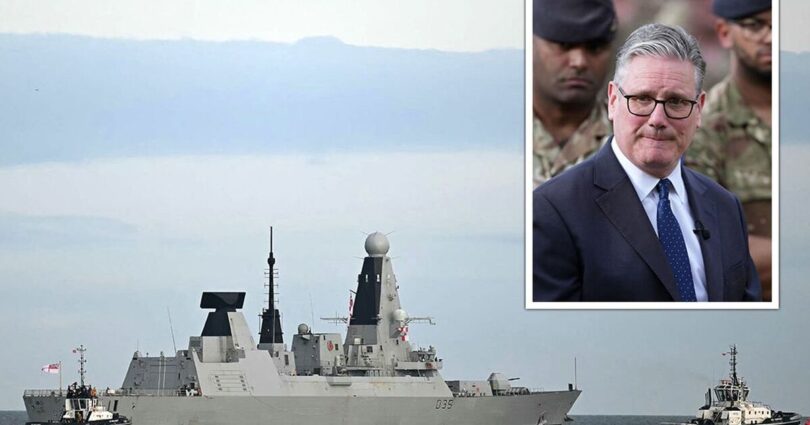
Sir Keir Starmer and HMS Dragon (Image: GETTY)
The fiasco over HMS Dragon indicates that the Royal Navy is not fit for purpose and would be unable to conduct even a modest Libya-style operation today, a leading naval expert has warned. The Type 45 destroyer, deployed less than a month ago from Portsmouth to help protect British air bases in Cyprus amid the Iran conflict, has been forced to dock in the eastern Mediterranean for repairs to its onboard water systems.
The Ministry of Defence described the issue as minor and said the ship remains at high readiness, with crew still able to access water for drinking, catering and showers. However, critics, including naval historian and Warships IFR editor Iain Ballantyne, see the episode as symptomatic of deeper, long-running problems with readiness and sustainment in a fleet stretched thin.
Read more: Fresh HMS Dragon embarrassment as warship forced ship to dock
Read more: Farage blasts ’embarrassing’ John Healey after huge Royal Navy mistake

US President Donald Trump (Image: Getty)
Mr Ballantyne said: “This current government has done nothing except fiddle around the edges of Defence as the decline continues for all the waffle about needing to be on a ‘war footing’.”
Earlier this week, Mr Ballantyne took to X to respond to a post by former Chancellor George Osborne, highlighting Britain’s contribution to the 2011 Libya campaign, when the Royal Navy improvised after the 2010 Strategic Defence and Security Review axed HMS Ark Royal and its Harrier jets, reduced naval personnel by 5,000 and left the fleet short of key capabilities.
In that conflict, Britain relied on a single destroyer for tactical air control close inshore and Army Apaches flying from the helicopter carrier HMS Ocean.
Mr Ballantyne offered a withering verdict, telling Express.co.uk: “Right now the RN would be unable to do even a Libya-style operation, and every government since the late 1990s is to blame.
« But the coalition chopping a third off the defence budget and cutting entire capabilities, for years, and some never replaced since, was the beginning of the steep decline.”
How does Britain actually fight a war? Who selects the targets? Where does the intel come from? Does the PM sit above it all or do they get involved in the detail of operations? Find out from those who were inside the room during the Libya conflict @polcurrency https://t.co/taYYbUIAp6
— George Osborne (@George_Osborne) April 6, 2026
His comments come as a shaky two-week ceasefire between the US, Israel and Iran shows signs of strain. Semi-official Iranian outlets published charts this week marking a “danger zone” over the Strait of Hormuz’s main Traffic Separation Scheme, suggesting sea mines had been laid by the Revolutionary Guard.
Oil prices rose above $97 a barrel on Thursday, with Brent crude up 2.9 % to $97.46. Ship-tracking data showed only four vessels with active AIS signals passing through on the first day of the truce.
President Trump has insisted US forces will stay in the region until a “REAL AGREEMENT” is fully honoured, warning that failure would trigger force “bigger, and better, and stronger than anyone has ever seen before.”
Iran claims the deal gives it control of the strait and the right to charge tolls while allowing continued uranium enrichment; the US and Israel say the waterway must remain open and safe, and that the truce does not cover Israel’s campaign against Hezbollah in Lebanon, where strikes have killed at least 182 in a single day.
The Royal Navy’s difficulties could not come at a worse moment. With roughly 20% of global oil and gas trade historically routed through the Strait of Hormuz, any renewed disruption would have severe consequences for energy markets and international security. Britain, historically Europe’s foremost naval power, now finds itself struggling to maintain even basic operational tempo on a single destroyer.
Mr Ballantyne has highlighted how capability gaps, delayed shipbuilding programmes and repeated “capability holidays” date back more than 25 years under governments of all parties.
The 2010 cuts delivered the sharpest blow, but the pattern of under-investment has persisted. Ministers in the Starmer government have spoken of shifting defence onto a war footing, yet the expert sees little substantive change beyond marginal adjustments while core problems remain unresolved.
The water-system fault on HMS Dragon, while officially downplayed, underscores the pressure on an ageing surface fleet that has seen availability issues and maintenance challenges for years. In a region where the US Navy routinely rotates carrier strike groups through ports for resupply, repairs and crew rest, even America’s vastly larger force is not immune to strain.
Without a sustained, cross-party commitment to reversing decades of decline — including urgent investment in hull numbers, sustainment and new capabilities — the Royal Navy will continue to operate at the limits of what a shrinking force can deliver, fears Mr Ballantyne. As global tensions rise in critical maritime chokepoints, the consequences of that long-term under-investment are becoming impossible to ignore.
Mr Ballantyne explores the moral ambiguity of the post-war era in his debut novel, Martin’s Eyes, from Chiselbury Publishing. Set in 1946 Austria, the historical thriller follows a tense confrontation between a war crimes investigator and a fugitive Nazi as they reckon with the ghosts of the conflict.