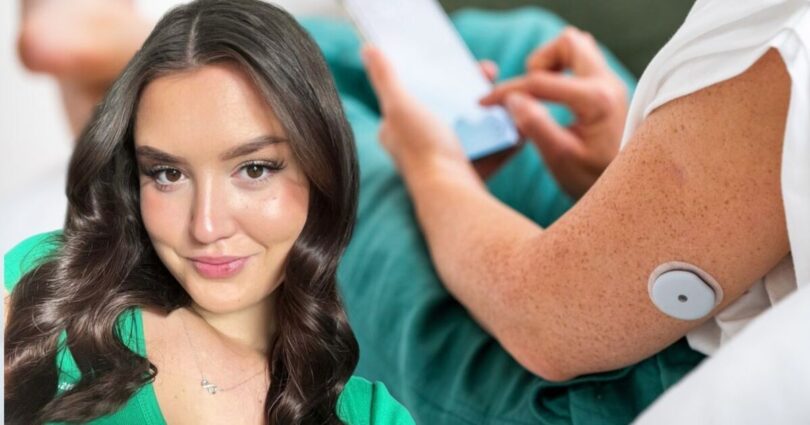
Holli was among the first patients to receive the new system. (Image: Holli Gamewell/Roche Diagnostics)
Hundreds of thousands of people with diabetes could benefit from a new device that can predict when they will be hit by low blood sugar. The Accu-Chek SmartGuide continuous glucose monitoring (CGM) system uses artificial intelligence to forecast glucose levels over the next 30 minutes, two hours and overnight. Users wear a small sensor on the back of their arm, which sends readings to a smartphone app every five minutes.
Holli Gamewell, 24, was diagnosed with type 1 diabetes last November. She was among the first patients to receive the new system on the NHS in January. She said: “It’s made a big difference. I get a notification if my glucose level is going to go low, so then I can actually prevent the hypo. Just before I go to bed, it tells me if I’m going to have a low overnight. I can have a snack before bed and then I’m usually fine.”
Read more: Trying one habit for a few minutes every day could cut risk of 8 major diseases
Read more: Microwave cooking technique could make chips much healthier
Type 1 diabetes occurs when your body cannot make a hormone called insulin, which helps cells use glucose for energy.
Hypoglycaemia, also known as a hypo, is a condition where a patient’s blood sugar drops too low.
Holli said hypos make her feel hot, shaky, dizzy and confused. If she knows one is looming, she can take action such as eating a few jelly babies to quickly raise her blood sugar.
Two other CGM systems are also available on the NHS. Accu-Chek is the first AI-driven system capable of predicting nighttime hypoglycaemia.
It has allowed Holli, of Salford, Greater Manchester, to continue working in her cafe job where she is sometimes the only person on shift.
She added: “Having the prediction features means that I can comfortably do a job where I’m on my own, and I don’t have to worry.
“It’ll pop up on my phone and I can sort it, then I don’t have to go through the process of having to sit down and manage it. So it just eases my anxiety a lot.”
Holli has been supported since her diagnosis by Amy Jolley, a lead diabetes specialist dietitian at Salford Care Organisation.
She said the rollout of CGMs in recent years has been “absolutely game-changing” for many patients.
She added: “Previously, people would have to prick their finger, obtain a blood sample, put it onto a strip, into a meter, and the meter would give them the result.
“All of that takes about 30 to 45 seconds, and you’d probably get around two or three data points in a 24 hour period. Now we get a result every five minutes automatically.”

The CGM system helps Holli prevent hypos that leave her shaky (Image: Holli Gamewell/Roche Diagnostics)
Ms Jolley said the Accu-Chek’s overnight prediction feature was “extremely novel” and could ease people’s fears about suffering a dangerous hypo while sleeping.
Patient feedback has also welcomed the 30-minute forecasts, she added. “We’ve been told that accuracy is extremely high,” Ms Jolley said.
“That gives people the time to prepare so they’re not having to wait until they have symptoms of hypoglycaemia before they act.
“That’s particularly important around things like driving where, if you have a hypoglycaemic event, you have to stop, treat it and it delays you for over 45 minutes.”
More than 5.8 million people are living with diabetes in the UK. An estimated 284,000 people with Type 1 and 151,800 with Type 2 are eligible for the Accu-Chek system in England.
The first NHS organisations to offer it include Bath and North East Somerset, Swindon and Wiltshire Integrated Care Board, and NHS Somerset Integrated Care Board.
Peter Hampson, head of medical affairs at Roche Diagnostics UK & Ireland, which makes the device, said: “For many people living with diabetes, the fear of blood sugar dropping overnight is a constant worry.
“This technology helps remove some of that uncertainty by predicting potential lows before they happen, giving people greater confidence and peace of mind in their day-to-day lives.”
Source link