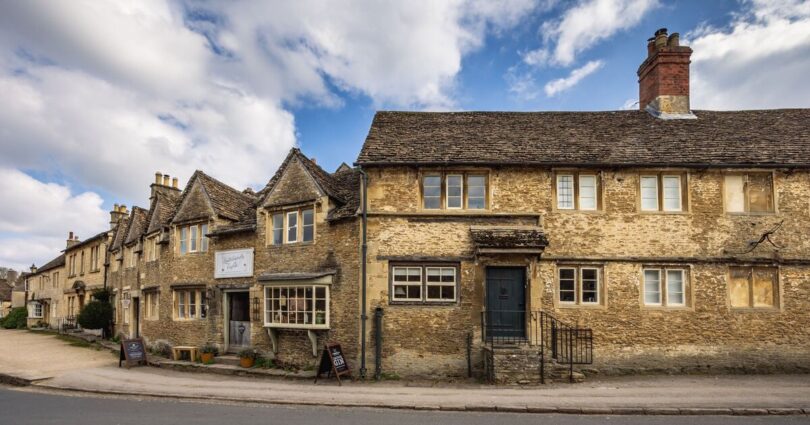
Some of the buildings date as far back as the 1200s (Image: Getty)
Proud locals in a medieval village with buildings that remain exactly the same as they did hundreds of years ago are determined to preserve its charm for as long as they can.
Sitting just outside of the adored and much-explored Cotswolds area, tucked away in Wiltshire, the village is often described as one of the most beautiful in the country.
Lacock is a real gem of what is a quintessentially English village, home to a famous abbey and buildings that are strictly protected by the National Trust. With its local museum and guided tours, locals are able to celebrate the culture curated and ensure its legacy lives on.
Restrictions
Famously, due to its need for perfect preservation, Lacock has a number of restrictions in place, which allows for it to feel like a real-life time machine. Since the National Trust took ownership of nearly the entirety of the village in 1958, they have worked tirelessly to prevent modern developments.
This has meant saying no to modernised street signs; overhead cables, modern lampposts, and other street ‘furniture’ are banned. Strict development rules apply in the conservation area.
READ MORE: Beautiful village oozing charm and unmatched views is ‘foodie heaven’
READ MORE: Abandoned sinking ‘ghost village’ has been branded the ‘Greek Chernobyl’

Multiple scenes in Harry Potter were filmed in the village (Image: Getty)
These restrictions extend to limitations on properties when it comes to things like roof alterations, extensions, or cladding and even satellite dishes being added.
On top of this, Article 4 directions are often used by Wiltshire Council, meaning any form of planning permission is required even for minor changes that typically don’t need consent. It’s all of these princesses that allow for the village to remain exactly as it is – picture-perfect.
Filming
It’s these specific limitations that have allowed for Lacock to be a time machine of sorts for film and TV, as they are able to use the streets and its buildings for sets instead of replicating a village of the same era.
Most notably, Lacock welcomed the cast of Harry Potter before it became the franchise we know it as today, and the students of Hogwarts roamed the halls of Lacock Abbey. Its cloisters were used as the corridors for Hogwarts, and the Warming Room provided the backdrop for Professor Quirrell’s classroom.

The village is protected by The National Trust (Image: Getty)
Meanwhile, other parts of the building, including the sacristy, were Snape’s potions classroom, and the Chapter House was used for scenes with the Mirror of Erised.
Outside of the major franchise, Downton Abbey has also filmed in the village, along with the 1995 adaptation of Pride and Prejudice and, later on, Fantastic Beasts: The Crimes of Grindelwald.
Historic Abbey
The abbey where most of this famous filming took place lies at the heart of the village and is surrounded by its very own woodlands area. Built upon the foundations of a former nunnery, it now has various architectural styles, with mediaeval rooms alongside its country house feel and, of course, a courtyard.
Its 800-year history is impressive, starting as a convent and eventually becoming the home of the Sharington and Talbot families.
When the abbey was shut down in 1539 by the orders of King Henry VIII during his break with the Roman Catholic Church, the property was sold. A year later, the reknowned abbey was bought for £730 by Sir William Sharington.
With his wealth and the ability to do whatever he wanted with his new home, William decided to demolish the church and form it into a country house. It continued to be passed down through generations of the family until, in 1994, Lacock Abbey was handed over to the National Trust.
A recent visitor described their experience at the abbey on TripAdvisor, writing: « Beautiful! Stunning gardens as well. The abbey cloisters are very historical, plus there is the Harry Potter link. It takes a while to walk round, there is an upper floor that again is interesting. Lots of information on the building changes throughout its history. The last room before you leave is amazing. »
Source link