
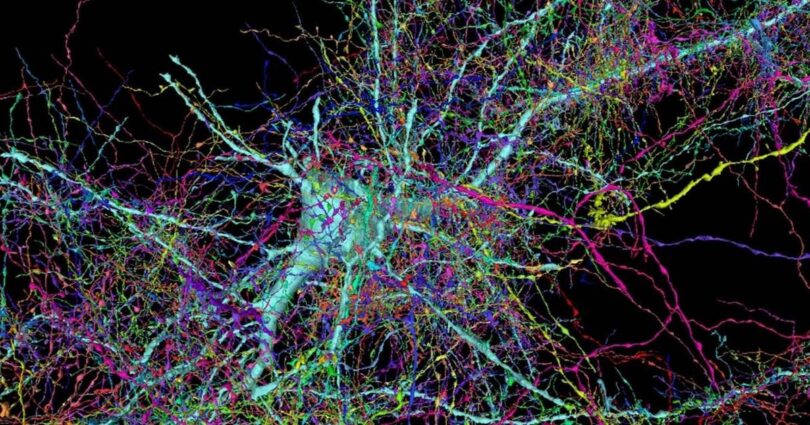
Scientists have edged closer to the sci-fi prospect of mind uploading after identifying a critical 14-minute window to preserve a brain’s intricate neural architecture following death. This concept—digitising consciousness to live on after the body fails—was popularised by science fiction programmes, most notably in the San Junipero episode of Black Mirror.
In a breakthrough detailed in a preprint published on bioRxiv on March 7, 2026, researchers at Nectome—a company specialising in high-fidelity connectome preservation—demonstrated near-perfect ultrastructural preservation of an entire large mammal brain using a protocol designed to align with human physician-assisted dying laws.
The team, led by Aurelia Song, Anna LaVergne and Borys Wróbel of Nectome Inc, found that blood washout and chemical fixation must begin within approximately 14 minutes of cardiac arrest to prevent irreversible damage from clotting (the « no-reflow » phenomenon).
Starting the process at around 18 minutes resulted in failed preservation, but under the 14-minute threshold, every neuron, synapse and molecular structure remained « beautifully preserved » across the whole brain.
The work, conducted on pigs as a human-sized proxy, refines aldehyde-stabilised cryopreservation: blood is replaced with fixatives to halt decay, followed by cryoprotectants that allow vitrification—a glass-like state at around -32°C—potentially stable for millennia.
Borys Wrobel, a lead scientist at Nectome, emphasised the shift towards scientific rigour in a technical manifesto: “I’ve introduced here a new kind of cryonics which I hope will move the field away from Pascal’s wager and towards a rigorous discipline that will become a mainstream part of end-of-life care.”
He stressed the procedure’s planned, non-emergency nature: “We do not offer an emergency response model because there is no emergency response model we could do which would meet our standard.”
While revival technology does not yet exist, Mr Wrobel asserts the method captures “all the information that would be needed for revival,” creating a “common currency for connectomic analysis” that future scanning and simulation could read.
The protocol’s compatibility with assisted dying frameworks—such as those in Oregon—marks a major leap from earlier lab-based animal trials.
Nectome is reportedly preparing to offer the service to terminally ill individuals, allowing them time with family before the scheduled procedure.
Critics note the process remains 100% fatal and speculative, echoing controversy around Nectome’s 2018 origins when it pitched brain preservation explicitly tied to euthanasia.
However, the new evidence of time-sensitive, high-quality preservation in a clinically feasible setting brings mind uploading tangibly nearer—provided future advances can decode and reconstruct the frozen connectome.
High-resolution electron microscopy images of the preserved synapses are available on Nectome’s site, offering visual proof of the technique’s precision.
Whether this heralds digital immortality or merely eternal preservation remains an open—and profoundly ethical—question.
Source link