
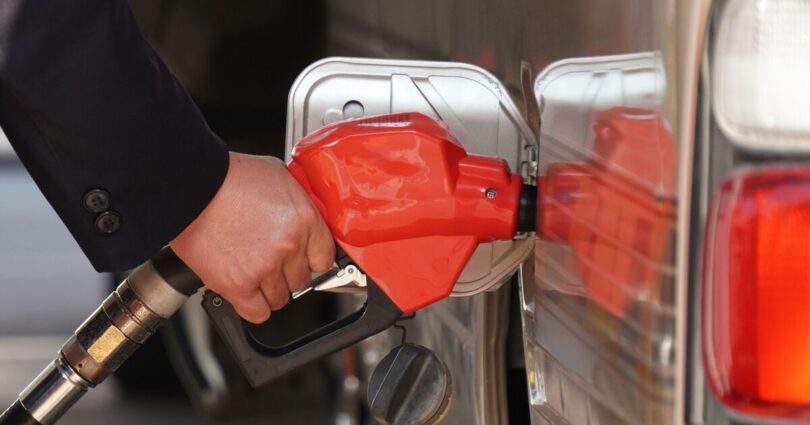
Fuel prices are under pressure as fears grow oil could surge towards $200 a barrel (Image: Sheldon Cooper/SOPA Images/Shutterstock)
Oil prices could soar to a staggering $200 a barrel amid fears that escalating conflict in the Middle East may choke off one of the world’s most critical energy supply routes. Market analysts are warning that the effective closure of the Strait of Hormuz – through which roughly a fifth of global oil supplies pass – is already pushing crude prices sharply higher and could trigger an unprecedented spike if disruption continues.
Brent crude surged to nearly $120 a barrel on March 9 and has remained above $100 since March 13, following a series of strikes and retaliatory attacks on key oil and gas infrastructure across the region. Shipping traffic through the strategic waterway has largely ground to a halt after Iran declared the strait closed to all but its enemies and threatened to target vessels attempting to pass. Only a handful of ships – mostly Indian, Pakistani, Turkish and Chinese-flagged vessels – have been allowed to pass in recent days. Energy market experts say the situation has dramatically increased the risk of extreme price shocks.

Only a handful of ship have made it through the Strait of Hormuz in recent days (Image: Andre M Chang/ZUMA Press Wire/Shutterstock)
Read more: Fuel station shortages as panic buying sets in – everything drivers need to know
Read more: UK energy bills suffer ‘apocalypse now’ blow with years of pain ahead
Vandana Hari, founder of oil market analysis firm Vanda Insights, warned: « Benchmark Middle Eastern crudes like Oman and Dubai have already crossed the $150 threshold, so $200 is already within sight, even if not for Brent and West Texas Intermediate. »
Analysts at consultancy Wood Mackenzie have also said Brent could soon hit $150 and that $200 oil is not « outside the realms of possibility » in 2026.
Efforts to stabilise the market by releasing 400 million barrels from emergency stockpiles are unlikely to fully offset supply losses. Researchers at OCBC estimate the world could still face a daily shortfall of around 10 million barrels.
The International Monetary Fund estimates that every 10 percent rise in oil prices, sustained over a year, would correspond with a 0.4 percent increase in global inflation and a 0.15 percent reduction in economic growth.
Adi Imsirovic, an energy expert at the University of Oxford, said oil at these levels « would be a major handbrake to the world economy ».
However, some analysts argue the spike may be limited by rising production in countries such as the United States, Canada and Brazil, as well as reduced demand if prices climb too high.
Brent’s record nominal high remains $147.50 during the 2008 financial crisis – equivalent to roughly $224 in today’s money.
Buyers typically begin cutting consumption once oil reaches extremely high levels, a process known as demand destruction.
Although oil demand is less flexible than for most goods, prices would eventually moderate after climbing beyond a certain threshold.
Industry analyst Bob McNally said no one knows exactly where that tipping point lies, but it could be higher than the previous nominal peak of $147 a barrel.
Oil prices will ultimately depend on how quickly two opposing forces play out – buyers scrambling to secure limited supplies at any cost and others cutting back on use as prices surge, Professor Gregor Semieniuk told Al Jazeera.
That balance, economists warn, will determine whether crude continues climbing towards $200 or starts to fall back.
Source link