
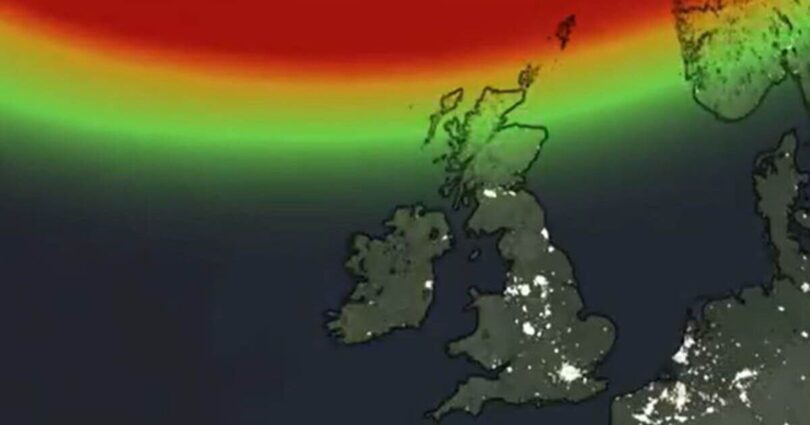
The Northern Lights glowing waves of light in the night sky caused by charged particles from the Sun colliding with gases in Earth’s atmosphere. These interactions produce beautiful colours like green, pink, purple, and even red. With spring officially beginning today, March 20—the equinox—this period (March to April) offers one of the best opportunities of the year to see the Aurora Borealis.
*** Ensure our latest news headlines always appear at the top of your Google Search by making us a Preferred Source. Click here to activate or add us as Preferred Source in your Google search settings. ***
And now the Met Office has named the areas across the UK most likely to see the incredible light show.
In a post on X, the forecaster told star gazers to “keep an eye out as there is a chance of seeing the northern lights » tonight, March 20.
“Sightings are most likely across Scotland where skies are clear but perhaps into northern England too », the post added.
The distance to the aurora belt, compounded by light pollution or twilight, means it can be difficult for the naked eye to see the phenomenon clearly and it is often portrayed much brighter in pictures than it appears to the naked eye.
The Met Office’s aurora forecast reads: “Multiple Coronal Mass Ejections may arrive during 20-21 March, plus a solar wind enhancement is expected to connect to Earth during 21 March.
“Periods of enhanced auroral visibility are likely over the following nights, especially Friday and Saturday nights.
“Aurora may be visible at times, where skies are clear, across Scotland and perhaps northern England and similar latitudes.”
Here are some top tips when it comes to seeing the Auroras, according to the Met Office:
Source link