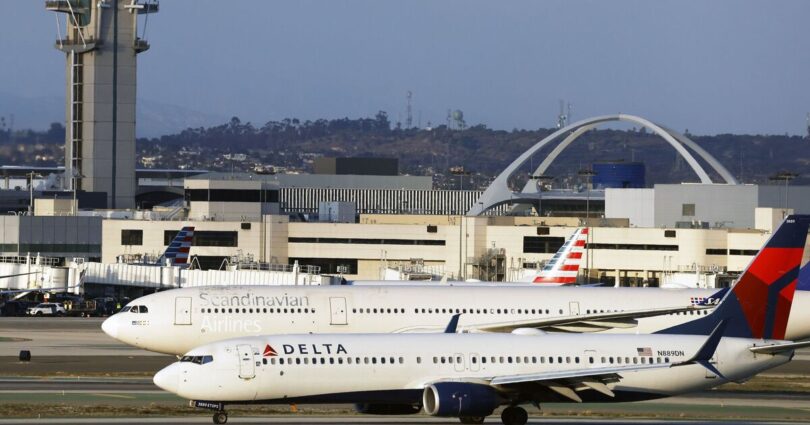
The Iran war has claimed its first major European aviation casualty after Scandinavian Airlines became the first significant carrier on the continent to axe flights in response to rocketing fuel costs.
SAS — which operates as the national carrier for Denmark, Norway and Sweden — confirmed on Tuesday it was withdrawing a substantial number of services from its timetable, blaming an energy market upended by the Middle East conflict.
« Given the ongoing situation in the Middle East, including the sharp and sudden increase in global fuel prices, we are taking measures to strengthen our resilience, » a spokesman said.
« One such measure is a limited number of short-term flight cancellations. »
Hundreds of departures have been pulled this week, with the airline focusing the cuts on brief internal Scandinavian hops where alternative services exist. SAS is one of the continent’s busiest operators, connecting roughly 25 million passengers to destinations worldwide each year.
Threat to European aviation
The decision has amplified fears that the Hormuz crisis could snowball into a sector-wide emergency across Europe, reports the Telegraph. The strait is the transit point for approximately half the jet fuel Europe imports in normal times, drawing heavily on supplies from Kuwait and Saudi Arabia — both now cut off from western buyers by the blockade.
With kerosene representing the single largest line item in any airline’s accounts, and crude prices having surged to levels not seen in four years, the commercial arithmetic on many routes is deteriorating rapidly.
Air New Zealand — which carries around 16 million passengers annually — took the same step last week, but SAS’s scale makes it a more consequential signal.
An unhedged gamble
SAS’s exposure to the price surge is partly self-inflicted. The carrier dismantled internal rules requiring it to lock in cover on at least 40 per cent of its fuel consumption, leaving itself entirely at the mercy of spot market prices. Where those protections currently stand for the year ahead remains unclear.
Hedging contracts shield airlines from sudden price shocks by fixing the cost of fuel in advance. Without them, every move in the crude oil price feeds directly through to operating costs.
Rivals have fared better by maintaining more conservative positions. British Airways owner International Airlines Group disclosed last week that it had covered the vast majority of its near-term fuel needs — 80 per cent through to the end of March and 70 per cent across the following quarter.
Budget operators have built the most comprehensive defences. Ryanair confirmed to investors in January that nearly all of its near-term fuel exposure had been locked in — 84 per cent at $77 per barrel for the current quarter, with coverage for the fiscal year opening in April secured at $67 on 80 per cent of requirements.
Source link