
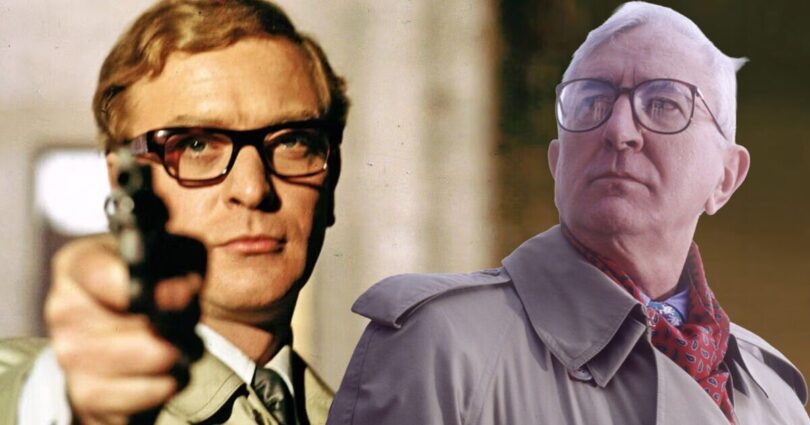
Len Deighton, who has died at 97, saw Michael Caine star as Harry Palmer in film of The Ipcress File (Image: Shutterstock)
In the spring of 1960 a 31-year-old former chef and flight attendant called Len Deighton got in touch with the Daily Express to pitch an idea he called the ‘cookstrip’. It had come about because he didn’t like taking his expensive recipe books into his messy kitchen. The solution, as he later explained it, was a simple cartoon-style illustration.
“I wrote out the recipes on paper, and it was easier for me to draw three eggs than write ‘three eggs’,” he recalled. “So I drew three eggs, then put in an arrow. For me it was a natural way to work.” He had developed the idea a decade earlier as a jobbing pastry chef at the Royal Festival Hall, London, leaving to work for the British Overseas Airways Corporation between 1956 and 1957 before settling down as an illustrator.
The first ‘look and cook’ strip – featuring steak and designed to be cut out and kept – was subsequently published on March 6 in the Your Home section of the Express, still selling more than four million copies a day. It was an early break in what would become a glittering writing career lasting more than half a century.

Michael Caine played Deighton’s hitherto unnamed hero, Harry Palmer, in The Ipcress file and sequels (Image: ITV/Shutterstock)

Len Deighton’s first ‘cookstrip’ was published in the Daily Express on March 6, 1960 (Image: Daily Express)
But Deighton, working by then as a successful commercial artist who would eventually design some 200 book covers, including the first UK edition of Jack Kerouac’s cult hit On The Road, was already looking to other things. While on holiday in the Dordogne in south-west France later that year, he began sketching out the plot of what would become his first novel. A chance meeting with a literary agent spurred him to finish and it was published in 1962 as The IPCRESS File.
Arriving in shops the same year as Dr No hit the big-screen, Deighton’s working-class intelligence officer was polar opposite to Ian Fleming’s suave James Bond. 007’s exotic locations were replaced with grubby British backstreets, soot-stained walls and dingy pubs. The violence of Bond also appalled Deighton who kept it to a minimum in his own books.
« It might have sunk without a ripple but it did very well, because the critics used me as a blunt instrument to beat Ian Fleming over the head,” he once recalled, probably with a smile. Like his creator, Deighton’s hero was a bright, upwardly-mobile grammar school boy with an interest in military history, cooking and a taste for French cigarettes.
He memorably described the acts of writing as throwing a hand grenade and The IPCRESS File was immediately explosive. With a plot involving Cold War brainwashing and the development of atomic weapons, the book was an overnight success – selling more than 2.5 million copies in three years before being adapted into the Bafta-winning Michael Caine movie in 1965 by, perhaps ironically, Bond film producer, Harry Saltzman.
Having put off inventing a name for his streetwise hero, he became Harry Palmer (a deliberately dull name) when portrayed by Caine. The book was rebooted as a six-part ITV series four years ago with Peaky Blinders’ star Joe Cole as Palmer. Deighton and Caine became firm friends and, in one scene where Palmer is seen breaking two eggs at once to make an omelette, the author’s hands were used on screen because the actor couldn’t get the hang of it.

Deighton, left, shows Caine how to crack two eggs at once in famous Ipcress File scene (Image: ITV/Shutterstock)
While Deighton, who eventually wrote 39 novels and a brace of non-fiction Second World War histories and cook books, might not have become a household name, he was every bit as influential as the other legendary 20th century British spy writers.
Shane Whaley, who founded the Spybrary podcast, said: “Few authors produced a body of work as rich and enduring as his from the cool, sharply observed Harry Palmer (or “Unnamed Spy”) novels that captured the mood of the 1960s, to the epic nine-book Bernard Samson series beginning with Berlin Game in 1983.
“Deighton was a master storyteller whose characters felt utterly real: flawed, weary, intelligent survivors navigating a morally ambiguous world. What distinguished him from contemporaries such as John le Carré or Ian Fleming was his perspective. Deighton wrote from a working-class viewpoint rather than that of the officer class; his protagonists relied on guile rather than degrees or club ties. In many ways, Deighton’s work reshaped the spy novel.”
Slow Horses creator Mick Herron told the Express: « Len Deighton was more than just a spy novelist; he was a cool spy novelist – few could get away, as he did, with being photographed beside a helicopter. His early work was as acclaimed for its stylishness as for his plotting, while the best of his later Bernard Samson novels were as good as the modern spy novel gets. One of the few true masters of the genre. »
Espionage had long been in the writer’s blood. Born in Marylebone, London on February 18, 1929, in the sick bay of a workhouse because the local hospital was full, Leonard Cyril Deighton grew up in a large house owned by his parents’ wealthy employer. His mother Dorothy was a cook and his father Leonard chauffeur to the keeper of prints and drawings at the British Museum.
As an 11-year-old in 1940, a neighbour in Gloucester Place Mews was arrested on suspicion of spying. At her trial it emerged that Anna Wolkoff, a British national of Russian descent, was a German spy who had been having an affair with a cipher clerk at the US embassy. « It was a major factor in my decision to write a spy story at my first attempt at fiction, » he would recall.
Deighton passed the 11-plus to enter Marylebone Grammar School. He disliked formal education but loved reading – often playing truant at the local library where he would spend the day immersed in books.
Having left school at 16, he did his National Service in the RAF – where he learned photography, flying and scuba-diving – before working for brief periods as a railway clerk, chef and air steward. After studying at St Martin’s School of Art and the Royal College of Art in London, he began a successful career as a book illustrator.

London under Nazi occupation in 2017 BBC adaptation of Deighton’s SSGB (Image: PA / BBC)
His cookstrip moved to the Observer in 1962 with a collection published in 1965 in the Len Deighton Action Cookbook.
In the late 1960s, he was travel editor for Playboy magazine and a familiar public figure alongside the other stars of Swinging London. He left the UK in 1969 and never returned full-time. Despite becoming increasingly well-known as a novelist, he never lost his love of cooking. On his 97th birthday in February, he celebrated by creating the same cocktails for his family that he made aloft during his BOAC days as a flight attendant.
The Ipcress File was followed by Horse Under Water (1963), Funeral in Berlin (1964) and Billion-Dollar Brain (1966). The latter two were also filmed for the big screen with Caine in the leading role. The London-born actor also played Harry Palmer in two more non-Deighton films and the unnamed agent would eventually appear in eight books.
Deighton’s later works included the trilogies – all of which featured jaded intelligence officer Bernard Samson – Berlin Game, Mexico Set and London Match (1983-1985), Spy Hook, Spy Line and Spy Sinker (1988-1990) and Faith, Hope and Charity, the last of which became his final novel in 1996. He considered taking a break but then decided to retire fully. Having moved to Ireland with his second wife, Ysabele, and their two sons they later divided their time between homes in Portugal and Guernsey.
It suited Deighton who rarely gave interviews and never found writing especially easy. « The best thing about writing books is being at a party and telling some pretty girl you write books,” he told the BBC‘s Desert Island Discs. « The worst thing is sitting at a typewriter and actually writing the book. »
His alternate-history novel, 1978’s SS-GB, imagined a Britain that has lost the Second World War and was occupied by the Germans. It was brought to television by the BBC in 2017, leading to a revival of interest.
His histories, for which he interviewed hundreds of veterans from all sides of the Second World War included Fighter: The True Story of the Battle of Britain (1977). It was controversial for claims ground crew refused to come out of the air raid shelters during repeated bombing raids.
Later histories included Blitzkrieg (1979), focussing on Germany’s lightning successes, and Blood, Tears and Folly (1993), an all-incompassing look at the Second World War.

Deighton working at home in London in 1966 (Image: Popperfoto via Getty)
Rob Mallows, creator of The Deighton Dossier, got to know the author after creating the online tribute to his work. “He was a very private person, I got the impression he didn’t suffer fools gladly,” he told the Express. “What always struck me about Len, given he didn’t go to university, was that he became a jackal of all trades and master of many. He was a real polymath, someone as comfortable interviewing German generals from the Second World War for his history books as coming up with exciting new characters for his fiction.
“What an imagination to flip from cookery books to spy novels to articles for Playboy magazine on foreign travel. The fact he could feel at home in so many areas really says something about his brilliance. But as an author, he let his books do the talking.”
And their influence undoubtedly continues, with tributes from leading modern practitioners of the genre. Former CIA analyst turned spy writer David McCloskey told the Express: “Len Deighton was one of spy fiction’s grand masters – easily occupying the same firmament as Le Carre even if he never became a household name.
“One of Deighton’s master strokes was to center his spy stories not on action heroes or upper-crust Oxbridge gentleman spies, but on working-class antiheroes who fight their battles in the back offices of the espionage business.”
Spy writer Alex Gerlis, author of The Second Traitor, said: “Deighton was a master storyteller and a skilled writer of espionage novels. He’s always been held in high regard among current writers of espionage fiction, who’d happily admit to admiring his plots, his characters, writing style – and his output.”
Andrew Child, who has taken the mantle of the Jack Reacher books from his brother Lee, said: “Len Deighton’s body of work was astounding in its quality, its scope, and its audacity. He broadened the field of spy fiction – and, to my mind, increased its appeal – with his range of hard-edged, streetwise characters which stood in stark contrast to, for example, James Bond, the standard bearer of fictional espionage at the start of his career. Reading Deighton’s Bernard Samson series for the first time was one of the greatest pleasures of my life, and it was also a vital apprenticeship during my own journey to becoming a novelist.”
He is survived by his second wife, Ysabele, and their two sons.

Michael Caine on the set of The Ipcress File in 1964 (Image: Getty)
Source link