
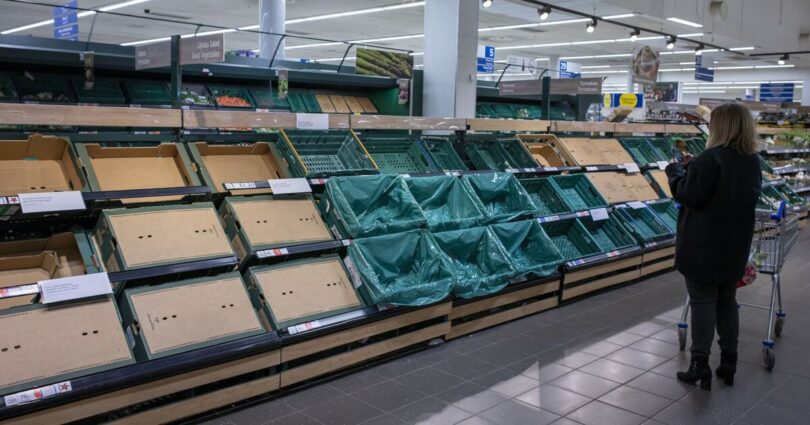
Britain could be weeks away from fuel shortages, rationing and bare supermarket shelves unless the Iran war’s stranglehold on Gulf oil shipments is broken, one of the country’s most senior energy experts has warned.
Nick Butler — Gordon Brown’s former energy adviser and a BP veteran of 27 years — told reporters that the near-total halt in tanker departures from the Strait of Hormuz was already locking in a supply crunch that governments needed to prepare for urgently.
He said it would mean « a form of rationing », adding: « In the short-term, we have to look at what supply we have and look at the crucial sectors, the health service, food supply, hospitals, those are key elements that must be protected.
« And beyond that, it is then for the Government to decide how to ration what is left if we get to that situation. »
Prof Butler, now based at King’s College London, said: « We’ve now had more than a week of almost no tankers coming out of Hormuz, that will continue this week on everything that you’ve reported this morning…
« And there will be a real shortage, a physical shortage of supply in a few weeks’ time. How long that goes on we don’t know but I think the Government here, and other governments, must now be preparing for a significant shortfall of supply over the next two months, » he told the BBC.
Working families left exposed
While the government is understood to be drawing up a financial support package, internal discussions reported by the Daily Mail suggest it may be confined to welfare recipients and those drawing pensions — shutting out the millions of working households already under pressure from higher prices across the board.
Any scheme is reported to take its shape from the winter fuel payment model, under which a fixed cash sum goes annually to a defined group of vulnerable recipients — in that case, around six million people on pension credit or benefits.
Pump prices have already moved sharply. Figures released over the weekend show diesel has risen by an average of 18p a litre since fighting broke out, leaving drivers paying 160.3p at the forecourt, according to the RAC.
Household energy bills are currently held in check by Ofgem’s price cap, frozen until the end of June. Should the Hormuz blockage persist beyond that point, families could face a steep jump when the cap is next reviewed.
Starmer rules out escalation
Sir Keir Starmer said Britain would not be « drawn into a wider war » over the conflict, but conceded that forecasting the economic fallout remained difficult.
At a press conference he told reporters: « We’re not ruling anything out, but it is very difficult to say at this juncture what the position will be in July, which is when the current energy cap runs out, or what the position will be in September. »
The Prime Minister pledged to hold energy companies to account, vowing they would not be permitted to « make huge profits from the hardship of working people » and promising to ensure « every penny of the savings that we delivered at last year’s budget » was passed on to consumers.
A new £53million pot has been set aside for the estimated number of homes reliant on heating oil — a fuel whose price has doubled since the conflict ignited, leaving those households particularly exposed given it falls outside the Ofgem cap.
Sir Keir used the moment to renew his push for domestic renewable energy, framing it as the only lasting shield against international market volatility.
« There’s no denying – because we’ve seen this first-hand, we saw it in Ukraine, we saw it in the Twelve-Day War, we’re seeing it again now – if you’re on the international market for oil and gas, you’re vulnerable to the price going up on the international market, » he said.
« Because we, the UK, have little control over that, and obviously, oil doesn’t give us control over that, because we sell onto the market.
« What gives us control is renewables, our own home-grown energy, which is then more secure and more independent, which is why I think that we should go further and faster in relation to renewables. »
Source link