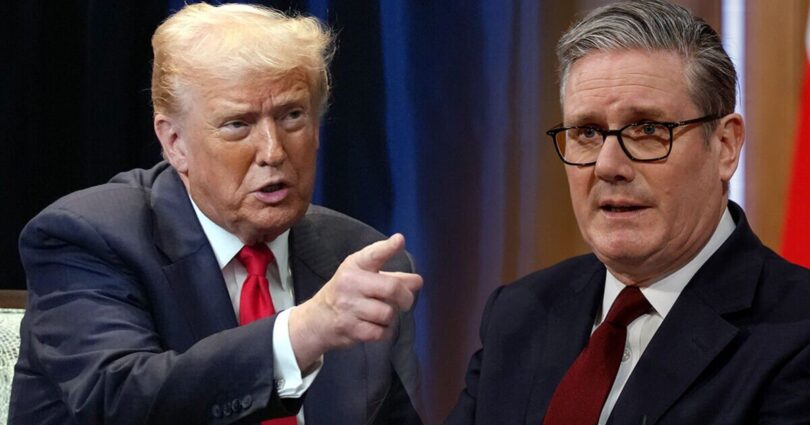
US President Donald Trump is not happy with Keir Starmer (Image: Getty)
Sir Keir Starmer is increasingly walking a thin tightrope as Donald Trump steps up his uncompromising approach. As the Middle East crisis deepens further and begins to be felt in the wallets of Brits, the Prime Minister finds himself between a rock and hard place.
Does he bow to the enigmatic US President’s demands or stand firm with our European allies also sceptical of the war? It appears the latter is the option Sir Keir is more inclined to take, even if it incurs the wrath of the unpredictable Trump administration. Mr Trump, a well-documented NATO sceptic, has warned the future of the alliance could be in doubt unless allies — including the UK — agree to send warships to help secure the Strait of Hormuz, a key global trade route.

A Thai cargo ship on fire after being hit in the Strait of Hormuz (Image: Getty)
There is also a degree of irony to this new argument.
Mr Trump, who warned NATO faces a “very bad” future should its member states fail to help, previously said the US didn’t need the Royal Navy’s aircraft carriers as the UK pondered sending one to the region.
Fast-forward around a week and Mr Trump has said: “We’ll see if they help us, because I’ve long said that we’ll be there for them but they won’t be there for us.”
Many, like Germany’s defence minister, will point towards how it was actually the US-Israeli strikes on Iran which led to the blockade of the Strait of Hormuz and skyrocketing oil and gas prices.
It increasingly feels like the differences within NATO are playing out before our eyes.
After months of tensions, most notably over the US’ demands for Greenland, the resolve of NATO is being tested again.
Ministers have tried to brush off Mr Trump’s comments as “rhetoric” — the alliance has to hope it is just that.
Sir Keir said the UK is working with allies, including those in Europe, on a “viable plan” to reopen the Strait of Hormuz — although this would not fall within NATO.
At this stage, we don’t know what this would look like, but the signals from the PM and Government suggest significant military support is unlikely.
The UK could potentially send mine-hunting drones to the Strait of Hormuz rather than a warship, although Sir Keir insisted no final decisions had been made.
At a Downing Street press conference, the PM doubled down on his key message that he would not allow Britain to be drawn into a “wider war” in the Middle East — something the public generally backs, according to polls.
Mr Trump is continuing to test Sir Keir in what is almost certainly his biggest foreign policy challenge yet.
Regardless of whether his warnings are to be believed, the impact of the blockade of the Strait of Hormuz is something we cannot avoid.
Source link