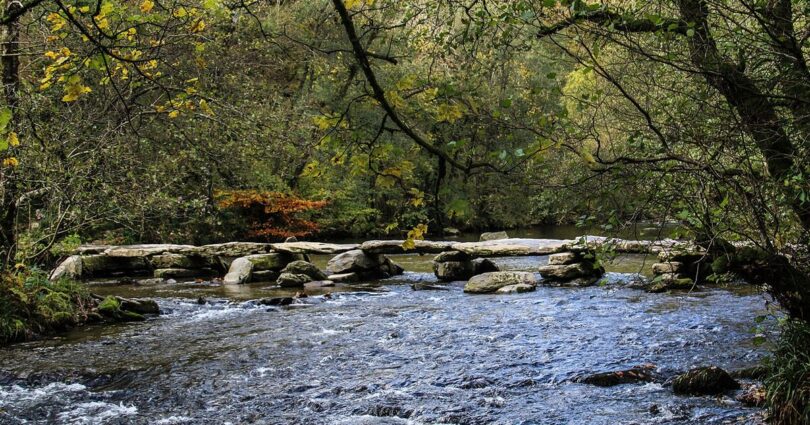
Deep in the countryside of Exmoor National Park lies what is often described as the UK’s oldest bridge, a remarkable crossing built from enormous stone slabs more than three millennia ago. The structure, known as Tarr Steps, spans the River Barle in Somerset and is one of the best-known examples of a “clapper bridge” – a simple design made by placing flat stone slabs on top of stacks of rocks without mortar.
Some historians believe the bridge could date back as far as 1000 BC, meaning it may be around 3,000 years old, although the exact date of its construction remains uncertain. The bridge stretches for about 55 metres (180ft) and consists of 17 spans, with the slabs resting on groups of vertical stones set into the riverbed. Each of the huge slabs can weigh up to two tonnes, making the structure both simple and surprisingly durable.
Sometimes referred to as “where the devil would sunbathe”, myth dictates that Satan himself built the bridge and still holds sunbathing rights to its stones.
One local legend claims the Devil supposedly used the stones as a place to sunbathe before being chased away by a local clergyman.
Despite its ancient design, Tarr Steps has survived for centuries and remains one of the largest clapper bridges in Britain.
Experts say the bridge’s origins are still debated. While some theories suggest it may date back to the Bronze Age, official heritage listings classify the existing structure as medieval, meaning parts of the crossing may have been rebuilt over time.
Over the centuries the bridge has repeatedly been damaged by powerful floods on the River Barle, with several of the huge slabs swept downstream during periods of heavy rainfall.
Despite this, the structure has always been restored using the same traditional design, with the stones carefully lifted back into place.
Tarr Steps is now one of the most popular historic sites in Exmoor National Park, attracting walkers, cyclists and tourists exploring the wooded Barle Valley.
The surrounding area forms part of the Tarr Steps National Nature Reserve, known for its ancient oak woodland and wildlife.
Visitors can still walk directly across the stone slabs today, much as travellers and traders are believed to have done for centuries.
Source link